
7 A/B Testing Best Practices Every Marketer Must Know
Did you know that companies using structured A/B testing see up to 20% higher conversion rates than those without clear strategies? Many teams jump into experiments without a plan, risking wasted time and missed opportunities. Understanding the key steps to effective A/B testing gives you a proven edge, helping you move beyond guesswork and uncover real data-driven success.
Table of Contents
- 1. Define Clear Goals Before Starting Experiments
- 2. Segment Your Audience For Targeted Results
- 3. Test One Variable At A Time For Accuracy
- 4. Ensure Proper Sample Size And Test Duration
- 5. Use Real-Time Analytics To Make Decisions
- 6. Leverage No-Code Tools For Faster Testing
- 7. Act On Insights And Iterate Continuously
Quick Summary
| Takeaway | Explanation |
|---|---|
| 1. Define Clear Goals | Establish SMART goals to create focused A/B tests. |
| 2. Segment Your Audience | Analyze demographics for targeted A/B testing insights. |
| 3. Test One Variable | Isolate changes to accurately assess performance results. |
| 4. Ensure Proper Sample Size | Run tests long enough to achieve statistical significance. |
| 5. Act on Insights Continuously | Treat A/B testing as an ongoing process for improvement. |
1. Define Clear Goals Before Starting Experiments
Successful A/B testing starts with crystal clear goals. Without a precise target, your experiments become pointless wanderings through data wilderness.
Research shows that formulating testing hypotheses as SMART goals transforms random testing into strategic decision making. SMART goals ensure your experiments are specific, measurable, attainable, relevant, and time-bound. This approach provides teams with definitive context to understand and interpret results effectively.
When defining your experiment goals, focus on concrete, trackable outcomes. According to research from leading marketing experts, an A/B test should target a specific measurable result like:
- Sales conversions
- Clickthrough rates
- Registration completion rates
- Average order value
For example, instead of a vague goal like "increase website engagement," create a precise objective such as "increase email signup rate by 15% within 30 days by testing two different call-to-action button designs."
This laser-focused approach transforms your A/B testing from guesswork into a strategic, data-driven process. By establishing clear goals upfront, you create a roadmap that guides your entire experimentation strategy.
Pro tip: Always align your testing goals with broader business objectives. Simplifying Experimentation Process can help you develop a systematic approach to goal setting and testing.
2. Segment Your Audience for Targeted Results
Audience segmentation is the secret sauce that transforms good A/B testing into exceptional marketing strategy. By diving deep into your user demographics and behaviors, you uncover nuanced insights that generic testing never reveals.
Thoughtful audience segmentation allows you to understand how different user groups respond uniquely to variations. Research shows that changes can work dramatically differently across segments such as:
- New users versus loyal customers
- Mobile users versus desktop users
- Age groups with distinct browsing behaviors
- Geographic regions with unique preferences
The magic happens when you recognize that a single experiment cannot speak for your entire audience. What increases conversions for one segment might alienate another. By breaking down your audience into meaningful subgroups, you create targeted experiments that provide precision insights.
To implement effective segmentation, start by analyzing your existing user data. Look at factors like purchase history, engagement levels, device types, and demographic information. This granular approach ensures your A/B tests deliver actionable results that reflect real user experiences.
Pro tip: 7 Smart Strategies for Segmenting Test Audiences Effectively can help you develop a more sophisticated segmentation approach that drives meaningful optimization.
Remember that successful segmentation requires cross functional collaboration. Involve your marketing, product, design, and development teams to leverage diverse perspectives and align testing efforts with broader organizational goals.
3. Test One Variable at a Time for Accuracy
In the world of A/B testing, changing everything at once is like throwing a handful of darts blindfolded. Scientific precision requires laser focus.
Research consistently demonstrates that subtle, focused changes deliver the most reliable results. By isolating a single variable, you create a clear line of sight between your experiment and its outcome. This methodical approach allows marketers to understand exactly which modification drives performance improvement.
Why single variable testing matters:
- Eliminates ambiguity in test results
- Provides clear attribution for performance changes
- Reduces statistical noise and complexity
- Enables precise understanding of user behavior
Imagine you want to improve your landing page conversion rate. Instead of redesigning the entire page, test one specific element. Perhaps you change the headline color or adjust the call-to-action button placement. By changing only one thing, you can definitively track its impact.
Multiple variable changes muddy the waters of your analysis. If you modify the headline, button color, and image simultaneously, you cannot determine which change triggered the result. Precision requires patience and discipline.
"Changing multiple elements at once makes it harder to determine which change influenced the outcome"
Practical tip: Create a structured testing plan that prioritizes single variable experiments. Document your hypothesis, expected outcome, and specific change before launching the test.
For more advanced insights into experimental design, Simplifying Experimentation Process can help you develop a systematic approach to A/B testing that maximizes learning and minimizes uncertainty.
4. Ensure Proper Sample Size and Test Duration
Running an A/B test is like conducting a scientific experiment. Your results are only as reliable as the sample size and duration you choose.
Statistical significance depends on collecting enough data to draw meaningful conclusions. Running tests too short or with too few participants can lead to misleading or entirely false insights.
Research suggests aiming for a test duration between two to eight weeks, depending on your monthly website traffic and conversion rates. This timeframe allows you to:
- Capture variations across different user segments
- Account for potential daily or weekly fluctuations
- Gather sufficient data for reliable statistical inference
The number of monthly visits and conversions directly impacts how long you should run your experiment. Websites with higher traffic can reach statistical significance faster than those with lower visitor counts.
Key considerations for sample size:
Smaller populations require more careful planning. Interestingly, some research indicates that the optimal test size can be substantially smaller than traditional hypothesis testing methods suggest especially when response variability is high.
Practical tip: Use statistical calculators to determine the minimum sample size needed for your specific scenario. Don't rely on guesswork or arbitrary timeframes.
For more detailed guidance on experiment duration, check out our Test Duration Recommendations to fine tune your testing strategy.
Remember that patience is key. Rushing your A/B test or stopping it prematurely can invalidate your entire experiment.
5. Use Real-Time Analytics to Make Decisions
In the fast-paced world of digital marketing, data is your superpower. Real-time analytics transform guesswork into strategic decision making.
Leveraging good data is fundamental to understanding your A/B test results. Without precise, immediate insights, tracking real-world performance becomes nearly impossible. Real-time analytics provide a window into user behavior moments after changes are implemented.
Why real-time data matters:
- Instantly detect performance variations
- Understand user interactions immediately
- Quickly identify winning variations
- Minimize potential negative impacts
However, proceed with caution. Research warns against peeking bias which occurs when marketers draw conclusions too early. Early data can be noisy and misleading. Running the full planned test duration remains critical for obtaining statistically valid results.
Practical strategies for effective real-time analytics include:
- Setting up comprehensive tracking before launching tests
- Defining clear metrics in advance
- Establishing minimum sample sizes
- Creating alert systems for significant changes
"Without good data, tracking real-world test results becomes impossible"
To optimize your approach, How to Choose Analytics Tools can help you select the right platforms for comprehensive tracking.
Remember that real-time analytics are a tool, not a crystal ball. Interpret data scientifically, remain patient, and let statistical significance guide your decisions.
6. Leverage No-Code Tools for Faster Testing
No more waiting weeks for developer support. No-code testing tools are the secret weapon that empowers marketers to run experiments independently and rapidly.
Traditional A/B testing often requires complex coding and technical resources. No-code tools demolish these barriers, enabling marketers to design, launch, and analyze experiments with minimal technical expertise.
Benefits of no-code testing platforms:
- Eliminate dependency on development teams
- Reduce experiment setup time
- Lower technical barriers to entry
- Enable rapid iteration and testing
- Provide visual editing capabilities
Research shows that simple tools can prevent workflow overload and significantly facilitate the testing process. Customer data platforms help build experiments with clean and actionable data foundations.
When selecting a no-code testing tool, consider these key features:
- Intuitive visual editor
- Robust analytics dashboard
- Integration capabilities
- Affordable pricing models
- User friendly interface
"Simple tools help prevent overload and facilitate testing processes"
To dive deeper into selecting the right experimentation platform, Understanding No-code Experimentation Tools offers comprehensive insights for growth-focused marketers.
Remember that while no-code tools democratize testing, strategic thinking remains your most powerful asset. These tools are accelerators, not substitutes for intelligent experimental design.
7. Act on Insights and Iterate Continuously
A/B testing is not a one-time event. It is a continuous optimization journey that transforms data into meaningful growth strategies.
Successful experimentation goes beyond running tests. The real magic happens when you transform insights into actionable improvements and maintain a consistent cycle of learning and refinement.
Why continuous iteration matters:
- Keeps your strategies dynamic
- Prevents stagnation in marketing approaches
- Builds a data-driven organizational culture
- Maximizes incremental improvements
- Adapts to changing user behaviors
Research highlights that successful A/B testing fosters a culture of data-driven decision making. This means viewing every test as a learning opportunity, regardless of whether the results are positive or negative.
Key steps for effective iteration include:
- Document test results comprehensively
- Share findings across team departments
- Identify specific learnings from each experiment
- Develop new hypotheses based on previous insights
- Implement winning variations
"Sharing results ensures that the test helps the entire team"
By presenting both successes and failures, you create valuable learning opportunities that extend beyond individual experiments.
For a deeper understanding of turning test results into strategic insights, Overcoming A/B Testing Challenges provides comprehensive strategies for continuous improvement.
Remember that the most successful marketers treat A/B testing as an ongoing conversation with their audience, not a one-time transaction.
Below is a comprehensive table summarizing the key strategies and steps for effective A/B testing, as discussed in the article.
| Strategy | Implementation | Benefits |
|---|---|---|
| Define Clear Goals | Set SMART goals with specific, measurable outcomes such as sales conversions or clickthrough rates. Align them with business objectives. | Transforms testing from guesswork to strategic analysis. |
| Segment Your Audience | Analyze user demographics and behaviors to create targeted experiments for distinct segments like new vs. loyal customers. | Provides precision insights and optimizes marketing strategies. |
| Test One Variable | Change one element at a time, such as button placement, to track its direct impact. | Reduces ambiguity, increases accuracy of results. |
| Proper Sample Size & Duration | Use statistical tools to calculate needed sample size and run tests 2-8 weeks based on traffic. | Ensures reliability of test results and statistical significance. |
| Use Real-Time Analytics | Set up comprehensive tracking with clear metrics and alert systems before starting tests. | Instant performance insights; minimizes negative impacts. |
| Leverage No-Code Tools | Choose platforms with visual editors and integration capabilities to run tests independently. | Speeds up testing process and reduces dependency on development teams. |
| Act on Insights Continuously | Document and share results, develop new hypotheses, and implement winning changes. | Fosters a dynamic, data-driven culture and maximizes learning. |
Unlock the Full Potential of Your A/B Testing Strategy Today
Struggling with unclear goals, complex audience segmentation, or cumbersome multi-variable experiments Every marketer knows that precision and speed are essential when running effective A/B tests. The article "7 A/B Testing Best Practices Every Marketer Must Know" highlights these challenges including the need for real-time analytics and no-code tools that empower marketers to test faster and smarter. If you want to transform your testing process into a strategic growth engine you need solutions designed to simplify and accelerate your workflow.
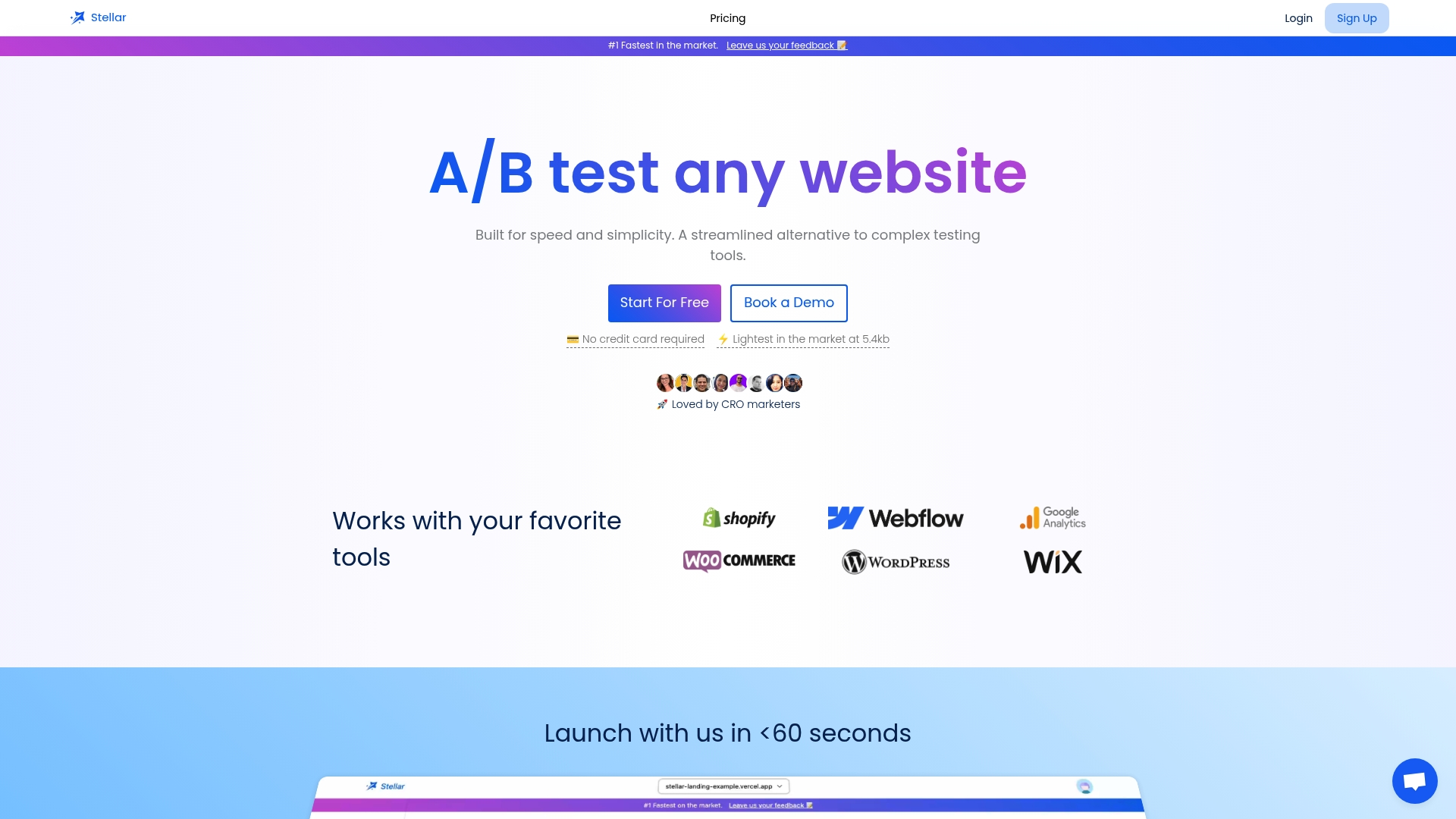
Take control of your experiments with Stellar’s lightweight and intuitive platform. You will benefit from a no-code visual editor that removes technical barriers and lets you launch tests quickly. Advanced goal tracking helps you focus on measurable outcomes while dynamic keyword insertion creates personalized landing pages that resonate with user segments. With real-time analytics built in you get instant insights without guesswork. Join marketers and growth hackers at small to medium businesses who rely on Stellar’s A/B Testing Tool to achieve faster data-driven decisions. Ready to bring clarity to your experimentation and start improving conversion rates now Explore how our platform can simplify your A/B testing strategy by visiting https://gostellar.app and start your journey towards smarter, results-driven marketing.
Frequently Asked Questions
What are SMART goals in A/B testing?
SMART goals are specific, measurable, attainable, relevant, and time-bound objectives that guide your A/B testing experiments. Start by formulating precise testing hypotheses, such as increasing email signup rates by 15% within 30 days, to turn random testing into a data-driven process.
How can I segment my audience effectively for A/B tests?
Audience segmentation involves breaking down your users into meaningful groups based on demographics or behaviors. Analyze user data such as purchase history and device types, and run targeted A/B tests for each segment to uncover insights that generic testing may miss.
Why should I test one variable at a time in my A/B tests?
Testing one variable at a time ensures accuracy by eliminating ambiguity in results. Focus your experiments by changing just one element, like the call-to-action button color, to clearly see its impact on performance without mixing effects from other changes.
What is the ideal duration for running an A/B test?
The ideal test duration typically ranges from two to eight weeks, depending on your website's traffic and conversion rates. Ensure you collect enough data during this period to accurately assess the effects of your changes, aiming for statistical significance in your results.
How can I use real-time analytics during A/B testing?
Real-time analytics allow you to monitor user interactions immediately and detect performance variations as they happen. Set up tracking ahead of time and define key metrics to interpret data effectively while still completing the full test duration for reliable insights.
What are the benefits of using no-code tools for A/B testing?
No-code tools empower marketers to run A/B tests independently without needing developer support. Utilize these platforms to simplify experiment setup and enable rapid iterations, resulting in faster testing cycles and quicker insights for optimization.
Recommended
Published: 11/4/2025