
6 Actionable Tips for AB Testing Optimizely Success
Figuring out how to actually improve your website's performance can feel overwhelming when every idea seems like a guess. You want to know what changes make a real difference, but relying on personal opinions and gut feelings leaves you uncertain. Optimizely offers a hands-on solution that replaces guesswork with clear evidence—and you don't need to be a developer to start seeing results.
This list will guide you through practical ways to set up, manage, and measure effective experiments using Optimizely. You’ll discover how to create experiments without coding, personalize content dynamically, and interpret data with confidence. Get ready to learn actionable steps that transform your ideas into proven wins, helping you make smarter decisions and improve conversion rates without unnecessary complexity.
Table of Contents
- 1. Understanding AB Testing With Optimizely
- 2. Setting Up No-Code Experiments Easily
- 3. Leveraging Dynamic Keyword Insertion
- 4. Tracking Goals And Measuring Results
- 5. Using Real-Time Analytics For Quick Decisions
- 6. Choosing The Right Pricing Plan For Your Needs
Quick Summary
| Takeaway | Explanation |
|---|---|
| 1. A/B Testing Requires No Technical Skills | Optimizely allows anyone to set up A/B tests using a visual editor without coding expertise needed. |
| 2. Start Testing with High-Impact Changes | Focus on elements like headlines or button colors for faster, more meaningful results in your experiments. |
| 3. Set Clear Goals for Your Experiments | Clearly defined objectives help you measure what truly matters to your business outcomes and growth. |
| 4. Use Real-Time Analytics for Better Decision-Making | Monitor performance updates live to quickly identify winning variations and fix issues before they impact results. |
| 5. Choose the Right Pricing Plan | Selecting an appropriate pricing tier ensures access to necessary features while allowing for business growth. |
1. Understanding AB Testing With Optimizely
A/B testing sounds complex, but it's really just comparing two versions of something to see which performs better. Optimizely is a platform that makes this process straightforward, even if you've never run an experiment before.
Think of it this way: you have a landing page that converts 10% of visitors. You suspect changing the button color might improve that. With Optimizely, you can test the new button color against the original and measure which one actually drives more conversions. No guessing. Just data.
Optimizely's Web Experimentation tool guides you through the entire process, from initial setup to analyzing results. You start by building an A/B test experiment with variations of your page, then define which audience sees which version, set up the metrics you want to track, and let the data speak for itself.
Here's what happens in practice:
- You create your original version as the "control" (your current page)
- You build a variation with your change (the test)
- Optimizely automatically splits traffic between the two versions
- The platform collects data on how each version performs
- After enough visitors have seen both versions, you get clear results
What makes this approach valuable is that no technical expertise required. You don't need a developer to write code or deploy changes. The visual editor lets you make modifications directly, and the platform handles all the complexity of traffic splitting and data collection.
The real power of A/B testing with Optimizely is turning assumptions into facts based on actual user behavior.
Many small to medium-sized businesses struggle with making optimization decisions because they rely on opinions rather than evidence. Your boss thinks the headline should be bigger. Your designer prefers a different layout. With Optimizely, you remove that guesswork. The winning variation isn't determined by who's most convincing in the meeting—it's determined by the actual results.
Start small. Pick one element to test. Maybe it's a button color, a headline, or a call-to-action. Set it up in Optimizely, run it for a week or two, and see what the data tells you. That's how successful marketers use experimentation to continuously improve their conversion rates without needing a massive budget or technical team.
Pro tip: Start your testing with high-impact elements like headlines, button copy, or form fields rather than minor design tweaks—you'll see meaningful results faster and can prove A/B testing's value to stakeholders sooner.
2. Setting Up No-Code Experiments Easily
The biggest barrier most marketers face isn't wanting to run experiments—it's thinking they need developers to set them up. That's not true anymore. No-code experiment setup has eliminated that bottleneck entirely.
With modern platforms, you can launch a full experiment in minutes without touching a single line of code. You don't need to wait for your development team's backlog or understand JavaScript. You can do this yourself, right now.
The setup process typically follows a straightforward path. First, you identify the page or section of your website where you want to test. Then you define your audience—who should see this experiment? You can target by basic attributes like location or device type, or use behavioral data to reach specific user groups.
Next comes the fun part: building your variation. Using a visual editor lets you click elements on your page and change them directly. Want to test a different headline? Click it and type. Testing a button color? Click and choose. No coding required.
Here's what a typical no-code setup includes:
- Page targeting to specify which pages run the experiment
- Audience creation using standard and behavioral attributes
- Visual editing tools to modify page elements
- Event tracking to measure what matters to your business
- Preview mode to see how your variation looks before launch
Once everything is configured, you review it in preview mode to catch any issues. This step saves you from launching something broken. You see exactly what your visitors will see.
No-code experiments mean you control the pace of optimization—no developer dependency, no delays, just faster learning.
After preview approval, you launch. The platform automatically splits traffic, tracks user behavior, and collects data. Some platforms even support redirect experiments and multi-page experiments if you need something more complex.
The beauty of this approach is speed. Traditional A/B testing used to take weeks or months because of development dependencies. Now? Days. Sometimes hours. This means you can run more experiments, learn faster, and optimize continuously without organizational friction.
Pro tip: Test your experiment in preview mode on multiple devices before launching to ensure buttons are clickable, text is readable, and the experience looks intentional across all screen sizes.
3. Leveraging Dynamic Keyword Insertion
Dynamic keyword insertion sounds technical, but it's actually one of the most powerful personalization tools you have. Instead of showing the same message to every visitor, you serve different content based on who they are and what they searched for.
Imagine a visitor arrives at your landing page after searching for "blue running shoes." With dynamic keyword insertion, you can automatically display "Shop Blue Running Shoes" as your headline instead of a generic "Find Your Perfect Shoes." That relevance boosts engagement immediately.
Optimizely's Feature Experimentation enables this through flag rules and variations. You define different rules that determine which content each user sees. One rule might deliver content to users from New York, while another targets visitors on mobile devices. Each rule can serve completely different variations without requiring code changes.
Here's how the process works in practice:
- Define flag rules based on user attributes or behavior
- Create variations that contain different content or messages
- Optimizely automatically matches users to the right variation
- Track performance to see which variations drive better results
The real magic happens when you select dynamic content variations that respond to user context. A first-time visitor sees one message. A returning customer sees another. Someone from a high-value geographic region sees a premium offer.
This approach transforms your landing pages from one-size-fits-all to genuinely personalized experiences. You're not guessing what resonates with different audiences. You're delivering targeted messages based on actual user data.
Dynamic keyword insertion turns anonymous visitors into recognized individuals by showing them messages that feel personally relevant.
The setup is straightforward. You identify the variables that matter for your business—location, device type, traffic source, customer history. Then you create variations targeting each segment. Optimizely handles the delivery and tracking automatically.
Many growing companies see 15-30% conversion lift when they move from generic messaging to dynamically inserted, relevant content. That's not because the copy is better. It's because visitors feel the message was written specifically for them.
Pro tip: Start with your highest-traffic segments first—target based on geographic location or device type, then expand to behavioral attributes as you gain confidence in your data.
4. Tracking Goals and Measuring Results
Running an experiment without tracking goals is like driving with your eyes closed. You might reach your destination, but you'll never know if you took the best route. Goal tracking transforms data into actionable insights.
Every A/B test needs clear objectives aligned with your business. What matters most? Sales? Email signups? Time spent on page? Downloads? The goal you choose determines what you measure and how you interpret results.
Optimizely lets you set multiple goals for a single experiment. You might track primary conversions (purchases) and secondary metrics (email signups or content views) simultaneously. This gives you a complete picture of how each variation affects user behavior.
Here's the challenge many marketers face: they track vanity metrics instead of business metrics. Clicks don't pay the bills. Conversions do. Setting clear conversion goals for your A/B tests ensures you measure what actually matters to revenue and growth.
When setting up your goals, consider these elements:
- Primary metric that reflects your core business objective
- Secondary metrics that provide context or show side effects
- Time window for measurement (how long the test runs)
- Statistical significance threshold (usually 95% confidence)
- Sample size needed to draw conclusions
Once your experiment runs, Optimizely's analytics show you real-time results. You see which variation is winning and whether the difference is statistically significant or just random noise. Statistical significance matters because small sample sizes can mislead you.
Measuring results without understanding statistical significance means you might optimize for coincidence rather than real improvement.
The data tells a story. Maybe variation B has 12% more conversions than variation A. That sounds great, but if only 47 people saw each version, that difference could disappear with larger sample sizes. Optimizely shows you confidence levels so you know when results are reliable.
After your test concludes, the analysis becomes strategy. Which variation won and why? What does that tell you about your audience? What should you test next? This cycle of hypothesis, test, measure, and learn is how successful marketers compound small wins into significant revenue growth.
Pro tip: Set your goals and success metrics before launching your experiment, not after—this prevents bias and ensures you measure what matters rather than finding post-hoc reasons to declare success.
5. Using Real-Time Analytics for Quick Decisions
Traditional A/B testing used to mean waiting weeks for results. You'd launch an experiment, then check back two weeks later to see what won. That's no longer necessary. Real-time analytics let you monitor performance as it happens.
With Optimizely, you see conversion rates, click-through rates, and other metrics updating live as visitors interact with your variations. This visibility changes everything about how you manage experiments and make decisions.
The speed advantage is significant. Instead of discovering a broken link after two weeks, you spot it within hours and fix it immediately. Instead of wondering if a variation is performing well, you get instant feedback and can act on it faster than competitors.
Real-time monitoring enables smarter decision-making through several mechanisms. You can detect issues before they tank your results. You can identify winning variations early and scale them faster. You can collaborate with team members using up-to-the-minute data instead of stale reports.
Here's what real-time analytics typically show you:
- Live conversion rates for each variation
- Traffic distribution across versions
- Click-through rates on specific elements
- Goal completions as they happen
- Statistical significance updates
The key is knowing when to act. Real-time analytics in marketing helps you distinguish between normal fluctuation and genuine performance differences. Early in an experiment, data is noisy. Variations can swing wildly based on random chance.
After sufficient traffic accumulates, patterns emerge. Real-time dashboards show confidence levels so you know when results are reliable. Some platforms use advanced statistical methods that let you make confident decisions with smaller sample sizes than traditional approaches require.
Real-time analytics don't mean you should make knee-jerk decisions, but they do let you pivot quickly when data clearly supports a change.
A winning variation might be obvious after just a few days of data. Other times, you need patience. Real-time monitoring lets you see both scenarios clearly. You're not flying blind anymore.
The competitive advantage belongs to marketers who can test, measure, and optimize faster than their competition. Real-time analytics compress the testing cycle from weeks to days, multiplying how many experiments you can run annually and how quickly you can compound improvements.
Pro tip: Check your analytics dashboard daily during the first week of any experiment to catch technical issues early, but avoid making final decisions until you have sufficient statistical significance regardless of what the daily numbers show.
6. Choosing the Right Pricing Plan for Your Needs
Picking the wrong A/B testing platform can waste thousands of dollars or worse, leave you without critical features when you need them. Choosing the right pricing plan means matching your business size, traffic volume, and ambitions to what you actually pay for.
Optimizely and similar platforms typically offer multiple pricing tiers. Small businesses start with basic plans. Growing companies upgrade to business plans. Enterprises get custom solutions tailored to their specific needs. Understanding what each tier includes helps you avoid overpaying or underpaying.
Most platforms structure pricing around key factors. Your monthly traffic volume matters most. A business with 10,000 monthly visitors pays differently than one with 1 million. User seats also factor in. Do you need five team members accessing the platform or fifty?
Here's what typically varies across pricing tiers:
- Monthly tracked users or pageviews allowed
- Number of team members with access
- Advanced targeting capabilities
- Integration options with other tools
- Analytics depth and reporting features
- Priority support levels
- Custom implementation assistance
Starting small is smart. Many platforms offer free or low-cost tiers for businesses under certain traffic thresholds. This lets you learn the platform, run initial experiments, and prove value before committing to higher investment. You might qualify for a free plan if your monthly tracked users stay under 25,000.
As you grow, features become increasingly valuable. Advanced targeting lets you test with specific audience segments. Deeper analytics help you understand not just what won, but why. Integration with your existing marketing tools eliminates manual data entry.
The right pricing plan should feel affordable today while giving you room to grow without hitting feature limitations.
Don't assume you need enterprise features immediately. Many growing businesses find that mid-tier plans cover everything necessary for rapid optimization. You can upgrade later as traffic scales. Testing pricing page strategies also helps you understand customer value perception and what tier investments actually deliver revenue improvements.
Custom quotes apply when your needs exceed standard tiers. Implementation costs, dedicated support, and custom integrations add up. Get multiple quotes. Ask specifically what's included in each tier and what triggers additional costs.
One often-overlooked factor: trial the platform first. Most offer free trials where you can explore features with your actual data. This prevents surprises after purchase.
Pro tip: Start with a plan one tier below where you think you need to be, then upgrade if you hit limitations—most companies overestimate the features they actually use in the first six months.
This table presents a summarized overview of the main concepts and practical tips outlined in the guide regarding A/B testing, no-code experiments, dynamic keyword insertion, and related tools and strategies provided by Optimizely.
Unlock Your AB Testing Potential With No-Code Ease and Real-Time Insights
The article highlights key challenges marketers face like the misconception that setting up experiments requires developers, the frustration of guessing results instead of knowing them, and the struggle to personalize campaigns effectively. You want a tool that delivers fast setup with no coding, dynamic keyword insertion for personalization, and real-time analytics to make confident decisions instantly.
That is exactly where Stellar comes in. Our lightweight A/B testing platform empowers marketers and growth hackers at small to medium-sized businesses to launch experiments quickly, optimize with data instead of opinions, and tailor messages that truly resonate with audiences. Features like a no-code visual editor simplify experiment creation while advanced goal tracking ensures you measure what matters to your growth.
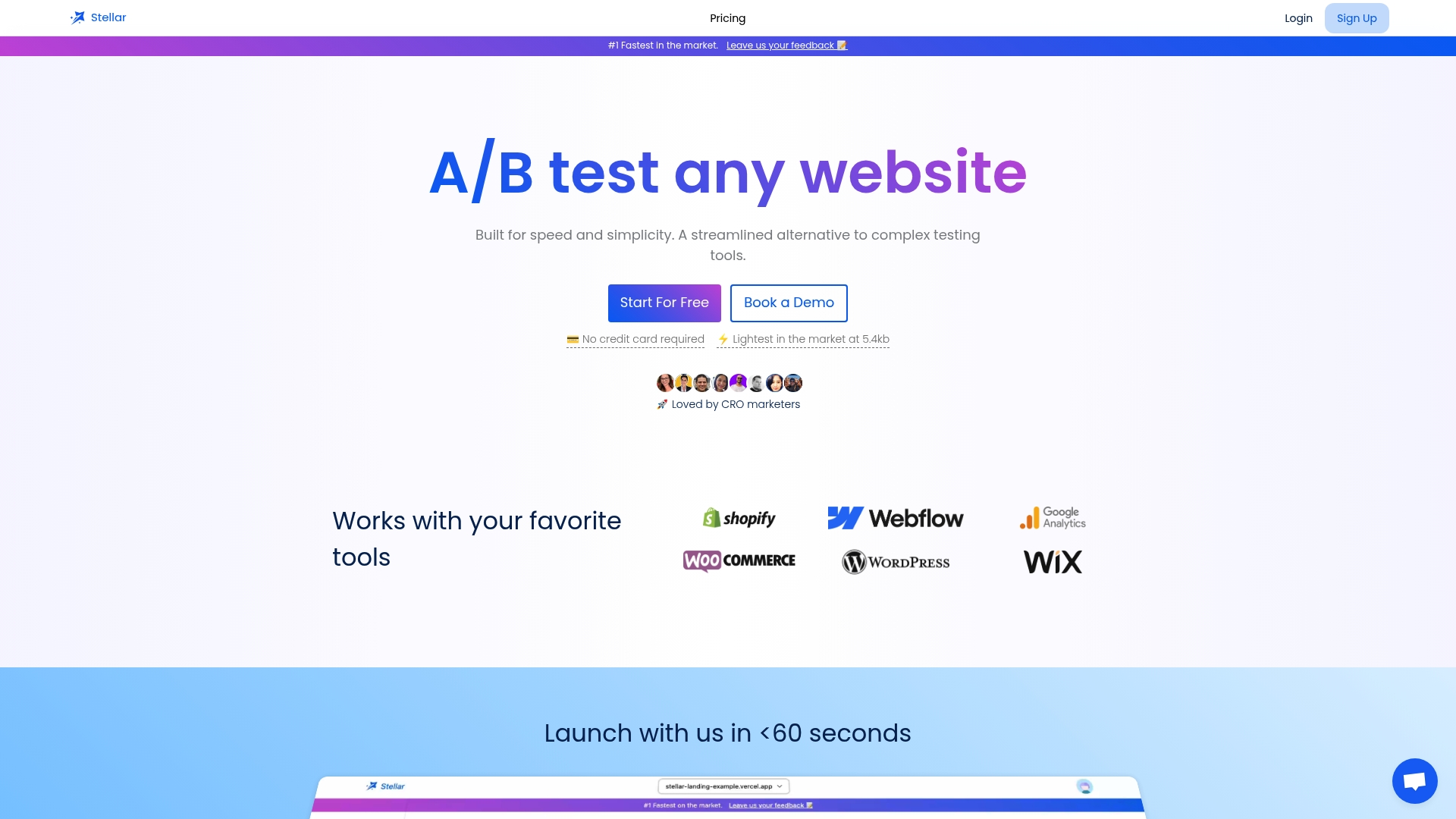
Ready to ditch the delays and guesswork? Experience the fastest way to run powerful A/B tests, build personalized landing pages with dynamic keyword insertion, and access real-time analytics all from one sleek platform. Visit Stellar to start your free plan now and transform your optimization strategy today.
Frequently Asked Questions
How can I set up my first A/B test with Optimizely?
To set up your first A/B test with Optimizely, start by selecting a webpage to test. Use the visual editor to create changes and define your audience, then launch the test and monitor results over a defined period, typically 1-2 weeks.
What metrics should I prioritize for measuring A/B test success in Optimizely?
When measuring A/B test success in Optimizely, prioritize metrics that align with your business goals, such as conversion rates or user engagement. Establish clear primary and secondary goals before launching your test.
How can I ensure my experiment runs smoothly without developer help?
You can ensure your experiment runs smoothly without developer help by utilizing Optimizely's no-code features. Use the visual editor to make changes directly to your webpage, making it easy to launch your experiments within hours.
What is the importance of real-time analytics in A/B testing?
Real-time analytics are crucial in A/B testing as they allow you to monitor performance immediately. Use this data to identify issues or winning variations quickly, enabling you to make decisions based on real-time user interaction.
How do I choose the right pricing plan for Optimizely?
Choosing the right pricing plan for Optimizely involves assessing your business size, traffic volume, and team needs. Start with a lower-tier plan to test core features, then scale up as your traffic increases or as more advanced capabilities become necessary.
What initial changes should I consider testing for better conversion rates?
For better conversion rates, consider testing high-impact elements like headlines, call-to-action buttons, or page layouts. Start with one element at a time and measure the results over a few weeks to identify significant improvements.
Recommended
- 7 Best Practices in AB Testing Every Marketer Should Know
- 12 Powerful AB Test Examples for CRO Success in 2025
- Top 10 AB Testing Examples for CRO Marketers in 2025
- 12 Exemples d’AB Testing Incontournables pour Booster votre Taux de Conversion en 2025
- 7 Steps to Master an Influencer Strategy Checklist
Published: 2/25/2026