
Content Experiments for Marketers: Complete Guide
Most marketing teams waste valuable resources guessing what content will succeed. With nearly 90% of marketers citing data-driven strategies as key to higher returns, guessing is no longer enough. Content experiments help cut through opinions by turning digital content into measurable insights. By understanding how to systematically test and refine content, marketers can boost engagement, uncover hidden opportunities, and achieve stronger results with greater confidence.
Table of Contents
- Defining Content Experiments In Marketing
- Types Of Content Experiments For Marketers
- Essential Elements Of Effective Testing
- Step-By-Step Setup And Management Process
- Common Mistakes And How To Avoid Them
- Comparing Content Experiments And Traditional Testing
Key Takeaways
| Point | Details |
|---|---|
| Content Experiments Enhance Decision-Making | Marketing experimentation allows for systematic testing of content variations, enabling data-driven decisions and optimization. |
| Types of Content Experiments | Strategies such as A/B testing, multivariate testing, and personalization experiments provide diverse insights into audience preferences. |
| Essential Testing Elements | Successful experiments require clear hypotheses, controlled variables, and robust data collection processes to drive meaningful results. |
| Distinction from Traditional Testing | Content experiments offer more precise measurements, quicker iterations, and lower costs compared to conventional marketing testing methods. |
Defining Content Experiments in Marketing
Content experiments represent strategic approaches marketers use to systematically test, validate, and optimize digital content performance. Marketing experimentation allows teams to make data-driven decisions by comparing different content variations and measuring their impact on key performance indicators.
According to research from eprints, content experiments involve methodically designing tests that isolate specific variables to understand their influence on audience engagement. These experiments can target multiple elements, including:
- Headline variations
- Visual design components
- Call-to-action messaging
- Content length and structure
- Multimedia integration
The core purpose of content experiments is transforming guesswork into precise, measurable insights. By systematically testing hypotheses, marketers can uncover nuanced audience preferences and optimize content strategies with unprecedented accuracy.
Marketers can implement content experiments through various methodological approaches, such as A/B testing, multivariate testing, and split testing. Understanding the Marketing Experimentation Process provides deeper insights into selecting the most appropriate experimental design for specific marketing objectives.
Successful content experiments require rigorous planning, clear hypothesis definition, statistically significant sample sizes, and robust analytics tracking. By embracing a scientific approach to content creation, marketers can continuously refine their strategies, improve audience engagement, and drive meaningful business outcomes.
Types of Content Experiments for Marketers
Content experiments are diverse strategic approaches that allow marketers to validate and optimize their digital strategies. According to research from eprints, marketing experiments can be categorized into several fundamental types that help teams systematically test and improve content performance.
According to marketinginsidergroup, the primary types of content experiments include:
- A/B Testing: Comparing two versions of content to determine which performs better
- Multivariate Testing: Examining multiple variables simultaneously
- Split URL Testing: Comparing entirely different webpage designs
- Personalization Experiments: Tailoring content to specific audience segments
- User-Generated Content Tests: Evaluating engagement with crowd-sourced materials
Each experimental approach offers unique insights. A/B testing, for instance, allows marketers to isolate specific elements like headlines, images, or call-to-action buttons and measure their direct impact on audience engagement. Understanding Why Run Split Tests for Better Marketing provides deeper context on selecting the most appropriate testing methodology.
Successful content experiments require careful planning, clear hypothesis formulation, statistically significant sample sizes, and robust analytics tracking. By systematically exploring different content variations, marketers can transform intuitive guesswork into precise, data-driven strategies that significantly enhance audience interaction and conversion potential.

Essential Elements of Effective Testing
Marketing experimentation demands a structured approach to generate meaningful insights. According to research from eprints, effective testing requires careful methodological design that ensures reliable and actionable results.
The core elements of robust content experiments include:
- Clear Hypothesis Formation: Defining precise, measurable objectives
- Controlled Variable Management: Isolating specific factors for accurate analysis
- Statistical Significance: Ensuring sample sizes support valid conclusions
- Comprehensive Data Collection: Tracking multiple performance metrics
- Unbiased Test Design: Minimizing potential experimental biases
Research from columbia emphasizes the critical importance of rigorous experimental design. Marketers must carefully select test variants that provide meaningful comparative insights. How to Choose Test Variants: A CRO Marketer's Guide 2025 offers advanced strategies for selecting the most impactful experimental parameters.
Successful testing goes beyond mere data collection. It requires a systematic approach that transforms raw information into strategic insights. By meticulously controlling experimental variables, establishing clear objectives, and implementing robust analytical frameworks, marketers can unlock profound understanding of audience behaviors and preferences, ultimately driving more effective content strategies.
Step-by-Step Setup and Management Process
Content experiments require a systematic approach to ensure meaningful and actionable insights. According to research from eprints, successful marketing experiments follow a structured methodology that transforms theoretical concepts into practical, data-driven strategies.
The comprehensive setup and management process involves these critical stages:
- Objective Definition
- Identify specific marketing goals
- Determine key performance indicators (KPIs)
- Establish clear, measurable outcomes
- Hypothesis Formulation
- Develop precise, testable hypotheses
- Predict potential experimental outcomes
- Outline expected impact on target metrics
- Experimental Design
- Select appropriate testing methodology
- Define control and variant groups
- Determine sample size and duration
- Implementation
- Deploy test variants
- Ensure technical setup is accurate
- Monitor initial performance signals
- Data Collection and Analysis
- Track comprehensive performance metrics
- Apply statistical significance testing
- Validate experimental results
Research from columbia emphasizes the importance of rigorous data management throughout the experimental process. 8 Test Scheduling Strategies for Maximum Efficiency provides additional insights into optimizing experiment timelines and performance.
Successful content experiments are not just about collecting data, but transforming that data into strategic insights. By meticulously following each stage of the setup and management process, marketers can systematically improve their content strategies, making informed decisions that drive meaningful business outcomes.
Common Mistakes and How to Avoid Them
Content experiments are intricate processes vulnerable to numerous potential pitfalls. According to research from eprints, marketers frequently encounter systematic errors that can compromise experimental integrity and invalidate critical insights.
The most prevalent mistakes in content experiments include:
- Insufficient Sample Size
- Running tests with statistically insignificant audience segments
- Drawing premature conclusions
- Failing to account for natural data variability
- Biased Experimental Design
- Introducing unintentional selection bias
- Neglecting proper control group management
- Allowing personal assumptions to influence experimental parameters
- Poor Hypothesis Development
- Creating vague, unmeasurable objectives
- Lacking clear, specific performance indicators
- Failing to align hypotheses with broader marketing goals
- Improper Data Interpretation
- Misunderstanding statistical significance
- Overemphasizing minor variations
- Ignoring contextual nuances in experimental results
Research from columbia emphasizes the critical nature of methodological rigor. Digital Marketing Mistakes: Complete Expert Guide provides additional context on avoiding common experimental pitfalls.
Successful marketers approach content experiments with scientific precision. By understanding and proactively addressing these common mistakes, teams can develop more robust, reliable experimental frameworks that generate truly actionable insights and drive meaningful strategic improvements.
Comparing Content Experiments and Traditional Testing
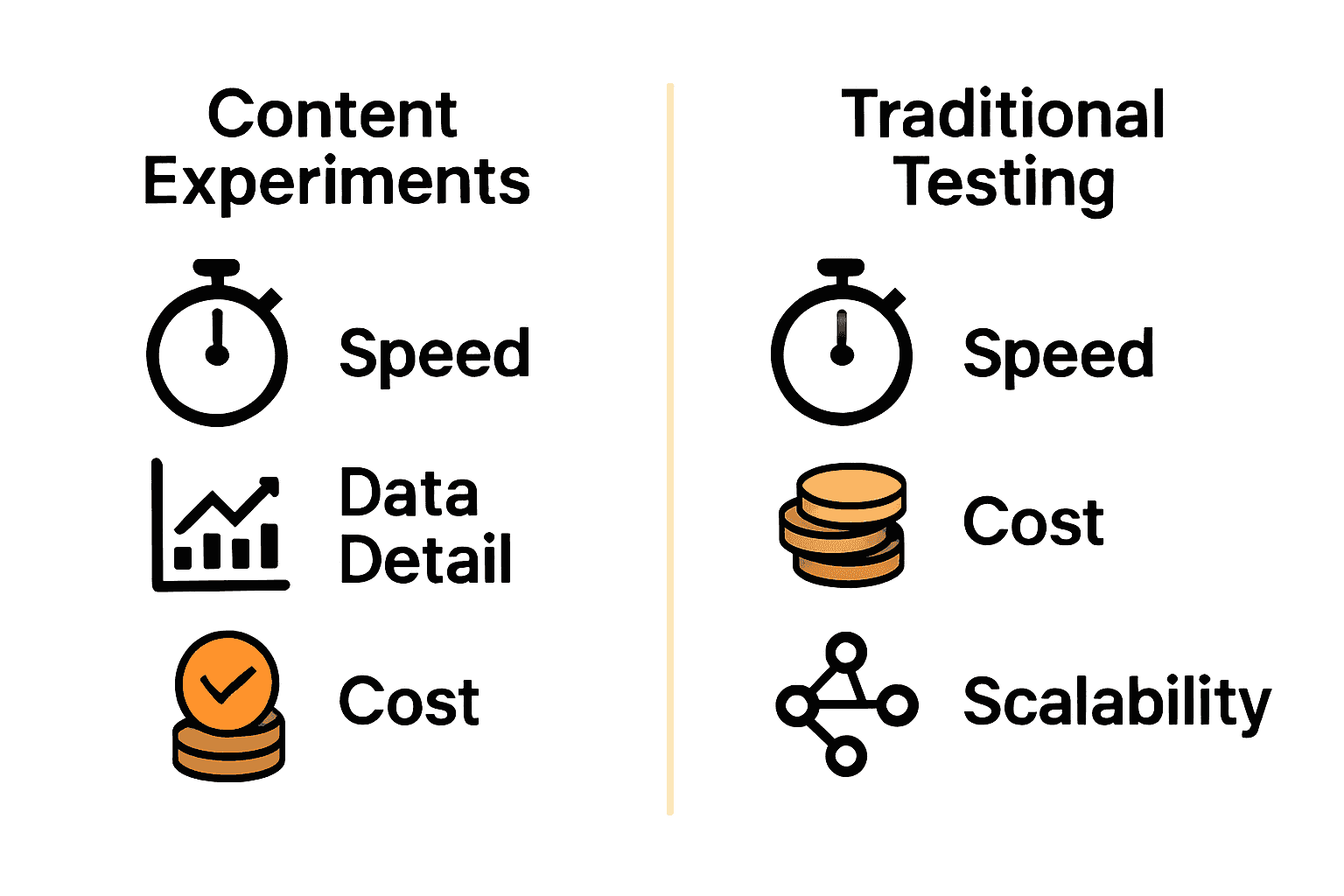
Marketing research methodologies have dramatically evolved, with content experiments representing a sophisticated alternative to traditional testing approaches. According to research from eprints, modern experimental designs offer more nuanced, data-driven insights compared to conventional marketing assessment techniques.
Key differences between content experiments and traditional testing include:
-
Precision of Measurement
- Content Experiments: Quantitative, granular data points
- Traditional Testing: Often qualitative, subjective assessments
-
Speed of Iteration
- Content Experiments: Real-time adjustments and immediate feedback
- Traditional Testing: Slower, more linear progression
-
Cost-Effectiveness
- Content Experiments: Lower resource investment
- Traditional Testing: Higher operational expenses
-
Scalability
- Content Experiments: Easily replicable across multiple channels
- Traditional Testing: Limited adaptability
Research from en highlights the transformative potential of experimental approaches. Understanding A/B Testing vs Split Testing: Key Differences provides additional context on distinguishing between various experimental methodologies.
The shift towards content experiments represents more than a technological upgrade—it's a fundamental reimagining of how marketers generate insights. By embracing data-driven, adaptable testing frameworks, organizations can move beyond intuition-based decision-making and develop strategies rooted in empirical evidence and real-world performance metrics.
Unlock Powerful Content Experiments with Stellar
Marketers face challenges like designing clear hypotheses, managing variables, and achieving statistical significance to truly optimize content performance. This guide highlights the need for a streamlined, no-code approach to testing that delivers real-time insights and eliminates guesswork. If refining your headlines, visuals, or call-to-action messaging sounds familiar, leveraging efficient tools becomes essential to avoid common pitfalls and boost conversion rates.

Take control of your content experiments today with Stellar, the fastest A/B testing tool designed for marketers and growth hackers who need simple yet powerful solutions. Featuring a lightweight script and a visual editor, Stellar helps you launch effective tests without technical barriers. Explore Advanced Goal Tracking and real-time analytics to turn your data into actionable insights immediately. Don’t wait to improve your marketing strategy — visit Stellar’s homepage now and start optimizing with confidence.
Frequently Asked Questions
What are content experiments in marketing?
Content experiments in marketing are strategic approaches used to test, validate, and optimize digital content performance through systematic comparisons of different content variations.
How do I set up an effective content experiment?
To set up an effective content experiment, define specific marketing objectives, formulate a clear hypothesis, design the experiment with control and variant groups, implement the tests, and collect and analyze data to derive actionable insights.
What types of content experiments can marketers use?
Marketers can use various types of content experiments, including A/B testing, multivariate testing, split URL testing, personalization experiments, and user-generated content tests to improve audience engagement and conversion rates.
What are common mistakes to avoid in content experiments?
Common mistakes in content experiments include insufficient sample size, biased experimental design, poor hypothesis development, and improper data interpretation, which can undermine the validity of the results.
Recommended
Published: 11/15/2025