
Conversion Metric Benchmarks: Complete Guide 2025
Most companies underestimate just how much setting the right benchmarks can influence online growth. In a digital world fueled by data, understanding conversion metrics helps businesses see not just what works, but why. Latest studies show that advanced attribution models can reveal conversion patterns traditional methods often miss. This article unpacks how clearly defined benchmarks transform random numbers into real strategies for better performance and smarter marketing decisions.
Table of Contents
- Defining Conversion Metric Benchmarks
- Key Types Of Conversion Metrics
- Establishing Industry Benchmark Standards
- Analyzing Conversion Metrics In Practice
- Common Pitfalls And Benchmark Misuses
Key Takeaways
| Point | Details |
|---|---|
| Importance of Conversion Metrics | Conversion metrics are essential for evaluating digital strategy effectiveness and should align with business objectives for better outcomes. |
| Advanced Analytical Frameworks | Utilizing sophisticated models, like Multi-Attribution Learning, enhances understanding of user behaviors and improves conversion predictions. |
| Common Benchmark Pitfalls | Businesses must avoid misusing benchmarks through blind comparisons and static data, ensuring they consider qualitative factors and context. |
| Dynamic Benchmark Standards | Establishing robust benchmarks requires adaptability in measurement approaches and regular updates to reflect industry variations. |
Defining Conversion Metric Benchmarks
Conversion metric benchmarks are systematic measurements that help marketers evaluate the effectiveness of their digital strategies by tracking how successfully users complete desired actions. These metrics transform raw website data into actionable insights, enabling businesses to understand their performance relative to industry standards and competitors.
According to research from arxiv.org, advanced Multi-Attribution Learning frameworks are emerging as powerful tools for predicting conversion rates. This approach integrates multiple attribution perspectives, allowing businesses to capture more nuanced user conversion patterns beyond traditional single-touchpoint analysis.
Key conversion metrics typically include:
- Conversion Rate: Percentage of visitors completing a desired action
- Click-Through Rate (CTR): Ratio of users clicking a specific element
- Cost Per Acquisition (CPA): Total marketing expense required to acquire a single customer
- Average Order Value: Mean monetary value of completed transactions
Interestingly, research from arxiv.org highlights a critical insight: businesses must carefully align their conversion optimization strategies with specific training objectives. Simply maximizing click-through rates does not guarantee improved conversion performance. Marketers need a holistic approach that considers the entire user journey and focuses on meaningful business outcomes.
Establishing robust conversion metric benchmarks requires continuous monitoring, sophisticated analytical techniques, and a willingness to adapt strategies based on emerging data insights. By leveraging advanced attribution models and maintaining a data-driven mindset, businesses can systematically improve their digital performance and drive sustainable growth.
For a deeper understanding of implementing these benchmarks, check out our conversion tracking guide for 2025.
Key Types of Conversion Metrics
Conversion metrics represent critical performance indicators that help businesses quantify and analyze user interactions across digital platforms. These metrics go beyond simple numerical tracking, providing deep insights into user behavior, engagement patterns, and overall marketing effectiveness.
Traditional conversion metrics can be categorized into several key types. Website Conversion Metrics include:
- Conversion Rate
- Bounce Rate
- Time on Page
- Pages per Session
- New vs. Returning Visitor Ratio
E-commerce Conversion Metrics expand this analysis with specific transactional measurements:
- Cart Abandonment Rate
- Average Order Value
- Revenue per Visitor
- Checkout Completion Rate
- Customer Lifetime Value
Interestingly, according to Wikipedia, emerging research suggests expanding our understanding of metrics beyond traditional measurements. Altmetrics now encompass non-traditional indicators like views, discussions, saves, and recommendations, providing a more comprehensive impact assessment.
Research from arxiv.org introduces innovative frameworks for predicting performance impact, demonstrating how semantic analysis can offer deeper insights into metric evaluation. This approach suggests that conversion metrics are not just numbers, but complex indicators of user engagement and business potential.

To gain a comprehensive view of conversion optimization strategies, explore our guide on benchmarking conversion rates effectively in 2025.
Establishing Industry Benchmark Standards
Establishing industry benchmark standards requires a systematic approach that goes beyond simple data collection, focusing on creating meaningful, comparable metrics that provide actionable insights for businesses across various sectors. These standards serve as critical reference points, allowing organizations to evaluate their performance against industry-wide expectations and identify areas for strategic improvement.
Research from Frontiersin highlights the complex nature of developing robust performance indicators. The study emphasizes that effective benchmark standards must encompass multiple dimensions, including:
- Quantitative performance metrics
- Qualitative assessment criteria
- Contextual industry-specific factors
- Adaptive measurement frameworks
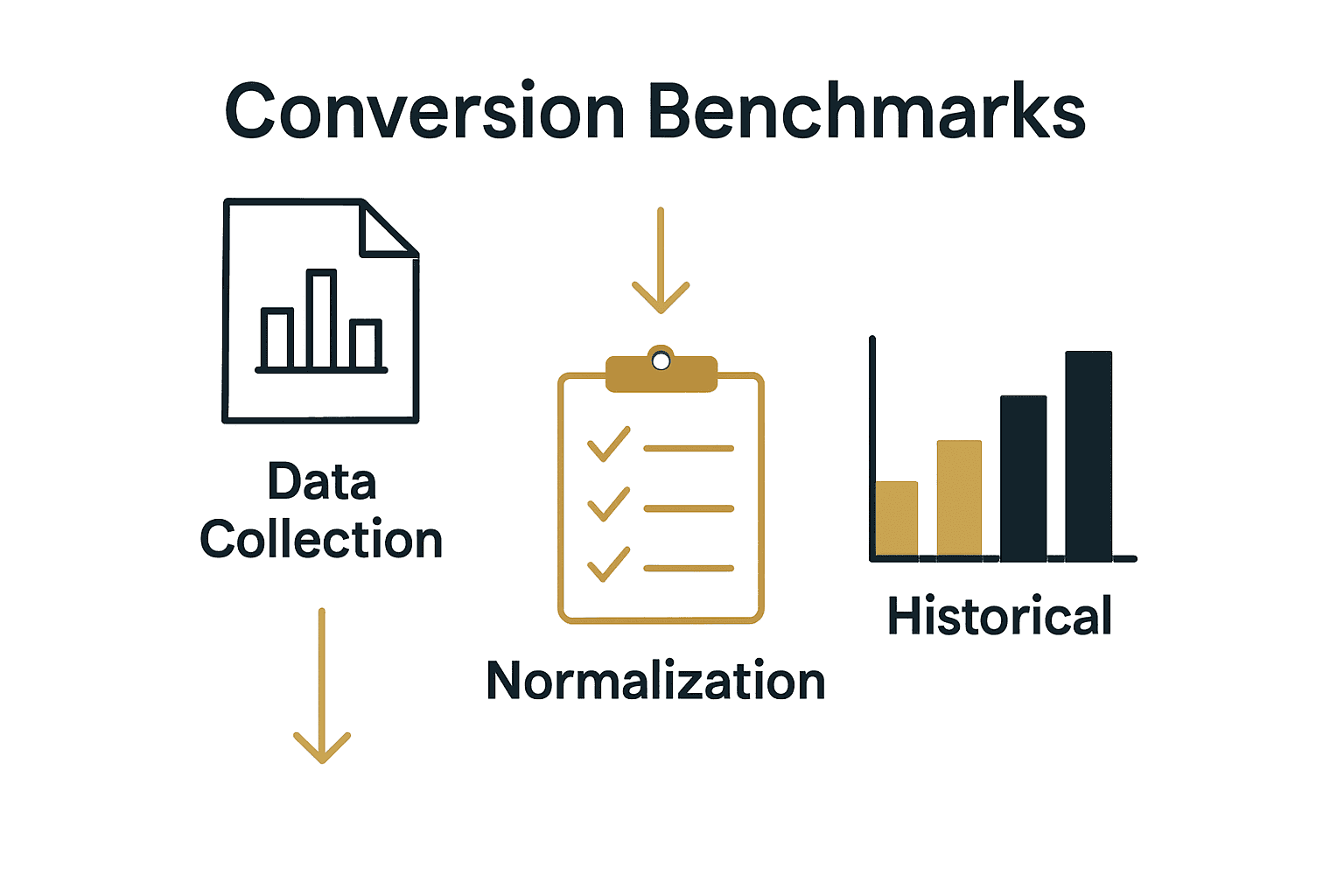
Key considerations for establishing reliable benchmark standards include:
- Consistency in data collection methodologies
- Normalization of metrics across different organizational scales
- Regular updating of benchmark parameters
- Accounting for industry-specific variations
- Incorporating both historical and predictive analytics
According to Michalakelis, developing comprehensive benchmark standards requires a structured framework that goes beyond traditional measurement approaches. The research suggests creating dynamic, adaptable metrics that can capture the nuanced performance characteristics of modern businesses.

Businesses seeking to implement robust benchmark standards must adopt a holistic approach that balances statistical rigor with practical applicability.
 This means moving beyond raw numbers to understand the context, potential, and unique challenges of each industry sector.
To dive deeper into crafting effective conversion benchmarks, check out our guide on conversion rate benchmarks for 2025.
Analyzing Conversion Metrics in Practice
Converting raw data into meaningful insights requires a strategic approach that goes beyond simple number crunching. Effective conversion metric analysis involves understanding the complex interactions between user behavior, marketing strategies, and business objectives.
Research from arxiv.org introduces the DCMT framework, which addresses critical challenges in conversion analysis such as selection bias and data sparsity. This innovative approach improves prediction accuracy by:
- Identifying underlying patterns in user interactions
- Mitigating potential data collection limitations
- Providing more nuanced conversion estimation techniques
- Enhancing recommendation scenario insights
Practical steps for analyzing conversion metrics include:
- Establish clear baseline measurements
- Segment data across multiple dimensions
- Identify correlation versus causation
- Implement continuous monitoring systems
- Create adaptive reporting mechanisms
Successful conversion metric analysis requires a holistic perspective that considers multiple factors. Key analytical strategies involve:
- Integrating quantitative and qualitative data
- Developing context-specific interpretation models
- Recognizing the dynamic nature of user behavior
- Maintaining flexibility in measurement approaches
To gain deeper insights into translating these metrics into actionable strategies, explore our article on digital marketing metrics that actually predict conversion.
Common Pitfalls and Benchmark Misuses
Conversion metric benchmarks are powerful tools, but they can quickly become misleading when misinterpreted or applied without nuanced understanding. Businesses often fall into predictable traps that undermine their analytical efforts and strategic decision making.
Research from rsisinternational.org highlights critical challenges in performance measurement during the digital era, revealing several common benchmark misuses:
- Over-relying on single-dimensional metrics
- Failing to contextualize data
- Ignoring industry-specific variations
- Mistaking correlation for causation
- Applying generic benchmarks without customization
Most significant benchmark misuses include:
- Blind Comparisons: Comparing metrics across dissimilar business models
- Static Benchmarking: Using outdated or fixed reference points
- Metric Tunnel Vision: Focusing on isolated metrics
- Neglecting Qualitative Factors: Reducing performance to pure numbers
- Inconsistent Data Collection: Using non-standardized measurement approaches
According to eajournals.org, successful performance evaluation requires a holistic approach that balances quantitative measurements with contextual understanding. The research emphasizes the importance of recognizing secondary benefits and potential interpretative nuances.
To navigate these complex analytical challenges, marketers must develop a sophisticated, adaptable approach to benchmark interpretation that goes beyond surface-level number crunching.
For practical strategies to avoid these pitfalls, explore our guide on digital marketing mistakes.
Unlock Your Conversion Potential with Stellar Today
Struggling to establish reliable conversion metric benchmarks that truly capture your marketing impact is a common challenge. The article highlights the pitfalls of misusing benchmarks and the importance of advanced goal tracking alongside flexible, real-time analytics. If you want to move beyond guesswork and static data, adopting tools that simplify comprehensive conversion analysis is essential for making informed decisions and driving sustainable growth.

Experience how Stellar’s lightweight, no-code A/B testing platform empowers marketers and growth hackers to test effectively without technical headaches. With features like dynamic keyword insertion and advanced goal tracking, you get actionable insights to refine every step of the customer journey. Don’t let outdated metrics hold you back. Visit Stellar now, explore our advanced goal tracking capabilities, and start optimizing your conversion rate benchmarks with ease and confidence.
Frequently Asked Questions
What are conversion metric benchmarks?
Conversion metric benchmarks are systematic measurements that help marketers evaluate the effectiveness of their digital strategies by tracking how successfully users complete desired actions. They transform raw data into actionable insights for businesses.
What key conversion metrics should I track?
Key conversion metrics include Conversion Rate, Click-Through Rate (CTR), Cost Per Acquisition (CPA), and Average Order Value. Each metric provides insights into different aspects of user behavior and marketing effectiveness.
How can I establish robust conversion metric benchmarks?
To establish robust conversion metric benchmarks, consistently monitor data, utilize sophisticated analytical techniques, and adapt strategies based on emerging insights. Consider both quantitative and qualitative factors for a comprehensive evaluation.
What are common pitfalls when using conversion metric benchmarks?
Common pitfalls include over-relying on single-dimensional metrics, failing to contextualize data, and neglecting qualitative factors. Businesses should avoid blind comparisons and static benchmarking to ensure accurate performance assessments.
Recommended
Published: 11/10/2025