
Designing Effective Landing Pages That Convert Leads
Most landing pages fizzle out before visitors even reach the call-to-action. Marketers pour hours into design and copy, yet only about 2.35 percent of landing page visitors actually convert on average. That might seem discouraging at first. But landing pages with sharply defined audiences and goals can far exceed this number, turning casual skimmers into loyal customers faster than you think.
Table of Contents
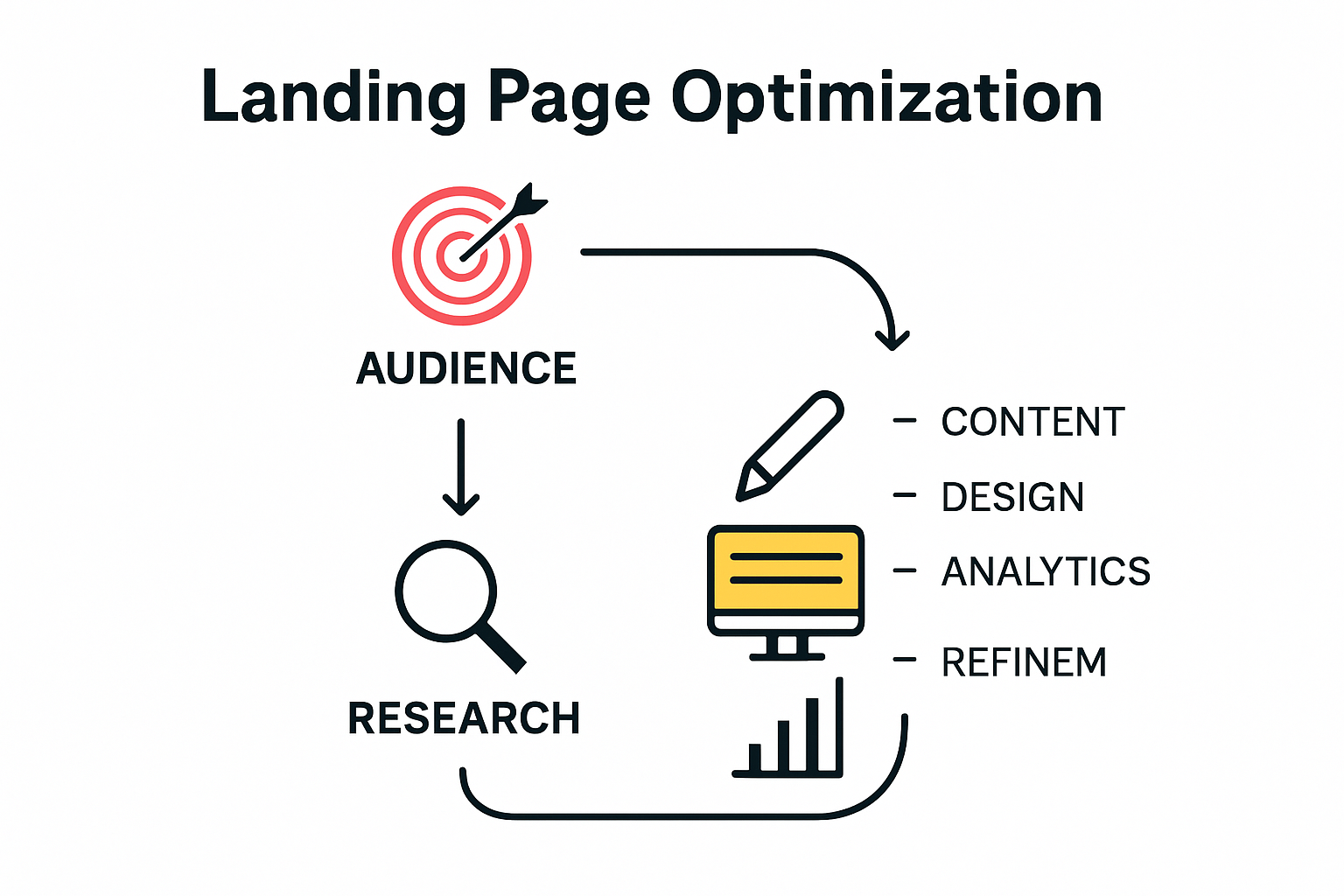
- Step 1: Define Your Target Audience And Goals
- Step 2: Research And Analyze Competitor Landing Pages
- Step 3: Create Compelling Content And Visuals
- Step 4: Optimize The Layout And User Experience
- Step 5: Implement Tracking And Analytics Tools
- Step 6: Test, Review, And Refine Your Landing Page
Quick Summary
| Key Point | Explanation |
|---|---|
| 1. Define your audience and goals | Understand your ideal customer and what you want them to do, clarifying your landing page's purpose. |
| 2. Research competitors thoroughly | Analyze competitor landing pages for insights on effective strategies and emotional appeals. |
| 3. Create compelling content | Use clear, benefit-focused headlines and authentic visuals that connect with your target audience. |
| 4. Optimize layout and user experience | Design an intuitive layout with clear visual hierarchy and strategically placed call-to-action buttons. |
| 5. Implement tracking and analytics tools | Utilize tools like Google Analytics to gather data on user behavior and refine your landing page continuously. |
Step 1: Define Your Target Audience and Goals
Designing effective landing pages starts with understanding precisely who you want to reach and what specific outcomes you aim to achieve. This foundational step transforms generic web pages into powerful conversion tools that speak directly to your ideal customers.
Begin by creating a detailed user persona that goes beyond basic demographics. Dive deep into your target audience's psychological landscape. What are their pain points? What motivates them to seek solutions? Consider factors like professional challenges, emotional triggers, and specific needs that your product or service addresses.
To construct an accurate persona, gather insights through multiple channels. Analyze existing customer data, conduct surveys, review support ticket interactions, and examine website analytics. Look for patterns in user behavior, search terms, and engagement metrics. According to Usability.gov, comprehensive personas help designers make more informed decisions that resonate with actual user experiences.
Parallel to understanding your audience, crystallize your landing page goals with extreme clarity. Are you seeking email sign-ups, product purchases, demo requests, or free trial registrations? Each goal demands a different strategic approach. Specific, measurable objectives will guide every design and copywriting decision.
Quick verification of successful audience and goal definition includes:
- A precise, one-paragraph description of your ideal customer
- Clear, quantifiable conversion objectives
- Documented user pain points directly addressed by your offering
Remember that your landing page is not about you. It is a strategic communication tool designed to solve your audience's problems quickly and compellingly. By investing time in this initial step, you create a solid foundation for a landing page that does not just attract visitors but transforms them into engaged customers.
Step 2: Research and Analyze Competitor Landing Pages
Competitor research transforms good landing pages into exceptional conversion machines. This critical step provides strategic insights that help you understand what works in your market and where opportunities for differentiation exist.
Start by identifying direct and indirect competitors in your specific market segment. Use tools like SEMrush or Ahrefs to discover which websites rank for similar keywords and target comparable audiences. Do not merely copy competitors but analyze their approaches with a critical eye.
Carefully examine each competitor's landing page elements. Scrutinize their visual hierarchy, headline structures, call-to-action placement, imagery selection, and overall messaging tone. According to academic research, the volume and presentation of content significantly impact user engagement and conversion rates.
Look beyond surface aesthetics and dive into deeper strategic elements. What emotional triggers are they using? How do they communicate value propositions? Which pain points do they address? Understand the psychological mechanisms driving their design choices.
Quick verification checklist for comprehensive competitor analysis:
- Documented breakdown of 3-5 key competitor landing pages
- Identified unique value propositions for each competitor
- Noted visual and messaging patterns in your market
- List of potential differentiation opportunities
Remember that effective competitor research is not about imitation but strategic innovation. By understanding the competitive landscape, you can craft a landing page that stands out while meeting fundamental user expectations. Your goal is to learn from others while creating something uniquely compelling that speaks directly to your target audience's needs.
Step 3: Create Compelling Content and Visuals
Creating compelling content and visuals transforms your landing page from a generic web space into a powerful conversion engine. This step bridges the gap between audience understanding and persuasive communication, turning casual visitors into engaged potential customers.
Craft your headline with surgical precision. Your primary headline must communicate value instantaneously, addressing the core problem your audience experiences. Avoid generic statements. Instead, speak directly to their specific pain point with a clear, benefit-driven message that creates an immediate emotional connection.
Visual design plays an equally critical role in capturing and maintaining user attention. According to research in web design psychology, strategic visual hierarchy can dramatically enhance landing page persuasiveness. Select imagery that represents your target audience authentically. Use high-quality, professional visuals that showcase real people or scenarios your potential customers can relate to.
Write copy that focuses ruthlessly on benefits rather than features. Describe how your solution solves problems, transforms challenges, and creates tangible improvements in users' professional or personal lives. Use clear, concise language that eliminates unnecessary complexity. Break complex ideas into digestible, scannable paragraphs that guide the reader's eye naturally through your value proposition.
Verification checklist for compelling content and visuals:
- Headline clearly communicates unique value proposition
- Visuals authentically represent target audience
- Copy focuses on specific, measurable benefits
- Text is concise and easily scannable
- Emotional and rational triggers are strategically incorporated
Remember that every word and image must earn its place on your landing page. Your goal is not to impress but to connect, persuade, and ultimately convert. By combining strategic messaging with purposeful design, you create a landing page that does not just attract attention but compels action.
To help you quickly verify your progress at each stage, the following checklist summarizes key criteria to ensure your landing page is optimized for conversions.
| Step | Verification Criteria |
|---|---|
| Define Audience & Goals | 1-paragraph ideal customer description; measurable objectives; documented user pain points |
| Competitor Research | Breakdown of 3-5 competitors; note value propositions and differentiation |
| Compelling Content & Visuals | Clear headline; authentic visuals; benefit-focused, concise copy |
| Optimize Layout & UX | Value proposition in hero area; follows eye-scanning patterns; logical CTA placement |
| Tracking & Analytics | Tracking code installed; conversion goals; heat mapping and event tracking |
| Test, Review & Refine | Documented test hypothesis; statistically significant tests; winning version implemented |
Step 4: Optimize the Layout and User Experience
Layout and user experience design transform your landing page from a static information display into an intuitive, conversion-driving interface. This step focuses on creating a seamless journey that guides visitors effortlessly toward your desired action.
Begin with a strategic visual hierarchy that naturally directs users' attention. Position your most critical information prominently, typically within the first screen view. The hero section should immediately communicate your core value proposition, using a combination of compelling headline, supporting subtext, and visually striking imagery that creates an instant emotional connection.
Consider the psychological patterns of user scanning behavior. Most users follow either an F-pattern or Z-pattern when consuming web content. Design your layout to accommodate these natural eye movements by placing key information and call-to-action buttons along these invisible paths. According to guidelines from the U.S. Web Design System, maintaining simplicity and focus is paramount to effective user experience.
White space is not empty space it is a powerful design tool. Strategic use of negative space helps create visual breathing room, highlighting important elements and preventing cognitive overload. Break your content into digestible sections with clear visual separation. Use consistent color schemes, typography, and graphic elements that reinforce your brand identity while maintaining a clean, professional appearance.
Verification checklist for optimized layout and user experience:
- Hero section clearly communicates primary value proposition
- Key information follows natural user scanning patterns
- White space is used strategically to enhance readability
- Call-to-action buttons are prominently and logically placed
- Design maintains consistent brand identity
Remember that exceptional user experience is about intuitive navigation and emotional resonance. Your landing page should feel like a smooth, guided conversation that anticipates and addresses user needs before they even articulate them.
Step 5: Implement Tracking and Analytics Tools
Tracking and analytics transform your landing page from a static web element into a dynamic, continuously improving conversion machine. This critical step provides the insights necessary to understand user behavior, identify optimization opportunities, and make data-driven design decisions.
Google Analytics serves as the foundational tool for most landing page tracking. Install the tracking code across your entire landing page, ensuring comprehensive data collection. Focus on key metrics that directly reflect user engagement and conversion potential. Track elements like time on page, scroll depth, click-through rates, and most importantly, conversion rates for your primary call-to-action.
Dig deeper with specialized conversion tracking tools. Platforms like Hotjar or Crazy Egg provide heat maps and user session recordings that reveal exactly how visitors interact with your landing page. These visual analytics tools expose hidden user behavior patterns, showing precisely where users click, scroll, and potentially lose interest.
According to Harvard Business School research, effective analytics implementation supports continuous optimization. Set up conversion funnels to track user journeys from initial landing page visit to final conversion. Identify exactly where potential customers drop off and use these insights to refine your design, messaging, and user experience.
Verification checklist for analytics implementation:
- Google Analytics tracking code installed
- Conversion goals established
- Heat mapping tool activated
- User session recording enabled
- Custom event tracking configured
Remember that analytics are not just about collecting data but interpreting it strategically. Your landing page is a living asset that should continuously evolve based on real user interactions. Treat each data point as a conversation with your potential customers, revealing their preferences, frustrations, and paths to conversion.
The following table summarizes popular tracking and analytics tools mentioned in this guide, outlining their core purposes and main features for optimizing your landing page.
| Tool | Purpose | Main Features |
|---|---|---|
| Google Analytics | Site-wide analytics, conversion rate tracking | Time on page, conversion goals, event tracking |
| Hotjar | User behavior visualization | Heatmaps, session recordings |
| Crazy Egg | Detailed interaction analytics | Click tracking, scroll maps |
| Optimizely | A/B testing and experimentation | Split testing, performance measurement |
| Google Optimize | Landing page optimization through experiments | A/B and multivariate testing |

Step 6: Test, Review, and Refine Your Landing Page
Testing transforms your landing page from a static design into a dynamic, high-performing conversion tool. This final step is where data meets creativity, allowing you to systematically improve your page's effectiveness through strategic experimentation.
A/B testing becomes your primary optimization method. Create two distinct versions of your landing page, changing only one variable at a time. This could involve testing headline variations, different call-to-action button colors, image selections, or layout configurations. Tools like Optimizely or Google Optimize make this process straightforward, allowing you to split traffic between versions and measure precise performance differences.
According to Usability.gov, successful A/B testing requires statistical significance. Run your tests long enough to collect meaningful data typically at least two weeks or until you have a substantial sample size of visitors. Pay attention to key metrics like conversion rate, time on page, and bounce rate. These indicators reveal not just which version performs better, but why certain design choices resonate more with your audience.
Do not view testing as a one-time activity but as an ongoing optimization process. Continuous refinement is the hallmark of high-converting landing pages. After each test, document your findings, implement the winning variation, and prepare for your next experiment. This iterative approach ensures your landing page remains responsive to changing user preferences and market dynamics.
Verification checklist for landing page testing:
- Documented A/B test hypotheses
- Clear performance metrics established
- Statistically significant test duration planned
- Winning variation identified and implemented
- Insights documented for future optimization
Remember that every test is a conversation with your audience. By listening carefully to their behavior and preferences, you create a landing page that does not just attract visitors but genuinely connects with them, transforming casual browsers into committed customers.
Turn Your Landing Page Optimizations Into Real Conversions Fast
Struggling to transform your insights on effective landing page design into measurable results? The article highlighted how crucial A/B testing, data-driven decisions, and continuous improvement are for a high-converting landing page. But if traditional testing tools feel slow or complex and you lack technical resources, you are not alone. Many marketers and growth teams face these barriers and want an easier path to performance gains.
Take action quickly with the fastest A/B testing platform for SMBs.
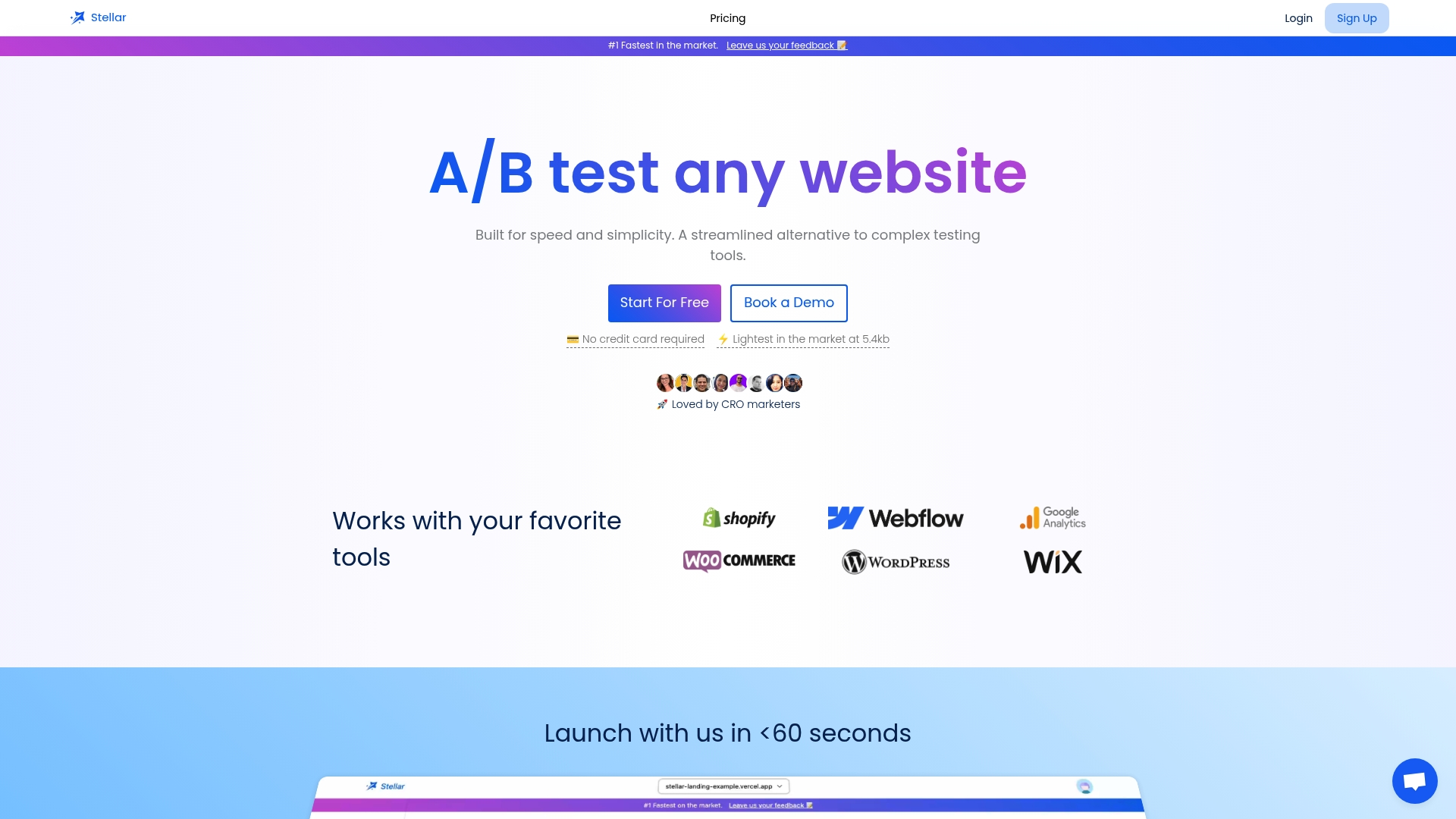
Let Stellar do the heavy lifting. Our platform is built for effective landing page experiments with a simple no-code visual editor, dynamic keyword personalization, and advanced real-time analytics. Get set up in minutes, run experiments without touching code, and watch your conversion rates improve without complex processes. Visit Stellar now and start optimizing your landing pages the smart way. See how easy it is to boost conversions and leave guesswork behind.
Frequently Asked Questions
What are the key components of an effective landing page?
An effective landing page includes a clear value proposition, compelling content, strategic visuals, intuitive layout, and strong call-to-action buttons. Each element should be designed to guide the visitor toward a specific conversion goal.
How can I define my target audience for a landing page?
To define your target audience, create detailed user personas by understanding their pain points, motivations, and needs. Utilize customer data, surveys, and analytics to identify patterns in user behavior and preferences.
What types of content work best on landing pages?
Content that focuses on user benefits rather than features works best on landing pages. Headlines should be clear and benefit-driven, and the copy should be concise, engaging, and tailored to resonate with the intended audience.
How important is A/B testing for landing pages?
A/B testing is crucial for optimizing landing pages. It allows you to compare different versions of your page to identify which elements drive better performance, helping you to refine your design based on actual user interactions.
Recommended
Published: 8/23/2025