
7 Proven Growth Hacking Strategies 2025 for Marketers
Over 80 percent of american marketers say rapid testing delivers the biggest gains in digital campaigns. Fast experimentation has shifted from a luxury to a necessity for brands who want to stay ahead in 2025. With consumer habits changing almost overnight, leveraging quick, smart tools can turn uncertainty into real advantage. This guide brings practical strategies that help you cut through noise, make more confident decisions, and grow your results—with less tech hassle and more data-driven clarity.
Table of Contents
- Leverage Fast A/B Testing For Quick Wins
- Personalize Landing Pages With Dynamic Keyword Insertion
- Automate Goal Tracking For Real-Time Insights
- Implement No-Code Experiments To Accelerate Innovation
- Utilize Advanced Analytics For Smarter Decisions
- Optimize User Experience With Lightweight Scripts
- Measure And Iterate Growth Experiments Frequently
Quick Summary
| Key Message | Explanation |
|---|---|
| 1. Prioritize High Impact Elements | Focus on optimizing key areas like headlines and call-to-action buttons for better conversion rates. |
| 2. Implement Automated Goal Tracking | Use automated systems for real-time performance insights that enhance decision-making speed and accuracy. |
| 3. Utilize No-Code Experiments | Leverage no-code tools to quickly test and iterate marketing strategies without technical complications. |
| 4. Personalize Landing Pages Dynamically | Tailor landing page content based on search intent to increase user engagement and conversion rates. |
| 5. Embrace Continuous Experimentation | Regularly test and refine strategies, treating every experiment as a learning opportunity for growth. |
1. Leverage Fast A/B Testing for Quick Wins
A/B testing is your secret weapon for rapid marketing optimization in 2025. By implementing strategic experimentation, you can uncover powerful insights that drive significant performance improvements without complex technical setups.
The key to successful A/B testing lies in understanding continuous monitoring techniques that enable faster decision making. According to research from arXiv.org, innovative approaches now allow marketers to generate 'always valid' statistical confidence intervals while maintaining test integrity. This means you can make informed choices more quickly and with greater precision.
To leverage fast A/B testing effectively, focus on these critical strategies:
- Prioritize High Impact Elements: Target key conversion points like headlines, call to action buttons, and page layouts
- Set Clear Hypotheses: Define specific measurable goals before launching your test
- Use Lightweight Testing Tools: Select platforms with minimal performance overhead
Successful marketers understand that speed does not mean sacrificing accuracy. By following a framework that balances speed, quality, and risk, you can optimize your online experiments rapidly. The research from arXiv.org suggests implementing principles that accelerate your ramp up process while maintaining statistical reliability.
With modern A/B testing approaches, you can transform your marketing strategy from guesswork to data driven precision. Start small, iterate quickly, and watch your conversion rates climb.
2. Personalize Landing Pages With Dynamic Keyword Insertion
Dynamic keyword insertion represents a powerful strategy to transform generic landing pages into hyper targeted conversion machines. By automatically tailoring content to match a user's specific search intent, you can dramatically improve engagement and conversion rates.
Research from MDPI highlights how optimizing A/B testing systems through dynamic strategy distribution can significantly enhance user engagement. The core principle is simple yet profound: match your landing page content precisely to what users are searching for.
To implement dynamic keyword insertion effectively, consider these strategic approaches:
- Extract Precise Search Terms: Capture the exact keywords users employ during their search
- Create Flexible Content Templates: Design landing pages with modular sections that can swap keywords seamlessly
- Use Smart Automation Tools: Leverage platforms that can dynamically replace page elements in real time
According to research from the University of Michigan Journals, the key to successful dynamic keyword insertion lies in understanding user experience principles. Your goal is to make visitors feel like the landing page was crafted specifically for them.
Implementing this strategy requires careful planning. Start by analyzing your most common search queries, then create landing page variants that speak directly to those specific user intentions. The result? Landing pages that feel personalized, relevant, and compelling to each individual visitor.
3. Automate Goal Tracking for Real-Time Insights
Real-time goal tracking is the pulse of modern marketing analytics. By implementing automated systems, you transform raw data into actionable intelligence that drives strategic decision making.
Research from Journal of Medical Internet Research underscores the critical importance of automated tracking systems in obtaining instantaneous insights. These systems go beyond traditional reporting by providing immediate performance snapshots that enable rapid strategic adjustments.
To build an effective automated goal tracking framework, focus on these key strategies:
- Define Clear Measurable Goals: Establish precise metrics before implementing tracking
- Select Integrated Analytics Platforms: Choose tools that offer comprehensive real-time dashboards
- Set Up Automated Alerts: Configure notifications for significant performance changes
- Implement Multichannel Tracking: Monitor goals across different marketing channels simultaneously
According to research from arXiv.org, advanced reinforcement learning frameworks now enable dynamic evaluation of causal effects. This means you can track not just what happened, but understand why specific outcomes occurred.
The most successful marketers treat goal tracking as a continuous learning process. By automating insights, you free up mental energy to interpret data and craft strategic responses. Your tracking system becomes less about collecting numbers and more about generating actionable intelligence that drives meaningful business growth.
4. Implement No-Code Experiments to Accelerate Innovation
No-code experimentation represents a revolutionary approach for marketers seeking to innovate without getting tangled in complex technical implementation. By removing coding barriers, you can rapidly test and validate marketing hypotheses with unprecedented speed and flexibility.
Research from Harvard Business School reveals the significant impact of no-code experimentation platforms in accelerating innovation cycles for startups. These tools democratize testing capabilities, allowing marketers to become true growth architects.
To successfully implement no-code experiments, focus on these strategic approaches:
- Select User Friendly Platforms: Choose tools with intuitive visual interfaces
- Define Clear Hypotheses: Establish specific measurable objectives before experimentation
- Start with Low Complexity Experiments: Build confidence through incremental testing
- Integrate Cross Functional Insights: Collaborate with design and product teams
According to research from arXiv.org, the 'Test & Roll' methodology provides a profit maximizing approach to A/B testing that requires minimal technical overhead. The key is transforming experimentation from a complex technical process into an agile strategic capability.
Successful marketers understand that innovation is not about complex tools but about asking the right questions. No-code experiments empower you to move faster, learn continuously, and make data driven decisions without getting bogged down in technical complexity.
5. Utilize Advanced Analytics for Smarter Decisions
Advanced analytics transforms raw data into strategic intelligence, enabling marketers to move beyond guesswork and into precision driven decision making. By leveraging sophisticated analytical frameworks, you can uncover insights that traditional reporting methods would never reveal.
Research from arXiv.org introduces a groundbreaking reinforcement learning framework that allows for dynamic evaluation of causal effects. This means you can now understand not just what happened, but precisely why it happened and how to replicate successful outcomes.
To effectively utilize advanced analytics, focus on these strategic approaches:
- Integrate Multiple Data Sources: Combine quantitative and qualitative data streams
- Implement Predictive Modeling: Use machine learning algorithms to forecast potential outcomes
- Develop Custom Dashboards: Create visualization tools that highlight actionable insights
- Embrace Continuous Learning: Treat analytics as an evolving strategic capability
Furthermore, the Test & Roll research from arXiv.org emphasizes the importance of profit maximizing analytical approaches. This means moving beyond traditional metrics to understand the true economic impact of your marketing strategies.
Successful marketers view advanced analytics not as a technical exercise but as a strategic conversation with your data. By asking the right questions and implementing intelligent tracking mechanisms, you transform raw information into a powerful competitive advantage.
6. Optimize User Experience With Lightweight Scripts
Lightweight scripts are the secret weapon for creating blazing fast websites that keep users engaged and convert more effectively. By minimizing performance overhead, you can deliver seamless digital experiences that feel instantaneous and intuitive.
Research from the University of Michigan Journals highlights the critical role of dynamic elements in improving user experience. Performance is no longer just a technical metric but a fundamental aspect of user satisfaction.
To implement lightweight script optimization, consider these strategic approaches:
- Minimize Script Size: Prioritize compact code with zero unnecessary dependencies
- Implement Asynchronous Loading: Prevent scripts from blocking page rendering
- Use Efficient Compression Techniques: Reduce script file sizes without losing functionality
- Monitor Performance Continuously: Track script impact on page load times
According to research from MDPI, dynamic strategy distribution can dramatically enhance user engagement. This means your lightweight scripts are not just about speed but about creating personalized, responsive experiences.
Successful marketers understand that every millisecond matters. By ruthlessly optimizing your scripts, you create digital environments that feel smooth, responsive, and perfectly tailored to user expectations. Your website becomes not just a destination, but an experience.
7. Measure and Iterate Growth Experiments Frequently
Frequent experimentation is the heartbeat of successful modern marketing. By continuously testing and refining your strategies, you transform guesswork into a precise science of incremental improvement.
Research from arXiv.org introduces a groundbreaking approach with 'always valid' statistical methods that enable continuous monitoring of experiments without compromising statistical integrity. This means you can make faster, more confident decisions based on real time data.
To effectively measure and iterate growth experiments, implement these strategic approaches:
- Establish Clear Baseline Metrics: Define precise performance indicators before starting
- Create Rapid Feedback Loops: Design experiments that generate insights quickly
- Embrace Incremental Testing: Break complex hypotheses into smaller testable components
- Develop a Culture of Curiosity: Treat each experiment as a learning opportunity
Further research from arXiv.org highlights a framework that balances speed, quality, and risk in online experiments. This approach provides marketers with principles and algorithms to optimize experimental processes and generate faster insights.
Successful growth hackers understand that experimentation is not about being right every time. It is about creating a systematic approach to learning, where each test brings you closer to understanding what truly drives your audience's behavior.
Below is a comprehensive table summarizing the key strategies for optimizing marketing in 2025 as discussed in the article.
| Strategy | Implementation | Expected Results |
|---|---|---|
| Fast A/B Testing | Prioritize high impact elements, use lightweight tools, set clear hypotheses | Faster decision-making with precise insights |
| Dynamic Keyword Insertion | Extract search terms, use modular content, implement smart automation | Enhanced user engagement and conversion rates |
| Real-Time Goal Tracking | Define goals, use integrated platforms, set automated alerts | Immediate performance insights and rapid adjustments |
| No-Code Experimentation | Use user-friendly platforms, start low complexity tests, integrate insights | Accelerated innovation with less technical complexity |
| Advanced Analytics | Integrate data sources, use predictive modeling, customize dashboards | Deeper strategic intelligence and economic impact understanding |
| Lightweight Scripts | Minimize script size, use asynchronous loading, monitor performance | Faster, smoother user experiences |
| Frequent Growth Experimentation | Establish baselines, create rapid feedback, embrace incremental testing | Continuous learning and precise improvements |
Accelerate Your Growth Hacking Success with Stellar's Powerful Tools
The challenge of executing fast and accurate growth experiments while personalizing user experiences is real. This article highlights the need for quick A/B testing, dynamic keyword insertion, and automated goal tracking to move beyond guesswork and deliver data driven results. If you want to eliminate technical barriers and boost conversions without sacrificing website performance or user satisfaction, Stellar is here to help.
Our lightweight A/B testing platform with a no-code visual editor ensures you can launch rapid experiments with minimal setup. Stellar’s dynamic keyword insertion enhances landing page relevance exactly as discussed. Plus, advanced real-time goal tracking empowers you to understand not only what happens but why. You can optimize continuously with a tool designed specifically for marketers and growth hackers at small to medium businesses.
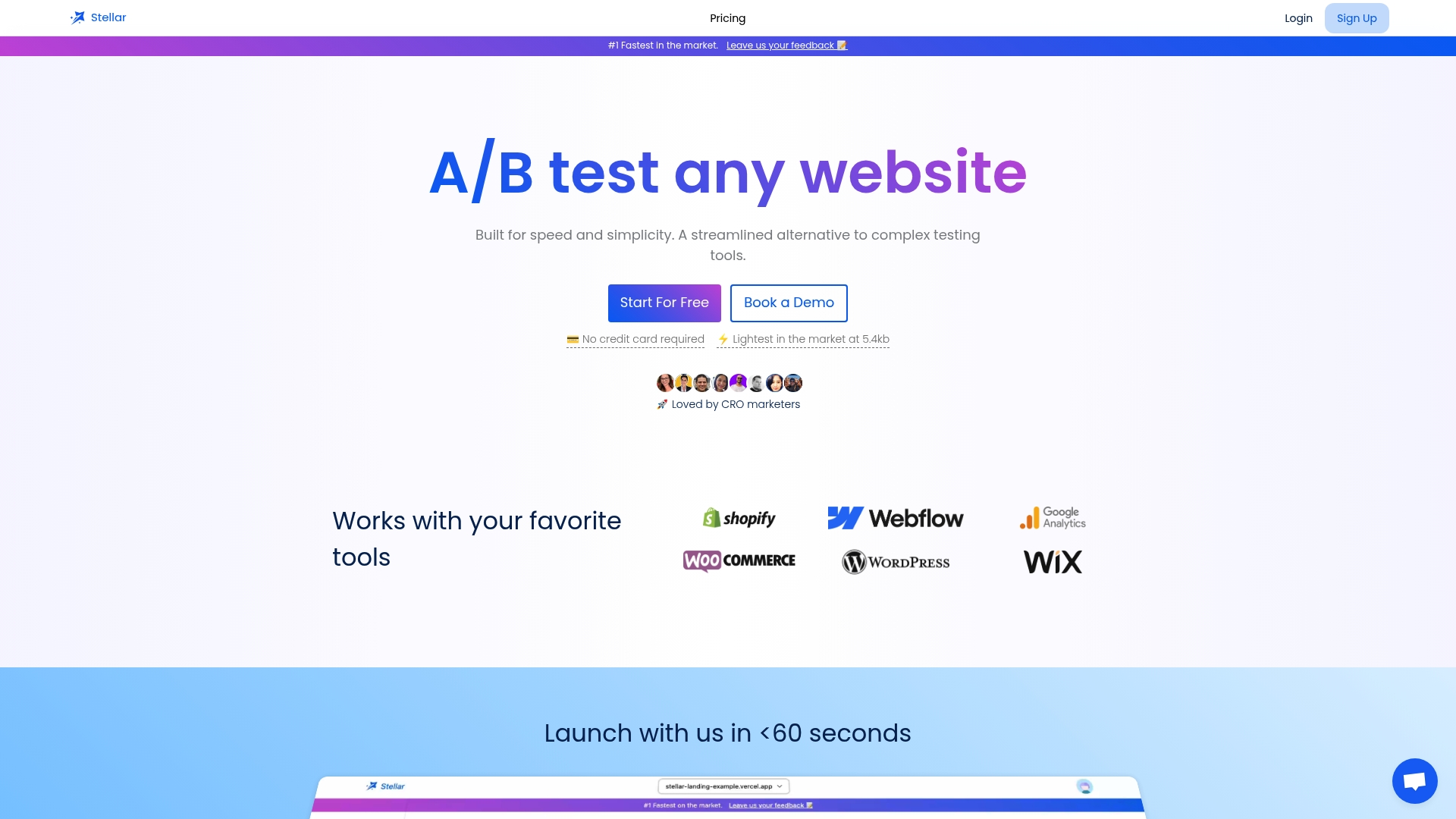
Ready to turn proven strategies into real growth? Experience the fastest and simplest way to implement 2025’s top marketing tactics. Visit Stellar now to start your free plan, explore our no-code visual editor, and master advanced goal tracking. Don’t wait to innovate. Take control of your experiments and get measurable results today.
Frequently Asked Questions
What is A/B testing and how can it improve my marketing strategy in 2025?
A/B testing is a method of comparing two versions of a webpage to determine which one performs better. Implement A/B testing by targeting key elements like headlines or call-to-action buttons, and analyze data to make informed decisions about your marketing campaigns.
How does dynamic keyword insertion enhance landing page performance?
Dynamic keyword insertion tailors your landing page content to match users' specific search queries, increasing relevance and engagement. Analyze your most common search terms and create flexible landing pages that automatically adapt to add those keywords.
What are the benefits of automating goal tracking for my marketing campaigns?
Automating goal tracking provides real-time insights into your performance, enabling faster decision-making. Set clear measurable goals, choose integrated analytics platforms, and use automated alerts to keep track of significant changes in your metrics.
How can I implement no-code experiments to speed up my marketing innovation?
No-code experiments allow marketers to test hypotheses without requiring technical knowledge or coding skills. Start by selecting user-friendly platforms that enable you to design and run experiments quickly, focusing on low complexity tests to build confidence.
What strategies should I use to leverage advanced analytics for smarter decision-making?
To utilize advanced analytics effectively, integrate multiple data sources and implement predictive modeling to forecast outcomes. Create custom dashboards that highlight actionable insights and embrace continuous learning to refine your approach as you gather more data.
Why is it important to frequently measure and iterate my growth experiments?
Frequent measurement and iteration help you find effective strategies rapidly, transforming guesswork into a systematic learning process. Establish clear baseline metrics, create rapid feedback loops, and regularly test your hypotheses to discover what truly motivates your audience.
Recommended
- Top Growth Hacking Secrets for Marketers in 2025
- Understanding Growth Hacking Strategies 2025 for Marketers
- 7 Top Digital Trends 2025 You Must Know for Growth
- Growth Hacking Definition: Was ist Wachstumshacking?
- Leveraging Social Media for Membership Growth and Engagement|CS
- Understanding Digital Marketing for Associations | Colossus Systems
Published: 11/23/2025