
Interpreting A/B Test Results for Actionable Insights
Most american businesses run dozens of experiments each year, yet only a small percentage actually see measurable results. The difference often comes down to how precisely teams define their goals and track their A/B test data. When every decision can impact conversion rates or customer experience, having a reliable process for testing and analysis is more valuable than ever. This step-by-step guide outlines how you can achieve practical, data-driven improvements that move your organization forward.
Table of Contents
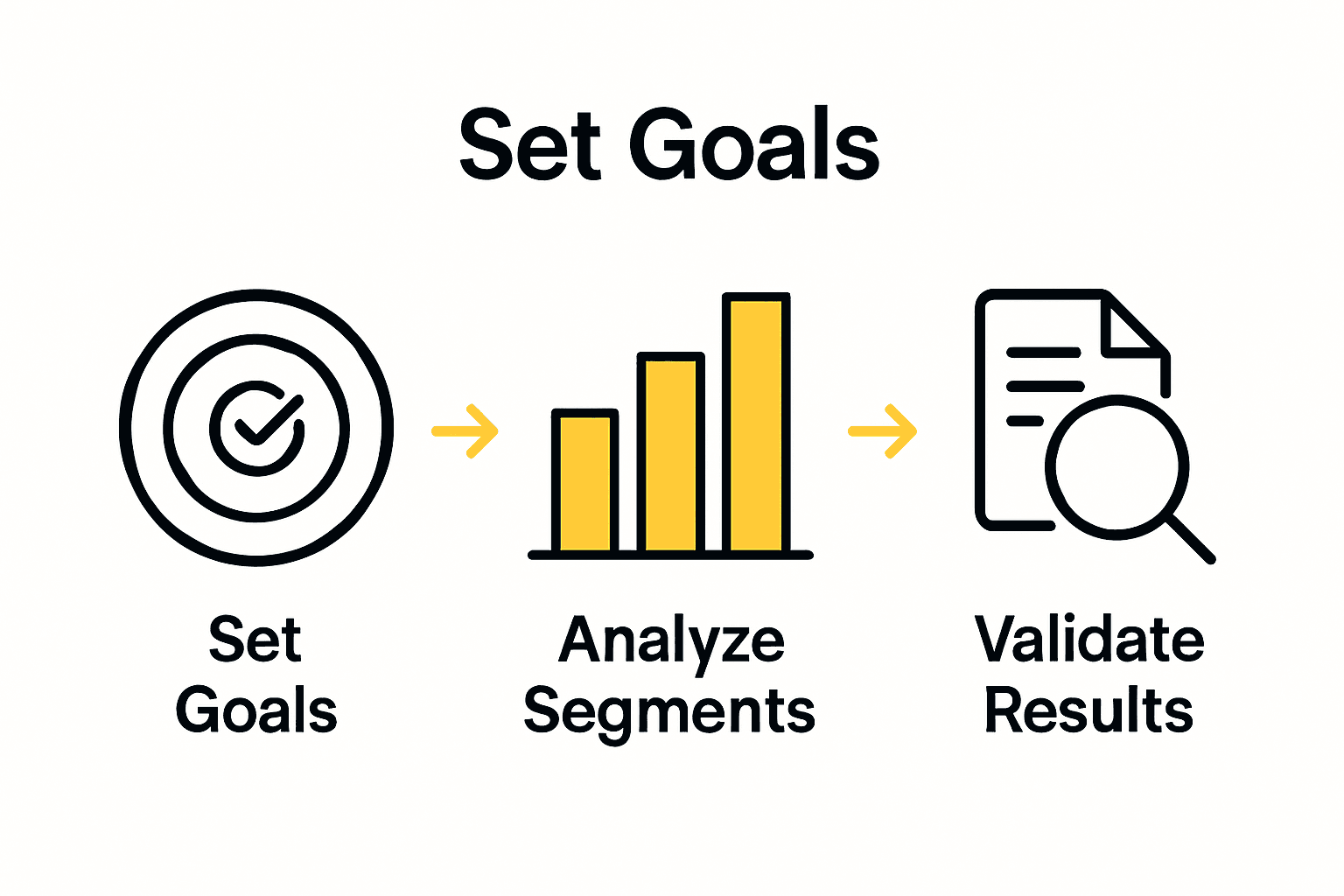
- Step 1: Define Business Goals And Success Criteria
- Step 2: Collect And Organize A/B Test Data
- Step 3: Review Key Metrics And Segmentation
- Step 4: Analyze Statistical Significance And Impact
- Step 5: Validate And Document A/B Test Findings
Quick Summary
| Key Insight | Explanation |
|---|---|
| 1. Set SMART Goals | Establish specific, measurable, achievable, relevant, and timely goals for your A/B testing. Tailor them to your business metrics for effective outcomes. |
| 2. Organize Your Data | Collect and structure both quantitative metrics and qualitative insights systematically. Utilize tracking tools for easy comparison and analysis. |
| 3. Analyze Key Metrics | Review performance metrics and segment data by user traits to uncover insights. Use visualizations to make complex data understandable. |
| 4. Assess Statistical Significance | Calculate p-values and consider multiple metrics to validate your results. Acknowledge effect size as a critical component of your analysis. |
| 5. Document Findings Thoroughly | Create a structured report of your experiments, including methodology and results. A standardized template enhances consistency for future tests. |
Step 1: Define Business Goals and Success Criteria
Setting clear objectives is the foundation of any successful A/B testing strategy. According to lennieandstan, you want to establish goals that are SMART: Specific, Measurable, Achievable, Relevant, and Timely.
Start by pinpointing exactly what business metric you want to improve. This could range from conversion rates and click-through percentages to revenue per user or signup completions. As Wikipedia notes, measurable outcomes like sales conversions are critical for effectively assessing experimental variants. Your goal might look like "Increase checkout conversion rate by 15% within the next quarter" or "Improve landing page signup rate from 2.3% to 3.5% in eight weeks."
Pro tip: Don't just pick an arbitrary number. Ground your goals in historical data and realistic expectations. Analyze your current performance metrics, understand your baseline, and set incremental targets that push your business forward without feeling overwhelming. By establishing precise, data-driven success criteria upfront, you create a clear roadmap for your A/B testing journey.
Once you've defined your goals, you're ready to design experiments that can deliver meaningful insights.
Step 2: Collect and Organize A/B Test Data
Now that you've established clear business goals, it's time to systematically gather and structure your experimental data. According to arxiv, effective A/B testing requires collecting both product metrics and user-centric data to facilitate comprehensive analysis.
Start by identifying the specific data points you'll track. Wikipedia emphasizes the importance of organizing user response data to accurately compare experimental variants. This means capturing quantitative metrics like conversion rates, click-through rates, and average session duration, as well as qualitative insights such as user feedback and interaction patterns. Create a standardized tracking spreadsheet or use an analytics tool that allows you to segment data by test variant, ensuring clean and easily comparable information.
Pro tip: Implement a consistent naming convention for your tests and data files. For example, use a format like "LandingPage_Variant_Date_Metric" that lets you quickly understand the context of each data set. This approach prevents confusion and makes future analysis much more straightforward. By meticulously collecting and organizing your data, you're setting the stage for meaningful insights that can drive real business improvements.

Step 3: Review Key Metrics and Segmentation
With your data collected, it's time to dive deep into analysis. Wikipedia emphasizes the critical importance of examining response rates and segmenting data by various user attributes to uncover meaningful patterns.
Start by comparing the core performance metrics between your test variants. Look beyond surface level numbers and break down results across different user segments like demographics, device types, and user behavior. arxiv highlights that understanding both user-centric and product-level data is crucial for comprehensive analysis. Pay special attention to statistical significance your results might reveal subtle but impactful differences that aren't immediately obvious.
Pro tip: Create visualization dashboards that make complex data digestible. Color code metrics, use comparative charts, and highlight statistically significant variations. This approach transforms raw numbers into actionable insights, allowing you to quickly identify which variant performs best for specific user segments. Remember that context is king transforming data points into strategic recommendations requires nuanced interpretation.
With your metrics reviewed, you're now prepared to draw meaningful conclusions about your A/B test experiment.
Step 4: Analyze Statistical Significance and Impact
Now it's time to transform your collected data into meaningful insights by understanding statistical significance. arxiv introduces innovative approaches for continuous monitoring of A/B tests, enabling more timely and accurate decision-making.
Start by calculating the p-value to determine whether the differences between your test variants are statistically significant. Look for a p-value below 0.05, which indicates a strong likelihood that the observed variations aren't due to random chance. arxiv suggests considering correlations between experiments for even more precise analysis. Pay attention to the effect size the absolute difference in performance between variants matters just as much as statistical significance.
Pro tip: Don't just rely on a single metric. Examine multiple performance indicators to get a comprehensive view of your experiment's impact. Create a weighted scoring system that helps you understand the holistic performance of each variant. This approach prevents you from making decisions based on narrow or potentially misleading data points. By systematically analyzing your results, you'll uncover nuanced insights that can drive meaningful improvements in your marketing strategy.
With statistical significance assessed, you're ready to draw actionable conclusions from your A/B test.
Step 5: Validate and Document A/B Test Findings
Wikipedia emphasizes that documenting your A/B test processes and outcomes is crucial for creating a reliable knowledge base and enabling future improvements. This final step transforms your raw data into a structured narrative that can guide strategic decision-making.
arxiv recommends conducting a systematic analysis to validate your findings before documentation. Create a comprehensive report that includes your initial hypotheses, experimental design, key metrics, statistical analysis, and clear conclusions. Break down the documentation into sections like experiment overview, methodology, results, statistical significance, and actionable recommendations.
Pro tip: Develop a standardized template for your A/B test documentation that ensures consistency across different experiments. Include screenshots, charts, and visual representations of your data to make the insights more digestible. Consider adding a section for potential limitations and future exploration areas. This approach not only validates your current findings but also sets the stage for continuous learning and optimization in your marketing strategy.
With your findings validated and documented, you're equipped to make data-driven decisions that can significantly impact your business performance.
Unlock Clear and Actionable Insights with Effortless A B Testing
Interpreting A B test results can be challenging when you struggle to organize your data and assess statistical significance. The article highlights the need for precise goal setting, meticulous data collection, and careful analysis to generate insights that truly drive business growth. If you find yourself overwhelmed by complex tools or unsure how to turn raw data into meaningful actions the right software can make all the difference.
Save time and remove guesswork with Stellar's A B Testing Tool. Engineered for marketers and growth hackers at small to medium-sized businesses Stellar offers a lightweight script and a no code visual editor that lets you set up experiments fast without slowing down your site. Combine this with advanced goal tracking and real time analytics to review key metrics and validate your findings confidently. Start experimenting smarter and make data driven decisions now by visiting https://gostellar.app and experience how simple interpreting your A B tests can be.
Frequently Asked Questions
What are the key metrics to analyze after an A/B test?
To effectively interpret A/B test results, focus on metrics such as conversion rates, click-through rates, and average session duration. By breaking down these metrics, you can identify which variant performed better and how it aligns with your business goals.
How do I determine if my A/B test results are statistically significant?
Calculate the p-value for your test results; a p-value below 0.05 typically indicates statistical significance. This helps you confirm whether observed differences between variants are likely due to your changes and not random chance.
How can segmentation improve my understanding of A/B test results?
Segmenting data by user demographics, device types, or behavior allows you to uncover meaningful patterns that may be hidden in overall averages. Take action by analyzing results within each segment to tailor your marketing efforts effectively.
What should I include when documenting my A/B test findings?
Your documentation should consist of an overview, experimental design, key metrics, statistical analysis, and actionable recommendations. Create a structured report to ensure that insights are clear and easily accessible for future reference.
How can I use A/B test findings to drive future decisions?
Translate your validated findings into actionable insights by creating targeted strategies based on what worked well in your tests. For example, if one variant increased conversion rates by 15%, implement similar changes across other marketing channels within the next quarter.
Recommended
Published: 11/27/2025