
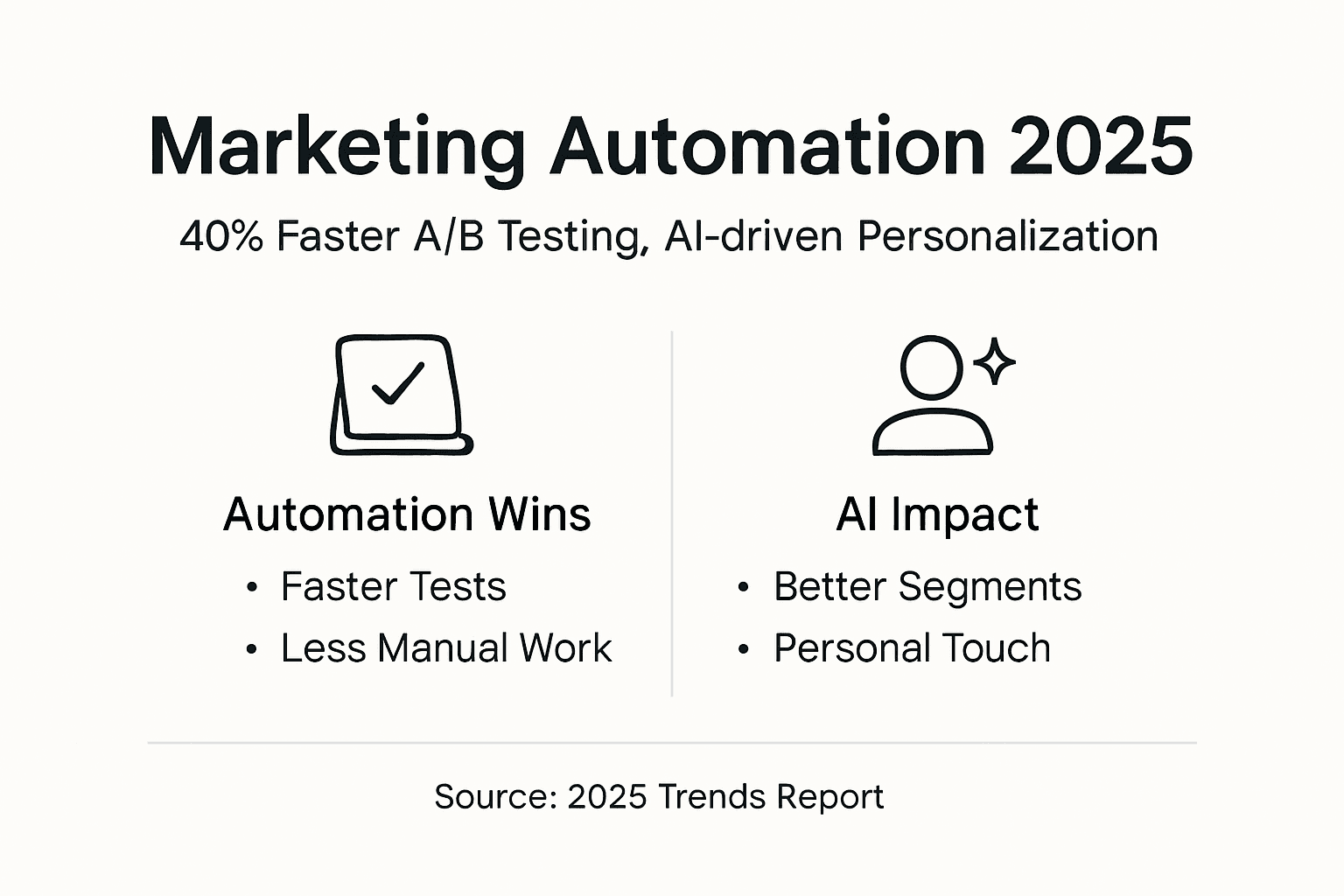
Marketing Automation Trends 2025: 40% Faster A/B Testing
By 2025, 80% of high-performing companies will leverage marketing automation to deliver personalized experiences across every customer touchpoint. For SMB marketers, keeping pace with these rapid changes while optimizing A/B testing and engagement strategies presents both opportunity and challenge. This article explores the most impactful trends: AI-powered personalization, automated testing workflows, and omnichannel integration.
Table of Contents
- Introduction To Marketing Automation Trends In 2025
- AI And Hyper-Personalization In Marketing Automation
- Automation Of A/B Testing: Accelerating Data-Driven Decisions
- Omnichannel Integration: Delivering Unified Customer Journeys
- Segmentation, Targeting, And Privacy Considerations
- Practical Implementation Guidance And Tool Selection
- Common Misconceptions And Challenges In Marketing Automation
- Conclusion: Harnessing 2025 Trends To Boost SMB Marketing Success
- Explore Advanced A/B Testing Solutions For SMB Marketers
- Frequently Asked Questions
Key Takeaways
| Point | Details |
|---|---|
| Adoption Rate | 80% of top companies use automation for personalized multi-channel experiences |
| AI Personalization | Dynamic content adaptation boosts engagement by 20-30% |
| Testing Automation | AI-driven A/B testing cuts manual optimization work by 40% |
| Omnichannel Impact | Unified customer journeys improve retention rates by 25% |
| Privacy Compliance | GDPR and CCPA require first-party data consent in all automation workflows |
Introduction to Marketing Automation Trends in 2025
Marketing automation has evolved from simple email scheduling to sophisticated systems that orchestrate personalized experiences across every channel. For SMB marketers, this evolution matters because 80% of high-performing companies adopt marketing automation for personalized customer experiences across channels. The competitive advantage is clear: automate repetitive tasks, personalize at scale, and make data-driven decisions faster.
The 2025 landscape centers on three core trends. First, AI transforms how you personalize content and predict customer behavior. Second, automation removes bottlenecks from A/B testing and campaign optimization. Third, omnichannel integration creates seamless journeys that keep customers engaged across email, social, web, and mobile.
Industries leading adoption include retail, SaaS, financial services, and healthcare. Each sector faces unique demands, but all share common goals: reduce manual work, increase conversion rates, and improve customer lifetime value. For SMBs, the challenge lies in selecting tools that deliver enterprise capabilities without enterprise complexity or cost.
Key obstacles SMB marketers encounter include:
- Limited technical resources to implement and maintain complex platforms
- Difficulty measuring ROI across multiple channels and touchpoints
- Data silos preventing unified customer views
- Privacy regulations requiring consent management and data governance
- Budget constraints limiting access to premium marketing automation tools in 2025
Understanding these trends positions you to select the right tools, build efficient workflows, and compete effectively against larger competitors with bigger budgets.
AI and Hyper-Personalization in Marketing Automation
AI transforms static marketing campaigns into dynamic conversations. Instead of sending the same email to thousands of subscribers, AI-driven dynamic content personalization boosts engagement by 20-30% by adapting messages based on individual behavior, preferences, and context. The system learns from every click, purchase, and interaction to refine future communications.
Hyper-personalization operates on multiple levels. At the surface level, AI inserts names and company details. At deeper levels, it adjusts product recommendations, content topics, imagery, and even send times based on when each recipient typically engages. Segmented and multi-channel AI-assisted outreach improves response rates by 20-35% and speeds conversions by 15-25%.
The mechanics work through predictive analytics and machine learning models that analyze historical data to forecast future behavior. When a prospect visits your pricing page three times but never converts, AI triggers a targeted email offering a demo or answering common objections. When a customer abandons their cart, the system sends a personalized reminder with social proof or a limited-time incentive.
Key personalization capabilities include:
- Dynamic email content blocks that change based on recipient attributes
- Predictive product recommendations using collaborative filtering
- Behavioral triggers that respond to specific action patterns
- Sentiment analysis to adjust tone and messaging approach
- Next-best-action suggestions for sales teams
Integrating AI-powered personalization and A/B testing creates a powerful feedback loop. Tests identify what resonates with different segments, while AI applies those learnings automatically across campaigns. This combination accelerates optimization and scales personalization beyond what manual processes allow.
Pro Tip: Start with one personalization variable and expand gradually. Testing too many dynamic elements simultaneously makes it impossible to identify what drives results. Begin with subject lines or hero images, measure impact, then layer in additional AI-driven personalization benefits over time.
Automation of A/B Testing: Accelerating Data-Driven Decisions
Traditional A/B testing requires marketers to manually create variants, split traffic, monitor results, and implement winners. This process consumes hours per test and limits how many experiments you can run. Automated A/B testing integrated with AI reduces manual optimization efforts by 40% by handling variant creation, traffic allocation, statistical analysis, and winner deployment automatically.

The automation workflow begins when you define a goal and provide baseline content. AI generates multiple variants by adjusting headlines, calls to action, layouts, or images. The system splits traffic dynamically, sending more visitors to top performers as patterns emerge. When statistical significance is reached, the winning variant automatically replaces the original across all channels.
Real-world impact appears quickly. A/B testing aligned with marketing automation increases email engagement rates up to 15% by continuously optimizing subject lines, preview text, and content layouts. Landing pages see similar gains when automation tests hero images, form lengths, and value propositions simultaneously.
| Testing Approach | Time per Test | Tests per Month | Decision Speed | Manual Effort |
|---|---|---|---|---|
| Manual | 8-12 hours | 2-4 tests | 7-14 days | High |
| Automated | 1-2 hours | 12-20 tests | 2-4 days | Low |
The efficiency gains compound over time. Running three times more tests per month means three times more learnings, faster optimization cycles, and compounding improvements to conversion rates. Each winning test becomes the new baseline for the next experiment.
Integrating AI and automated A/B testing integration with your marketing stack creates seamless workflows. Changes made in your automation platform automatically propagate to landing pages, emails, and ads. Results flow back to inform future campaigns and personalization rules.
Key testing capabilities to prioritize:
- Multi-armed bandit algorithms that optimize traffic allocation in real time
- Sequential testing that runs multiple experiments without waiting for completion
- Segmented testing that identifies what works for different audience groups
- Cross-channel testing that maintains consistency across touchpoints
Understanding A/B testing ROI for SMBs helps justify automation investment. Calculate time saved, conversion lift, and revenue impact to build your business case. Most SMBs see positive ROI within 60-90 days of implementing A/B testing benefits in automation.
Pro Tip: Use visual editors to build test variants without developer support. No-code tools let marketers iterate quickly, test more frequently, and maintain momentum between larger campaigns. This accessibility democratizes testing across your entire team.
Omnichannel Integration: Delivering Unified Customer Journeys
Customers interact with your brand across email, social media, your website, mobile apps, and physical locations. When these channels operate independently, you create disjointed experiences that frustrate customers and waste marketing spend. Effective omnichannel integration leads to 25% higher customer retention by ensuring consistent messaging and seamless transitions between touchpoints.
True omnichannel integration means more than broadcasting the same message everywhere. It requires orchestrating experiences where each channel plays a specific role in moving customers forward. Someone who clicks your Facebook ad sees a landing page that matches the ad's promise. If they don't convert, a personalized email follows up. When they return via Google search, your site remembers their interests and adjusts accordingly.
The technical foundation involves unified customer data platforms that consolidate information from all sources. Every interaction updates the central profile, enabling real-time personalization and coordination. Marketing automation platforms use these profiles to trigger appropriate messages through the right channels at optimal times.
SMBs face specific integration challenges. Legacy systems don't communicate with modern tools. Data exists in separate databases for email, CRM, analytics, and advertising. Budget constraints limit access to enterprise integration platforms. These obstacles lead to manual data transfers, duplicate records, and inconsistent customer experiences.
Best practices for managing omnichannel marketing in SMB context include:
- Start with your two highest-traffic channels and integrate them first
- Use middleware platforms that connect multiple systems without custom coding
- Establish clear data governance rules for how information flows between systems
- Create channel-specific content while maintaining consistent brand voice and offers
- Test cross-channel attribution to understand how channels work together
Successful omnichannel integration benefits extend beyond retention to influence acquisition costs, lifetime value, and operational efficiency. When systems share data automatically, your team spends less time on manual tasks and more time on strategy and creative work.
Segmentation, Targeting, and Privacy Considerations
Effective segmentation divides your audience into groups with shared characteristics, enabling targeted messaging that resonates more deeply than generic broadcasts. AI-driven segmentation increases response rates 20-35% and shortens conversion cycles by 15-25% by identifying patterns humans miss and updating segments dynamically as behaviors change.
AI analyzes dozens of variables simultaneously: demographics, firmographics, behavioral signals, engagement history, and predictive indicators. The system identifies micro-segments with distinct needs and preferences, then recommends optimal messaging strategies, content types, and outreach cadences for each group. As individuals move between segments based on their actions, automation adjusts their treatment accordingly.
Privacy regulations fundamentally reshape how you collect and use customer data. GDPR and CCPA require first-party data collection and consent management in automation workflows, forcing marketers to build transparent, permission-based relationships. The days of purchasing third-party lists and tracking users without consent are ending.
Compliance requires both technical controls and process changes. Your automation platform must track consent status, honor opt-out requests immediately, and provide audit trails for regulatory review. Marketing workflows need consent checks before sending messages, and data retention policies must automatically delete information after specified periods.
Practical compliance tactics for SMB marketers:
- Implement double opt-in for email subscriptions to verify consent
- Add preference centers where subscribers control frequency and content types
- Audit existing data sources to ensure proper consent documentation
- Train teams on privacy principles and platform-specific controls
- Review vendor contracts to ensure processors meet regulatory standards
- Use progressive profiling to gather information gradually rather than overwhelming new subscribers
Building AI segmentation and targeting improvements on a foundation of proper consent creates sustainable competitive advantage. Customers who willingly share information and expect value in return engage more deeply than those acquired through questionable means.
The shift toward data privacy compliance in marketing automation actually benefits SMBs. Smaller, engaged lists of permission-based contacts outperform large lists of disengaged recipients. Focus on quality relationships rather than quantity.
Practical Implementation Guidance and Tool Selection
Selecting the right marketing automation platform determines whether your investment drives growth or creates frustration. SMB marketers need tools that balance powerful capabilities with ease of use, reasonable pricing, and quick time to value. Prioritize platforms offering AI features, seamless A/B test integration, privacy controls, and intuitive interfaces that don't require technical expertise.
Evaluation criteria should include:
- Ease of use: Can marketers build campaigns without developer support?
- AI capabilities: Does the platform offer predictive analytics and automated optimization?
Platform Type Ease of Use AI Features Privacy Tools Typical Cost Best For Stellar Very High Advanced testing Strong $49-199/mo SMBs prioritizing fast, lightweight A/B testing Adobe Marketo Moderate Comprehensive Enterprise-grade $1000+/mo Mid-market teams with technical resources Salesforce Einstein Moderate Predictive AI Comprehensive $1250+/mo Companies heavily invested in Salesforce ecosystem
Implementation best practices accelerate adoption and maximize ROI:
- Start with one use case and expand after proving value
- Map existing workflows before configuring automation rules
- Import clean, deduplicated contact data to avoid garbage in, garbage out
- Set up basic tracking and attribution before launching campaigns
- Train team members on core features through hands-on practice
- Establish governance policies for who can create and modify campaigns
Low-code automation for SMBs removes technical barriers that slow adoption. Visual workflow builders let you map customer journeys, set triggers, and define actions through drag-and-drop interfaces. No coding knowledge required means marketing teams maintain independence and iterate quickly.
Pro Tip: Choose lightweight platforms with minimal performance impact on your website. Heavy scripts slow page load times, hurting both user experience and SEO rankings. Tools that add only 5-10KB to page weight deliver testing capabilities without compromising speed.
Common Misconceptions and Challenges in Marketing Automation
Many marketers hesitate to adopt automation due to misconceptions about complexity, cost, or impact. Understanding reality versus perception helps you make informed decisions and avoid common pitfalls that derail implementations.
Myth: Automation replaces human creativity and strategic thinking. Reality: Automation complements human creativity by handling scale and data but requires human strategy and content creation. Machines excel at repetitive tasks, data analysis, and optimization. Humans provide strategic direction, emotional intelligence, and creative concepts that resonate with audiences.
"The most successful marketing teams use automation to amplify human creativity, not replace it. Technology handles the mechanical work of sending emails and analyzing data, freeing marketers to focus on storytelling, strategy, and building genuine customer relationships."
Myth: Privacy regulations make automation too risky. Reality: Properly configured platforms help you comply with regulations by managing consent, tracking preferences, and enforcing data policies automatically. The risk comes from ignoring regulations, not from using automation.
Myth: Automation requires massive budgets and technical teams. Reality: Modern platforms offer affordable entry points and no-code interfaces that SMB marketers can implement independently. You can start with basic workflows and scale complexity as needs grow.
Common implementation challenges include:
- Data quality issues: Duplicate records, incomplete profiles, and outdated information undermine automation effectiveness
- Overly complex workflows: Starting with ambitious multi-step journeys leads to confusion and abandonment
- Lack of clear goals: Without defined success metrics, you can't measure ROI or optimize performance
- Insufficient testing: Launching automated campaigns without testing creates embarrassing errors at scale
- Team resistance: Staff who fear job displacement or change sabotage adoption efforts
Addressing these challenges requires change management alongside technical implementation. Communicate how automation makes jobs easier, not obsolete. Provide training and support. Start small to build confidence. Celebrate wins to maintain momentum.
Understanding automation misconceptions and realities helps you set realistic expectations and plan for success. Automation is a tool that amplifies your team's capabilities when implemented thoughtfully.
Conclusion: Harnessing 2025 Trends to Boost SMB Marketing Success
The marketing automation landscape in 2025 offers SMB marketers unprecedented opportunities to compete with larger competitors. AI-driven personalization delivers 20-30% engagement gains. Automated A/B testing reduces optimization work by 40% while accelerating decision cycles. Omnichannel integration improves retention by 25% through consistent, seamless experiences.
Success requires embracing experimentation and data-driven decision making. Start with tools that match your current capabilities and budget. Focus on one or two high-impact use cases before expanding. Build on early wins to justify additional investment and organizational support.
The Automation-Personalization-Integration framework provides a clear path forward. Automate repetitive tasks to free time for strategy. Personalize experiences to increase relevance and engagement. Integrate channels to create unified customer journeys. These three pillars support sustainable growth in an increasingly competitive digital landscape.
Explore Advanced A/B Testing Solutions for SMB Marketers
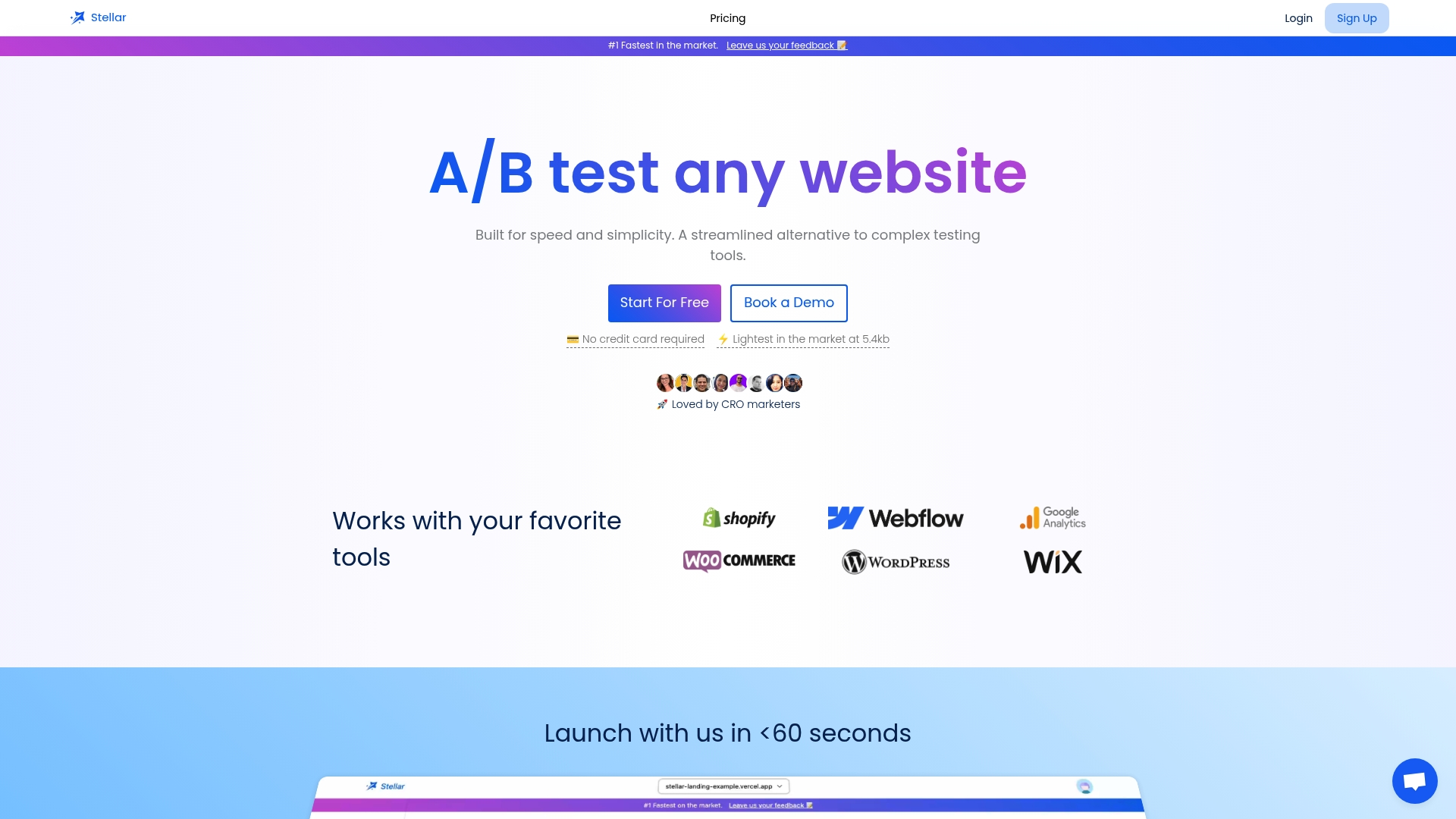
Ready to implement the automation trends covered in this article? Stellar provides lightweight, AI-powered A/B testing tools designed specifically for SMB marketers who need enterprise capabilities without enterprise complexity. Our no-code visual editor lets you create and launch tests in minutes, while advanced analytics reveal exactly what drives conversions.
Explore our comprehensive guides on A/B Testing Explained: Best Practices and Examples to understand core principles, review A/B Testing for Landing Pages: Complete Guide for channel-specific strategies, and compare platforms in our Top 10 A/B Testing Platforms for 2025 roundup.
Frequently Asked Questions
How can SMB marketers start with marketing automation without technical expertise?
Begin with no-code platforms offering visual editors and pre-built templates. Focus on one simple workflow like welcome email sequences or cart abandonment campaigns. Most modern tools provide guided setup wizards and video tutorials that walk you through each step without requiring coding knowledge.
What privacy regulations should SMB marketers prioritize in automated campaigns?
GDPR applies if you market to EU residents, while CCPA covers California consumers. Both require clear consent before collecting data, easy opt-out mechanisms, and transparent privacy policies. Implement double opt-in for subscriptions and add preference centers where subscribers control their data.
How do I measure marketing automation effectiveness beyond open rates and clicks?
Track conversion rates, revenue per email, customer lifetime value, and time to conversion. Monitor engagement velocity (how quickly prospects move through your funnel) and channel attribution to understand which touchpoints drive results. Compare manual campaign performance to automated workflows to quantify efficiency gains.
Can small marketing teams manage multiple automation workflows simultaneously?
Yes, with proper planning and the right tools. Start with two or three core workflows and document each thoroughly. Use templates and cloning features to replicate successful campaigns quickly. Schedule regular audits to pause underperforming workflows and optimize top performers.
What integration capabilities matter most for SMB marketing automation?
Prioritize CRM integration to sync contact data, website analytics to track behavior, and advertising platforms to coordinate messaging. Email service provider connections enable seamless campaign execution. Payment processor integrations help track revenue attribution and identify high-value customers.
Recommended
- Marketing Automation + A/B Testing: Integration Guide for 2025
- Advanced A/B Testing Strategies for CRO Marketers in 2025
- Fast Testing, Fast Results: Speed-Focused A/B Tools for 2025
- Best A/B Test Ideas for Marketers in 2025
- 6 Beispiele für digitale Strategien zur Prozessautomatisierung
- Conversion Optimierung Schritt für Schritt: Mehr Umsatz erzielen
Published: 3/1/2026