
Privacy in web analytics: a 2026 guide for marketers
Marketing professionals face a sobering reality: between 60% and 70% of European visitors reject cookie consent banners, rendering them invisible to traditional analytics platforms. This massive data gap transforms web analytics from a comprehensive intelligence tool into a partial, skewed snapshot. The shift to privacy-first regulations isn't temporary. It's the new normal, demanding fundamental changes in how you collect, analyze, and act on user behavior data. This guide clarifies privacy-first analytics principles and delivers practical strategies to maintain measurement accuracy while respecting user privacy and achieving full regulatory compliance in 2026.
Table of Contents
- The Impact Of Privacy Regulations On Traditional Web Analytics
- Core Principles And Methods Of Privacy-First Web Analytics
- Navigating Consent And Compliance: Effective Privacy Controls In 2026
- Innovative Privacy-Preserving Technologies: Case Study Of Silktide Analytics
- Enhance Your Privacy-Compliant Analytics With GoStellar
Key takeaways
| Point | Details |
|---|---|
| Privacy laws create data gaps | Most European users reject cookies, leaving 60-70% of traffic unmeasured in traditional analytics systems |
| First-party data is essential | Server-side tracking and minimal data collection preserve accuracy while meeting compliance requirements |
| Consent design affects results | Legally compliant banners reduce acceptance rates but lower legal risk and build user trust |
| Cookie-free methods work | Advanced techniques like cryptographic hashing enable visitor tracking without personal data storage |
| Privacy-first tools exist | Modern analytics platforms offer actionable insights without compromising user privacy or regulatory compliance |
The impact of privacy regulations on traditional web analytics
Privacy regulations fundamentally disrupted how marketers measure website performance. When the UK's Information Commissioner's Office implemented GDPR-compliant consent, they experienced a 90.8% drop in tracked traffic. This isn't an outlier. It's the expected outcome when you properly respect user choice.
The data loss creates several critical challenges for marketing teams:
- Incomplete conversion funnel analysis due to missing visitor segments
- Skewed demographic insights favoring privacy-unconcerned users
- Reduced sample sizes compromising A/B test statistical significance
- Attribution modeling failures from fragmented customer journey data
- Campaign ROI calculations based on partial traffic representation
Beyond data accuracy issues, cookie consent mechanisms impose massive productivity costs. Europeans spend 575 million hours annually clicking through consent popups, translating to 14.375 billion euros in lost economic value. This staggering figure reveals consent fatigue driving higher rejection rates over time.
Third-party cookies face extinction across major browsers. Safari and Firefox already block them by default. Chrome's delayed phase-out still signals the end of cross-site tracking as we knew it. Marketers relying on third-party pixels, retargeting pools, and lookalike audiences built from cookie data must rebuild their measurement infrastructure entirely.
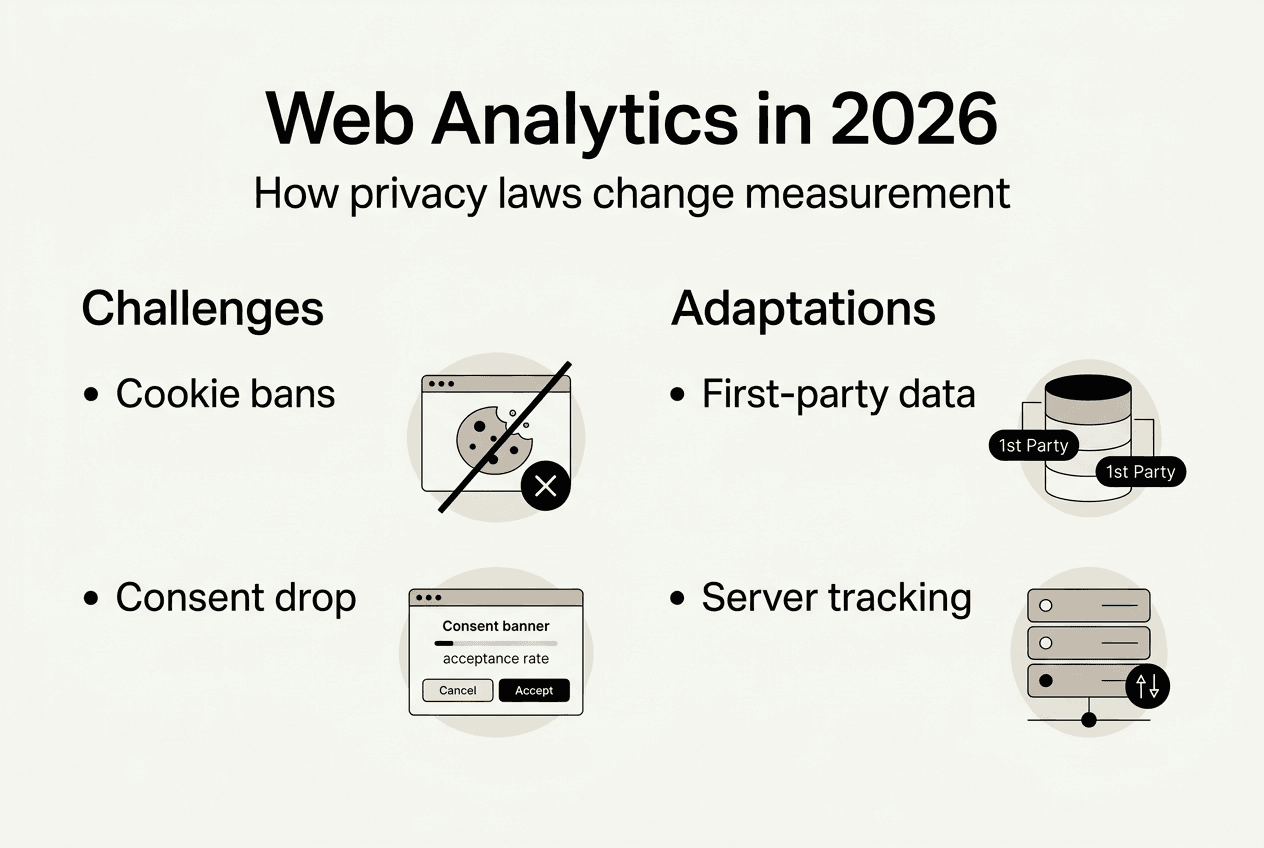
The legal landscape compounds technical challenges. GDPR, ePrivacy Directive, CCPA, and emerging regulations worldwide establish strict requirements for data collection consent. Non-compliance risks substantial fines and reputational damage. Understanding these impacts positions you to adopt privacy focused analytics strategies that maintain measurement effectiveness within legal boundaries.
Traditional analytics platforms designed for unrestricted data collection cannot adapt to this environment without fundamental architectural changes. The solution isn't better consent banners or creative legal interpretations. It requires embracing privacy-first measurement methodologies from the ground up.
Core principles and methods of privacy-first web analytics
Privacy-first analytics focuses on first-party data, minimal collection, and transparency to understand user behavior while respecting individual privacy rights. This approach shifts emphasis from tracking individuals across the web to measuring aggregated patterns within your own properties.

First-party data collection forms the foundation. You gather information directly from users interacting with your website, without relying on third-party cookies or external tracking networks. This data remains under your control, simplifying compliance and improving accuracy since browser restrictions primarily target cross-site tracking mechanisms.
Server-side tracking offers significant advantages over client-side JavaScript tags. Browser tracking protection increasingly blocks client-side analytics, creating data gaps even when users consent. Server-side implementation processes requests on your infrastructure before sending selective data to analytics platforms, giving you complete control over what information leaves your environment.
Minimal data collection means gathering only information necessary for legitimate business purposes. Instead of vacuuming up every available data point, identify specific metrics supporting defined goals. Aggregate behavior patterns rather than building detailed individual profiles. This approach reduces privacy risk, simplifies compliance documentation, and often improves performance by limiting data transfer volumes.
Transparency builds user trust and satisfies regulatory requirements. Clearly communicate what data you collect, why you need it, and how you use it. Make privacy policies accessible and understandable. Provide straightforward mechanisms for users to access, correct, or delete their data.
Implementing privacy-first analytics follows this structured approach:
- Define specific measurement goals aligned with business objectives rather than collecting data opportunistically
- Choose analytics tools designed for privacy compliance with features like automatic PII scrubbing and data minimization
- Implement server-side tracking infrastructure to maintain measurement accuracy despite browser restrictions
- Maintain transparency through clear privacy policies and easily accessible consent management interfaces
- Monitor ongoing compliance as regulations evolve and adjust practices proactively
Pro Tip: Your consent banner design directly impacts data quality and legal risk. Invest in GDPR compliant testing insights to optimize both compliance and conversion measurement accuracy.
The shift to privacy focused analytics strategies doesn't eliminate valuable insights. It refocuses measurement on meaningful patterns while eliminating invasive tracking practices that erode user trust and expose legal liability. Modern privacy-first platforms deliver actionable intelligence without compromising regulatory compliance or user relationships.
Navigating consent and compliance: effective privacy controls in 2026
Consent banner design carries significant legal and practical implications for your analytics data quality. Privacy compliant tracking requires equal prominence for accept and reject options, no pre-checked boxes, and easy withdrawal mechanisms. These requirements fundamentally change user behavior compared to dark pattern designs that nudged universal acceptance.
Legal design principles for compliant consent banners include:
- Equal visual weight and accessibility for accept and reject buttons
- Clear, jargon-free language explaining data collection purposes
- Granular controls allowing users to accept some cookies while rejecting others
- Prominent placement of privacy policy links with detailed information
- Simple withdrawal mechanisms allowing users to revoke consent easily
The impact on consent rates is dramatic. Only about 25.4% of users accept all cookies when presented with a compliant first-level banner in European markets. This represents the true baseline for cookie-based analytics coverage under proper compliance.
Comparing banner approaches reveals the compliance-data tradeoff:
| Banner Design | Legal Compliance | Typical Acceptance Rate | Data Coverage | Legal Risk |
|---|---|---|---|---|
| Pre-checked boxes, hidden reject | Non-compliant | 85-95% | High but legally invalid | Severe fines, enforcement |
| Prominent accept, small reject | Questionable | 60-75% | Moderate with legal uncertainty | Moderate regulatory risk |
| Equal prominence, granular controls | Fully compliant | 20-30% | Lower but legally defensible | Minimal with proper documentation |
| No banner, privacy-first analytics | Compliant (no consent needed) | 100% measurement | Complete with alternative methods | Minimal if properly implemented |
This comparison illustrates why many organizations pursue privacy-first analytics rather than optimizing consent rates. Achieving high acceptance with compliant design proves extremely difficult. Even optimized compliant banners leave 70-80% of traffic unmeasured in traditional analytics.
Compliance reduces legal exposure substantially. GDPR fines can reach 4% of global annual revenue or 20 million euros, whichever is higher. Beyond financial penalties, enforcement actions damage brand reputation and customer trust. The cost of proper compliance pales compared to potential enforcement consequences.
Pro Tip: Review and test your consent mechanisms quarterly as regulations evolve and enforcement guidance develops. What satisfied compliance requirements last year may not meet current standards, and proactive updates prevent costly retrofitting.
Understanding GDPR compliance for marketers extends beyond banner design to encompass data processing agreements, legitimate interest assessments, and data protection impact analyses. Many organizations benefit from dedicated privacy counsel to navigate complex multi-jurisdiction requirements.
The consent landscape will continue evolving. New regulations emerge globally, enforcement agencies refine guidance, and user expectations shift. Building flexible privacy infrastructure that adapts to changing requirements protects long-term measurement capabilities. Consider GDPR compliance in AB testing as you design experimentation programs that respect user privacy while delivering valid results.
Innovative privacy-preserving technologies: case study of Silktide Analytics
Silktide Analytics uses a cookie-free approach, avoiding storing IP addresses or User Agents alongside browsing history. This innovative method demonstrates how advanced cryptographic techniques enable accurate visitor measurement without personal data collection or cross-site tracking capabilities.
The technical implementation relies on cryptographic hashing with rotating salts. Silktide employs a hash with rotating salt to create unique, non-reversible visitor IDs and discards IP addresses and User Agents immediately after hash generation. This approach generates consistent visitor identifiers for return visit detection while making individual re-identification mathematically infeasible.
Here's how it works in practice. When someone visits your site, Silktide captures their IP address and User Agent string momentarily. It combines these with a site-specific salt value and processes them through a one-way cryptographic hash function. The resulting hash becomes the visitor ID. Silktide then immediately deletes the IP and User Agent, retaining only the anonymous hash.
The rotating salt adds an additional privacy layer. Salts change periodically, ensuring visitor IDs cannot be correlated across extended timeframes even if someone obtained hash values. This prevents building long-term profiles while maintaining short-term session and return visit tracking necessary for meaningful analytics.
Comparing traditional and privacy-first tracking methods:
| Tracking Method | Personal Data Stored | Cross-Site Tracking | Visitor Identification | Compliance Complexity |
|---|---|---|---|---|
| Third-party cookies | IP, device ID, browsing history | Yes, across entire network | Persistent across sites | High, requires consent |
| First-party cookies | IP, session data, site behavior | No, single site only | Persistent on single site | Moderate, often requires consent |
| Silktide cryptographic hash | None (hash only, IP/UA discarded) | No, unique hash per site | Session and return visits only | Low, no personal data |
| Server logs only | IP addresses, User Agents | No | Basic session detection | Moderate, IP considered personal data |
Key benefits of Silktide's approach include:
- No personal identifiable information storage eliminates most data protection obligations
- Unique hash generation per website prevents cross-site visitor tracking
- Immediate IP and User Agent deletion reduces data breach exposure
- Cookie-free operation bypasses consent requirements in many jurisdictions
- Mathematical irreversibility prevents re-identification even with hash access
Pro Tip: When evaluating privacy analytics tools, examine their cryptographic privacy features and verify they avoid storing raw personal data. Solutions claiming privacy compliance while retaining IP addresses or device identifiers carry ongoing regulatory risk.
This case study demonstrates that effective analytics doesn't require invasive tracking. Privacy-preserving technologies deliver the behavioral insights marketers need for optimization while respecting user privacy and simplifying compliance. As browser restrictions tighten and regulations expand, these approaches become increasingly essential for sustainable measurement programs.
The Silktide model represents one implementation of privacy-first principles. Other platforms employ different techniques like differential privacy, federated learning, or on-device processing. The common thread is prioritizing privacy protection in system architecture rather than treating it as a compliance checkbox. Exploring personalization without cookies reveals additional innovative approaches to privacy-respectful marketing.
Enhance your privacy-compliant analytics with GoStellar
Navigating privacy regulations while maintaining measurement accuracy requires purpose-built tools designed for the current landscape. GoStellar delivers privacy-focused marketing analytics specifically engineered for marketers and A/B testing specialists managing compliance requirements without sacrificing actionable insights.

Our platform supports full GDPR compliance and adapts to evolving global privacy standards, ensuring your measurement infrastructure remains defensible as regulations develop. GoStellar's lightweight 5.4KB script minimizes performance impact while delivering real-time analytics that inform optimization decisions confidently. The no-code visual editor enables rapid experimentation setup without technical resources, while advanced goal tracking captures conversion events accurately within privacy constraints. Small to medium-sized businesses gain enterprise-grade privacy compliance without enterprise complexity or cost. Explore our privacy analytics strategies to discover how GoStellar transforms privacy challenges into competitive advantages through smarter measurement approaches.
FAQ
What is privacy-first analytics and why does it matter?
Privacy-first analytics focuses on collecting only necessary first-party data while respecting user privacy through minimal data capture and transparent practices. This approach ensures regulatory compliance with GDPR, CCPA, and emerging privacy laws while maintaining useful behavioral insights. It matters because traditional cookie-based tracking faces browser restrictions and legal challenges that compromise data quality and expose compliance risks.
How do consent banner designs impact my data quality?
Legally compliant consent banners with equal prominence for accept and reject options typically achieve only 20-30% acceptance rates in European markets. This means 70-80% of your traffic becomes invisible to cookie-based analytics platforms. Poor consent management drastically reduces usable data while non-compliant designs expose you to substantial regulatory fines and enforcement actions.
What are the advantages of server-side tracking for privacy compliance?
Server-side tracking proves more resilient against ad blockers and browser privacy restrictions that increasingly block client-side JavaScript tags. It allows greater control over what data gets sent to analytics platforms, enabling you to filter sensitive information before transmission. This approach maintains measurement accuracy even as browser-based tracking faces mounting technical and regulatory obstacles.
Can I personalize marketing without using cookies?
Yes, through aggregated first-party data analysis and privacy-preserving visitor identifiers that don't rely on persistent cookies. Cookie-free solutions like Silktide Analytics demonstrate viable approaches using cryptographic hashing to recognize return visitors without storing personal data. These methods enable behavioral segmentation and content optimization while respecting privacy and avoiding consent requirements in many jurisdictions.
Recommended
Published: 3/17/2026