
Segmenting Visitors for Tests: Step-by-Step Strategy Guide
Over 60 percent of American businesses report that inaccurate segmentation leads to wasted marketing spend and missed opportunities. Understanding where your audience truly differs is what separates effective experimentation from guesswork. By focusing on structured segmentation strategies, you can ensure every A/B test delivers insights that truly move the needle, making even complex data actionable for American marketers and product teams.
Table of Contents
- Step 1: Define Segmentation Goals For Your Experiment
- Step 2: Select Visitor Attributes And Data Sources
- Step 3: Configure Audience Rules In Your Testing Tool
- Step 4: Launch Experiments With Targeted Segments
- Step 5: Validate Segment Accuracy And Analyze Results
Quick Summary
| Key Point | Explanation |
|---|---|
| 1. Define clear segmentation goals | Establish specific user behaviors and characteristics to enhance the relevance of your experiments. |
| 2. Focus on key visitor attributes | Choose relevant attributes from available data sources to create impactful segments for your analysis. |
| 3. Validate audience rules before launching | Ensure your audience segments are statistically significant to generate meaningful results from your experiments. |
| 4. Monitor experiments closely | Track traffic patterns and performance in real-time to identify any issues with your segment configurations. |
| 5. Analyze results for actionable insights | Examine segment performance metrics to understand user behavior and make informed marketing decisions. |
Step 1: Define segmentation goals for your experiment
Successful A/B testing starts with crystal clear segmentation goals that transform raw visitor data into actionable insights. Understanding strategic user segmentation enables marketers to create targeted experiments that deliver meaningful results.
To define your segmentation goals effectively, start by identifying the specific user behaviors and characteristics most relevant to your experiment. These might include demographic information like age and location, behavioral patterns such as purchase history or website interaction, or psychographic attributes like user preferences and motivations. The key is selecting segments that will provide statistically significant and meaningful differences in user response. Academic research suggests analyzing consumer decision rules through behavioral inference can help pinpoint the most insightful segmentation criteria.
Pro tip: Avoid creating too many segments. Complex segmentation can dilute your experiment's statistical power and make results harder to interpret. Focus on 3 5 distinct, meaningful segments that represent significant variations in your user base. This approach ensures you gather clear, actionable data without overwhelming your analysis.
Your next step will involve precisely mapping out these segments and preparing them for comprehensive testing and measurement.
Step 2: Select visitor attributes and data sources
Selecting the right visitor attributes and data sources is crucial for creating meaningful segmentation that reveals genuine insights about user behavior. Your goal in this step is to identify the most relevant and informative data points that will help you understand your audience more deeply.

Start by examining the data sources available in your analytics platform. These typically include website analytics tools, customer relationship management systems, user surveys, and behavioral tracking software. Key attributes to consider include geographic location, device type, browser, referral source, engagement history, purchase frequency, and conversion patterns. Look for attributes that demonstrate meaningful differences in user behavior and have enough volume to generate statistically significant results. Pay special attention to attributes that directly relate to your specific experiment objectives.
Pro tip: Quality trumps quantity when selecting visitor attributes. Instead of collecting massive amounts of data, focus on attributes that provide clear, actionable insights. Always ensure you have sufficient sample size for each segment to draw reliable conclusions. This approach prevents data noise and helps you create more targeted, effective experiments.
In the next step, you will map out your selected attributes and prepare them for detailed segmentation analysis.
Step 3: Configure audience rules in your testing tool
Configuring audience rules is the critical bridge between your segmentation strategy and actual experiment execution. This step transforms your carefully selected visitor attributes into precise targeting parameters within your testing platform.
Begin by navigating to the audience configuration section of your A/B testing tool. Most platforms offer sophisticated rule builders that allow you to create complex, multilayered audience segments. Start with broad criteria like traffic source, device type, or geographic location. Then drill down into more nuanced behavioral attributes such as page views, time spent on site, or specific interaction patterns. For example, you might create a segment for mobile users who have visited your pricing page more than twice in the last 30 days but have not completed a purchase. Most modern testing tools provide visual interfaces that make these configurations intuitive and straightforward.
Pro tip: Always validate your audience rules before launching the experiment. Run a quick preliminary check to confirm that your defined segment represents a statistically significant portion of your total traffic. Nothing derails an experiment faster than discovering midway that your audience segment is too small to generate meaningful insights. A good rule of thumb is to ensure each segment contains at least 1000 unique visitors for reliable results.
With your audience rules precisely configured, you are now ready to move forward and design the specific variations for your A/B test.
Step 4: Launch experiments with targeted segments
Launching experiments with targeted segments is the culmination of your strategic planning, where theoretical segmentation transforms into actionable insights. Behavioral user segmentation frameworks provide powerful mechanisms for understanding how different user groups respond to specific variations.
To launch your experiment, begin by verifying your audience rules and segment configurations one final time. Ensure that each targeted segment has sufficient traffic volume and meets your predetermined statistical significance thresholds. Most A/B testing platforms will provide real time traffic allocation insights, allowing you to monitor how your defined segments are being distributed across experiment variations. Causal segment discovery methodologies recommend carefully tracking differential treatment impacts across your identified user subgroups, which helps uncover nuanced insights that generic testing might miss.
Pro tip: Monitor your experiment closely during the initial hours. Watch for any unexpected traffic patterns or segment performance discrepancies that might indicate misconfigured rules. While your segmentation strategy has been carefully crafted, real world user behavior can sometimes surprise even the most meticulous planners.
With your experiment now live, you are prepared to gather meaningful data that will drive informed decision making across your digital platform.
Step 5: Validate segment accuracy and analyze results
Validating segment accuracy is the critical final stage of your experimentation process, transforming raw data into meaningful insights. Personalized treatment selection through causal heterogeneity analysis provides a robust framework for ensuring your segmentation strategy delivers actionable results.
Begin by examining the statistical significance of your experiment across different segments. Review key metrics like conversion rates, engagement times, and specific behavioral variations between your defined user groups. Causal inference methods from observational data can help you estimate the precise impact of your variations on different visitor segments. Pay close attention to segments that demonstrate unexpected performance variations, as these often reveal the most intriguing insights about user behavior. Look for statistically significant differences that suggest meaningful variations in how different user groups interact with your experiment.
Pro tip: Do not rush to conclusions based on initial data. Allow your experiment to run long enough to gather sufficient sample size, and always cross reference your findings with additional contextual information. Some variations might appear significant in early stages but normalize with extended observation.
With your segment accuracy validated, you are now prepared to translate these insights into strategic product and marketing improvements.
Streamline Your Visitor Segmentation and A/B Testing with Stellar
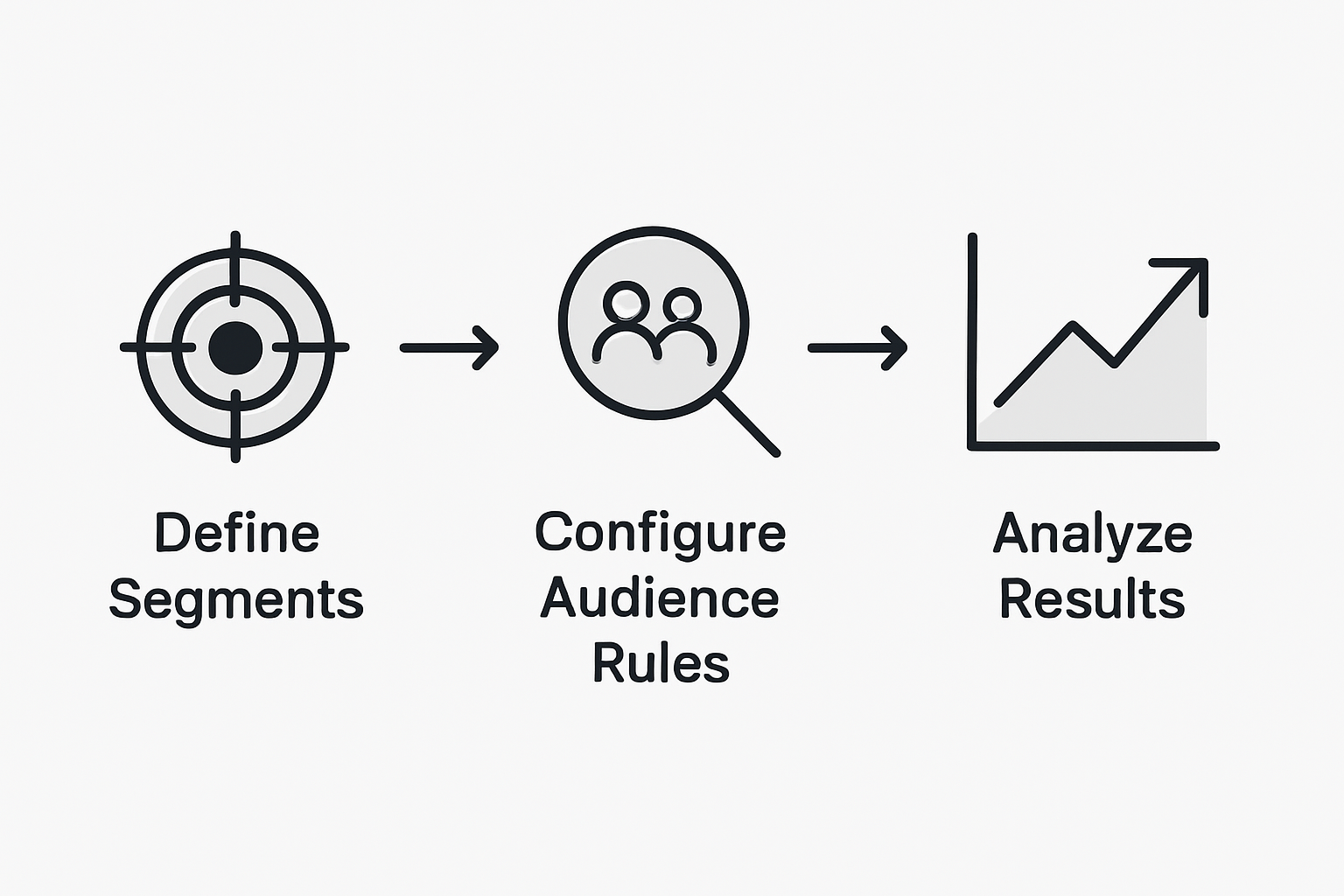
Segmenting visitors precisely as shown in the "Segmenting Visitors for Tests Step-By-Step Strategy Guide" is essential to unlocking actionable insights from your experiments. Yet, defining segmentation goals configuring audience rules and validating segment accuracy can become overwhelming without the right tools. You want to avoid complex setups that drain your time and risk diluting results while ensuring each segment holds statistical significance.
With Stellar's A/B Testing Tool you get a lightweight no-code visual editor designed for marketers and growth hackers who demand powerful segmentation without technical hassle. Benefit from real-time analytics and advanced goal tracking that directly support the detailed audience configurations and validation steps highlighted in the guide. Your experiments will launch faster with less risk of misconfigured segments and more confidence in your data.
Take control of your visitor segmentation today with Stellar at https://gostellar.app. Start optimizing your tests efficiently so you can make smarter growth decisions now. Explore how our platform simplifies every step of your experimentation journey from defining segments to analyzing results all in one place.
Frequently Asked Questions
What are segmentation goals in A/B testing?
Segmentation goals in A/B testing are specific targets that define how you divide your audience based on user behaviors and characteristics. To set effective goals, identify key differences that will allow you to generate meaningful insights from your test results.
How do I choose visitor attributes for my segmentation?
To select visitor attributes, examine the available data in your analytics platform, focusing on key factors like demographic information, device type, and engagement history. Prioritize attributes that highlight significant user behavior differences to enhance the effectiveness of your segmentation.
How can I configure audience rules in my testing tool?
To configure audience rules, navigate to the audience setup in your A/B testing tool and define the criteria based on your selected attributes. Create segments using both broad and specific behaviors, ensuring each segment represents a statistically significant portion of your total traffic before launching your tests.
What steps should I take to launch experiments with targeted segments?
Before launching your experiments, verify that your audience rules and segment configurations are accurate and meet the required traffic volume. Monitor the traffic allocation in real-time to ensure that your defined segments are performing as expected.
How can I validate segment accuracy after my experiment?
Start by analyzing the statistical significance of your results across different segments, looking at metrics like conversion rates and engagement times. Take time to review unexpected variations thoroughly, which may offer valuable insights, and avoid rushing conclusions based on early data.
Recommended
Published: 12/13/2025