
Top Beta Testing Websites: SMB Marketers' Guide to A/B Tools
TL;DR:
- Choose transparent, no-code A/B testing tools suited for SMB traffic volumes and experiment frequency.
- Bayesian testing engines enable faster, more intuitive decision-making for marketers.
- Focusing on simple, consistent headline and CTA tests yields the highest impact and faster insights.
Finding the right A/B testing tool feels overwhelming when you're working with a lean team, a tight budget, and zero patience for tools that require a developer on speed dial. Most platforms promise the world but bury their pricing or demand technical setup that stalls every experiment before it starts. VWO and Convert offer transparent pricing and visual editors that genuinely suit SMB workflows. This guide cuts through the noise by laying out clear criteria, comparing the leading beta testing websites, and helping you make a confident decision fast.
Table of Contents
- How to choose a beta testing platform
- Best beta testing websites for A/B tests
- Statistical engines and testing strategies
- Common pitfalls and real-world impact
- What most guides miss: hard-won lessons for SMBs
- Next steps: Find your ideal A/B testing platform
- Frequently asked questions
Key Takeaways
| Point | Details |
|---|---|
| SMB-friendly platforms | VWO and Convert offer practical pricing and visual editors ideal for marketers without developer support. |
| Sample size matters | Accurate A/B tests demand at least 10,000 monthly visits per variant and pre-calculated sample sizes. |
| Statistical approach impacts speed | Bayesian and sequential testing methods enable faster insights, while Frequentist approaches require more rigor. |
| High-impact tests | Headlines and CTA changes can produce 10–50% conversion lifts, especially when tested with structured methods. |
| Avoid common errors | Steer clear of peeking, novelty effects, and p-hacking for trustworthy results and actionable learnings. |
How to choose a beta testing platform
Not every A/B testing platform is built with SMBs in mind. Enterprise tools often pile on features you'll never use while charging prices that eat your entire growth budget. The right platform for your team needs to hit a specific set of requirements before you even look at the feature list.
Here's what to prioritize:
- Budget transparency: Look for platforms that publish pricing openly. Hidden costs for extra seats, experiments, or traffic overages will surprise you at billing time.
- No-code visual editor: If every test requires a developer, your experiment velocity drops to near zero. A/B testing without dev support is entirely achievable with the right tool.
- Traffic splitting controls: The platform must let you divide visitors evenly between variants. Traffic split 50/50 between variants is the baseline for valid results, and the tool should enforce minimum sample sizes before declaring a winner.
- Metric tracking depth: Goal tracking should cover clicks, form fills, purchases, and custom events without requiring JavaScript expertise.
- Reliable statistical engine: The platform should surface p-values or probability scores clearly so you know when results are trustworthy.
Pro Tip: Before committing to any platform, run a quick traffic check. If your site gets fewer than 20,000 monthly visitors, some platforms will never reach statistical significance in a reasonable test window. Filter your shortlist by minimum traffic compatibility first.
"The biggest mistake SMB teams make is choosing a platform based on feature lists instead of their actual traffic volume and experiment frequency. Match the tool to where you are today, not where you hope to be in two years."
Common pitfalls to watch for include peeking at results before the test reaches its pre-calculated sample size, running too many variants simultaneously, and tracking too many metrics at once. These habits inflate false positive rates and lead to bad decisions. No-code A/B testing tools with built-in guardrails can protect you from some of these traps automatically.
Finally, check whether the platform flags novelty effects, where visitors interact with a change simply because it's new, not because it's better. Good platforms let you set test duration rules to account for this.
Best beta testing websites for A/B tests
Once you know what to look for, compare leading platforms to pinpoint the best fit. Here's how the top options stack up for SMB marketing teams.
| Platform | Starting price | Visual editor | Bayesian stats | Best for |
|---|---|---|---|---|
| VWO | $198/mo | Yes | Yes | Growing SMBs |
| Convert | SMB-transparent | Yes | Yes | Lean teams |
| AB Tasty | Custom quote | Yes | Yes | Mid-market |
| Optimizely | $36K+/year | Yes | No (mSPRT) | Enterprise |
VWO Growth starts at $198 to $314 per month, Convert targets SMBs with transparent tier pricing, and Optimizely starts at $36K per year, making it a poor fit for most SMBs.
VWO
- Strong visual editor with heatmaps bundled in
- Flexible Bayesian engine speeds up decision-making
- Can get expensive as traffic scales
Convert
- Privacy-focused with GDPR-ready architecture
- Clean pricing with no surprise overage fees
- Smaller user community than VWO
AB Tasty
- Good personalization features alongside A/B testing
- Requires a demo to get pricing, which slows evaluation
- Better suited for teams with some experimentation maturity
Optimizely
- Best-in-class feature depth and integrations
- Enterprise pricing makes it inaccessible for most SMBs
- Overkill for teams running fewer than 10 tests per month
Pro Tip: If your team is under five people and running fewer than 20 experiments per year, start with Convert or VWO's entry tier. You can always upgrade as your program matures. Explore headline A/B test ideas to build your first test queue quickly.
Real-world case studies show platforms like VWO and Convert driving subscription lift and click-through rate improvements of 30% or more when teams run disciplined tests. Reviewing A/B test best practices before you start your first campaign will accelerate those results significantly.

Statistical engines and testing strategies
Choosing a platform isn't enough. Understanding the testing logic inside each tool will sharpen your decisions and help you avoid acting on data that looks significant but isn't.
Here are the three main statistical approaches you'll encounter:
- Frequentist testing: Uses p-values to determine significance. Conservative and reliable, but requires a fixed sample size decided before the test starts. Peeking at results early inflates false positives dramatically.
- Bayesian testing: Calculates the probability that one variant is better than another. Faster to act on and more intuitive for marketers. VWO uses a Bayesian engine to speed up decisions without sacrificing confidence.
- Sequential testing (mSPRT): Allows you to peek at results continuously without inflating error rates. Optimizely uses mSPRT to give teams real-time decision-making capability with guardrails.
| Approach | Peeking allowed | Speed | Best for |
|---|---|---|---|
| Frequentist | No | Slow | Low-risk, high-stakes tests |
| Bayesian | Limited | Fast | Agile SMB teams |
| mSPRT | Yes | Fastest | High-traffic continuous testing |
For most SMB marketers, Bayesian testing is the sweet spot. It produces results faster than frequentist methods while remaining interpretable without a statistics degree. If you're experimenting on choosing conversion actions, a Bayesian platform lets you act on early signals without waiting months for a frequentist test to conclude.
"Marketers who understand their platform's statistical engine make better decisions. Blind trust in a 'significant' result without knowing how it was calculated is how budgets get wasted."
Understanding conversion objective types before you set up your test helps you pick the right primary metric and avoid diluting results by tracking too many secondary goals. One test, one primary goal. That discipline pays off every time.
For statistical testing in A/B experiments, the choice of engine directly affects how quickly you can iterate and how much risk you carry with each decision.
Common pitfalls and real-world impact
As strategies become more sophisticated, it's crucial to avoid common testing mistakes and measure success accurately.
The most damaging mistakes SMB teams make are predictable and avoidable:
- Low-traffic traps: Running a test on a page that gets 500 visits per month means you'll wait six months or more for valid data. Always calculate required sample size before you start.
- Peeking: Peeking inflates error rates to 20 to 30%, meaning you're likely to declare a false winner if you check results daily and stop the test early.
- Multiple metrics: Tracking 10 goals simultaneously is p-hacking in disguise. Every additional metric increases the chance of finding a spurious significant result.
- Novelty effects: A new button color might spike clicks for 48 hours simply because it's different. Run tests long enough to capture at least two full business cycles.
- Ignoring inconclusive results: A flat result still tells you the change doesn't hurt performance. That knowledge has value.
The upside of getting this right is real. Industry benchmarks show conversion lifts of 10 to 50% from well-run headline and CTA tests, with some campaigns reporting subscription increases above 100% when testing pricing page copy.
Pro Tip: For revenue-related metrics, use non-parametric tests like the Mann-Whitney U test instead of standard t-tests. Revenue data is almost always skewed by outlier orders, and parametric tests will mislead you.
Explore CTA testing ideas if you want quick wins while you build your testing muscle. Small changes to button text and placement can move conversion rates meaningfully within a single two-week test cycle. Once you have momentum, shift toward improving conversions through more structural page-level experiments.
What most guides miss: hard-won lessons for SMBs
Most comparison articles focus on feature tables and pricing tiers. That's useful, but it misses the real competitive advantage in A/B testing: discipline and simplicity.
The teams that extract the most value from beta testing websites aren't running the most sophisticated experiments. They're running the most consistent ones. Headlines and CTA buttons consistently outperform complex multivariate experiments in terms of speed-to-insight and implementation ease. Start there.
Expert insight backs this up: combining A/B testing with heatmaps and session replays before you write your hypothesis dramatically improves test quality. You're not guessing at what to change. You're confirming friction points with behavioral data first.
Every inconclusive test is still a win if you documented a clear hypothesis and learned something about your audience. The teams that treat flat results as failures stop testing. The teams that treat them as data points keep compounding knowledge.
Understanding the statistical engine differences between platforms matters less than pre-defining your success metric before the test starts. That single habit eliminates p-hacking and makes every result interpretable. For teams without a dedicated statistician, this discipline is the difference between actionable insights and noise. Prioritize landing page testing ideas that can be executed in days, not weeks.
Next steps: Find your ideal A/B testing platform
You now have a practical framework to evaluate, compare, and select the right beta testing platform for your team. The next move is to match what you've learned to your actual traffic volume, team size, and experiment goals.
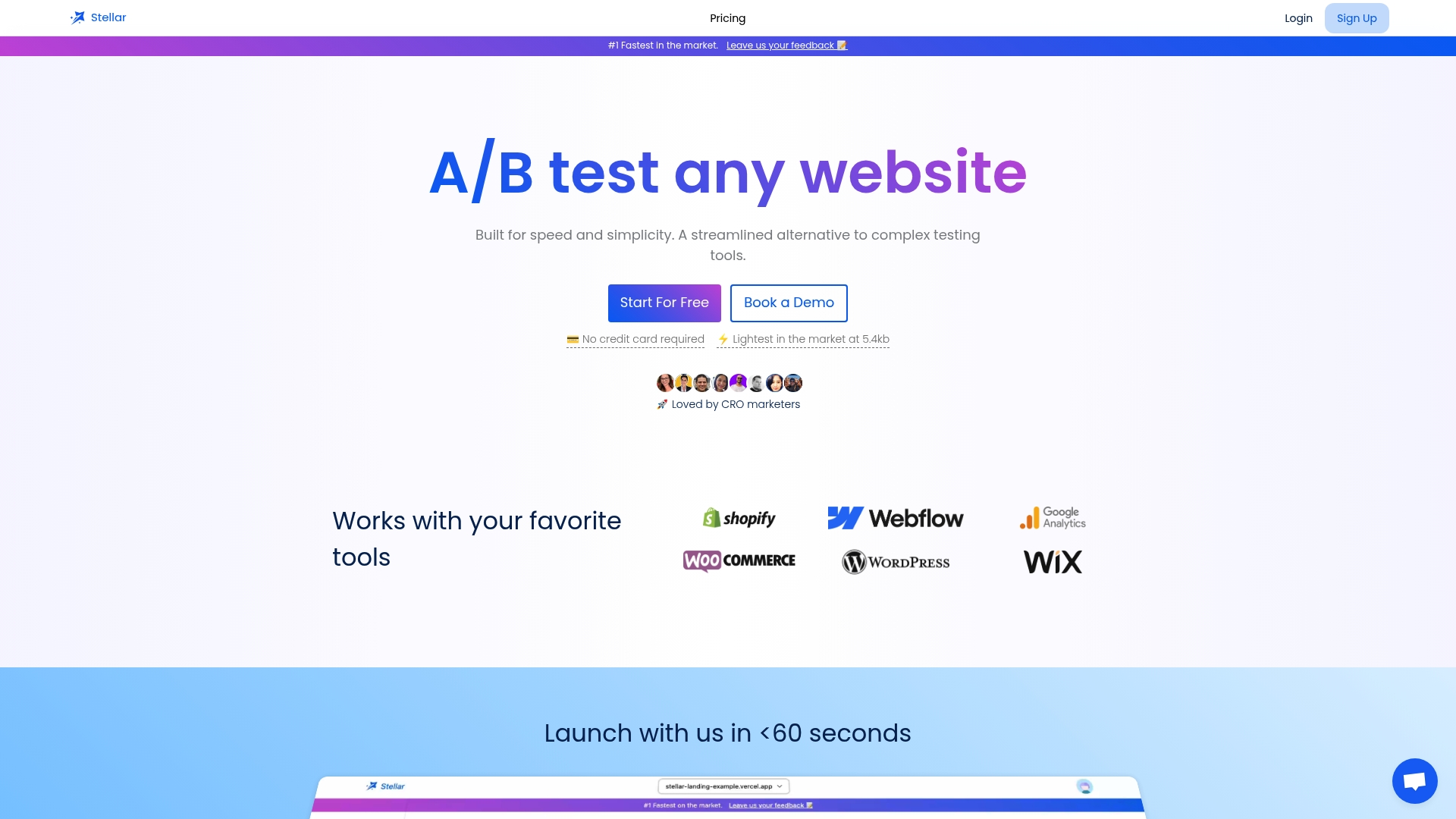
Stellar is built for exactly this kind of SMB workflow. With a 5.4KB script that won't slow your site, a no-code visual editor, and real-time analytics that surface actionable data without a statistics degree, it removes the friction that kills most testing programs before they start. A free plan covers businesses under 25,000 monthly tracked users, so there's no risk in trying it. Explore Stellar beta testing tools and see how fast your first experiment can go live.
Frequently asked questions
What is the minimum website traffic required for valid A/B testing?
Each variant needs at least 10,000 monthly visits for reliable statistical results. Running tests on lower-traffic pages extends test duration to impractical lengths.
Which beta testing website is best for SMBs?
VWO and Convert are recommended for small to medium businesses thanks to clear pricing structures and no-code visual editors that remove the need for developer involvement.
What A/B test elements bring the biggest impact?
Headlines and CTA buttons consistently deliver the fastest and most measurable results. Industry benchmarks show 10 to 50% conversion improvements from well-run tests on these two elements alone.
How can you avoid errors in beta testing?
Always pre-calculate your required sample size before starting, avoid checking results until the test completes, and use non-parametric tests for revenue metrics where data distribution is skewed.
Recommended
- A/B Testing Definition: The Marketer's Guide to Smarter Decisions
- Master website checking site tools for A/B testing success
- A/B Testing Without Dev Support: The Marketer's Handbook
- Master web testing in 2026: boost conversions 20% faster
- Best sales automation examples for e-commerce success | SuperSocial Blog
Published: 4/20/2026