
Run a Real Online Website Stress Test in 10 Steps for Engineers
For a quick smoke test, run a hosted URL tester like Loader.io. For repeatable engineering stress tests tied to CI, use a scriptable framework like k6. For a fast single-endpoint sanity check from the command line, ApacheBench does the job in seconds. Each class answers a different question, and picking the wrong one wastes a test window you may not get back.
TL;DR:
- Use k6 for repeatable, CI-integrated load tests with scripted user journeys and custom metrics, but verify product claims on virtual-user limits.
- Choose Loader.io for quick, single-URL checks when you need a response within minutes, understanding free-tier limits may cut tests short.
- Avoid relying solely on generator capacity by verifying infrastructure headroom, ensuring the load tool does not become a bottleneck before your system does.
- Follow strict testing protocols including authorization, data isolation, realistic scripting, warm-up exclusion, and stepwise ramping to obtain meaningful stress test results.
- Pair load testing with real-user analytics to validate if system improvements genuinely enhance user experience metrics under normal conditions.
Table of Contents
- Curated shortlist: k6, Grafana Cloud k6, Loader.io, ApacheBench
- Step-by-step online stress-test workflow you can run today
- How to choose the right online stress-test tool for your team
- Common pitfalls, generator limitations, and DoS-aware safety and defenses
- An engineer's quick checklist: 6 checks before you trust a test
- Gostellar as a complementary option for experiment and UX validation
- FAQ
- Sources
Curated shortlist: k6, Grafana Cloud k6, Loader.io, ApacheBench
k6 is a scriptable, CI-friendly load testing framework built for engineering teams who need repeatable results, not one-off checks. You write test logic in JavaScript, commit it alongside your application code, and run the same script locally, in a pipeline, or against staging before every release. It supports distributed runners for higher concurrency, and teams add custom business metrics (something like checkout_complete) so a regression in p95 latency can be tied directly to a drop in completed purchases. Treat any vendor-stated virtual-user ceiling as a product claim to verify yourself, not a guaranteed number.
Grafana Cloud k6 takes the same scripting model and removes the operational overhead: it hosts the load generation and gives you dashboards out of the box, so you are not standing up your own distributed runners or wiring Grafana into your pipeline by hand. The trade-off is the usual hosted one: convenience and faster setup in exchange for running tests on someone else's infrastructure rather than your own.
Loader.io sits at the opposite end of the complexity scale. It is a hosted concurrency tester built for quick checks: point it at a URL, set a concurrency level, and get a result in minutes, no scripting involved. Free hosted checkers in this category typically cap requests, duration, or concurrent connections, so treat the output as a smoke signal rather than proof your system survives a real traffic spike, a point worth remembering when free-tier limits, such as caps on total requests, requests per second, and test duration, can cut a test short before it reveals anything.
ApacheBench (ab) is the tiniest tool on this list: a command-line utility that fires concurrent requests at a single endpoint and reports timing and failure stats. It has no scripting model for multi-step user journeys and no browser rendering, but it is trivial to drop into a shell script or automated smoke check. Apache JMeter is the natural next step up from ab when you need a mature, open-source tool that handles both static and dynamic resources with CLI/headless execution for repeatable engineering tests, without committing to a full scripting framework like k6.
A few rules of thumb for picking among them:
- Use Loader.io or a similar hosted checker when you need a same-day answer on a single URL.
- Use k6 when the test needs to live in version control and run the same way every time.
- Use Grafana Cloud k6 when you want k6's scripting model without managing the runner infrastructure.
- Use ApacheBench when you need a five-second concurrency check inside a larger automated script.
Step-by-step online stress-test workflow you can run today
A stress test is only useful if it answers a question you defined in advance. Start there, then work through the mechanics.
- Define objectives and success criteria. Decide what "pass" and "fail" look like before you run anything: a maximum acceptable error rate, a p95 latency ceiling, a recovery time target.
- Compute target concurrency. Pull your real peak traffic from production analytics, then apply a 1.5x to 2x safety multiplier to account for growth and unexpected spikes. If you already track production traffic patterns for SEO or marketing purposes, that same traffic analysis work is a reasonable source for your baseline numbers.
- Get authorization and pick your window. Confirm in writing that you are allowed to run the test, and choose staging or a protected production window rather than guessing it is fine.
- Create test accounts and sanitize data. Never run a stress test against real customer accounts or live payment flows; isolate data so the test cannot mutate production records.
- Script realistic user journeys. Model login, browse, cart, and checkout as a sequence with think time between one and five seconds, parameterized inputs, and deliberate error paths like expired tokens.
- Warm up, then exclude it. Run a brief warm-up period to prime caches and connections, and strip that window out of your final analysis so it doesn't flatter your results.
- Ramp gradually. Step concurrency up in stages with sustain windows at each level, and define a hard stop threshold (error rate or latency ceiling) that halts the test automatically.
- Monitor three layers at once. Watch generator health, backend resource use, and user-facing latency simultaneously, not just one dashboard.
- Analyze percentiles, not averages. Compare p50, p95, and p99 latency, error rate, status code distribution, and recovery time after load drops.
- Correlate and retest. Match backend saturation points to the moment user-facing metrics degraded, fix the bottleneck, and run the same script again to confirm the fix held.
Pro Tip: Parameterize your request paths so their distribution mirrors production ratios; a script that hammers one cached URL will report a deceptively low p99 that has nothing to do with real-world performance.
AWS's foundational guidance on load testing frames a stress test as one that intentionally pushes load past expected peak to find the actual breaking point, the failure mode, and how gracefully the system degrades and recovers, starting below peak and climbing gradually rather than jumping straight to the ceiling.

One figure worth building into your monitoring plan from day one: AWS recommends tracking concurrency, throughput, p50/p95/p99 latency, HTTP status codes, timeouts, error rate, CPU/memory/database saturation, and recovery time as the core metric set for any serious test, not just the single average response time most dashboards show by default.
How to choose the right online stress-test tool for your team
The right tool depends less on brand reputation and more on what your application actually needs tested. Walk through these criteria before picking a product:
- Does the test need real browser rendering, or is a protocol-level HTTP call enough to represent the bottleneck you're worried about?
- How complex are the user journeys? A login-and-browse flow needs scripting; a static landing page doesn't.
- Does the test need to run in CI on every deploy, or is it a one-time check before a launch?
- Do you need distributed generation across regions to simulate realistic geographic traffic, or will a single generator do?
- What do cost and free-tier limits look like against the concurrency and duration you actually need?
- How is test data handled? Confirm the tool isolates test traffic from production data and doesn't log sensitive inputs.
A quick filter: if you need CI integration and results you can diff release over release, pick a scriptable framework like k6. If you need a five-minute answer on whether a single URL survives a concurrency spike, a hosted no-code tester is the faster path. Before committing to any vendor, ask how load is actually generated, which regions it originates from, whether your test data is isolated from other customers, what CI hooks exist, and what the rate limits are on their own service, since several "unlimited" claims turn out to have practical ceilings once you read the fine print.
Common pitfalls, generator limitations, and DoS-aware safety and defenses
The most common failure in online stress testing isn't the target system. It's the generator running out of headroom first. If your load tool's own CPU or network saturates before your application does, you get a false positive that looks like a system failure but is actually a testing-tool limitation; verifying generator capacity or switching to distributed runners fixes this.
Watch for these anti-patterns:
- Hammering a single endpoint with uniform requests, which tests your cache far more than your system.
- Skipping warm-up, which makes early results look worse than steady-state performance.
- Reusing fixed payloads that hit the same cached response every time instead of varied, parameterized inputs.
- Running against production without authorization or a rollback plan.
Because a stress test and a denial-of-service attack look identical from the network's perspective, follow the same precautions OWASP outlines for resilience: get explicit permission, never route load through unapproved third-party services, use dedicated test accounts, and design with rate limiting, connection timeouts, session timeouts, and bulkheads so one overloaded component doesn't take down the rest of the system. Report these same patterns back to engineering as mitigation targets: rate limiting at the edge, horizontal scaling for the component that saturated first, and connection timeouts tuned to fail fast rather than queue indefinitely.
An engineer's quick checklist: 6 checks before you trust a test
Before you act on any stress test result, confirm six things: you had explicit authorization to run it, you validated the generator wasn't the bottleneck, test data was isolated from production, your script included realistic think time, warm-up data was excluded from the final numbers, and backend metrics were correlated against real-user metrics, not just generator output. Keep this as a standing checklist in your team's runbook, and rerun the same script after every fix to confirm the regression is actually gone.
— Juan
Gostellar as a complementary option for experiment and UX validation
Stress testing tells you whether your system survives load. It won't tell you whether a UI change actually helps real visitors, and that's a different job entirely. We built Gostellar as a no-code visual editor for running A/B experiments, with a lightweight script designed to avoid adding measurable drag to page load, plus real-time analytics so you can see how a change performs under normal traffic rather than synthetic concurrency.
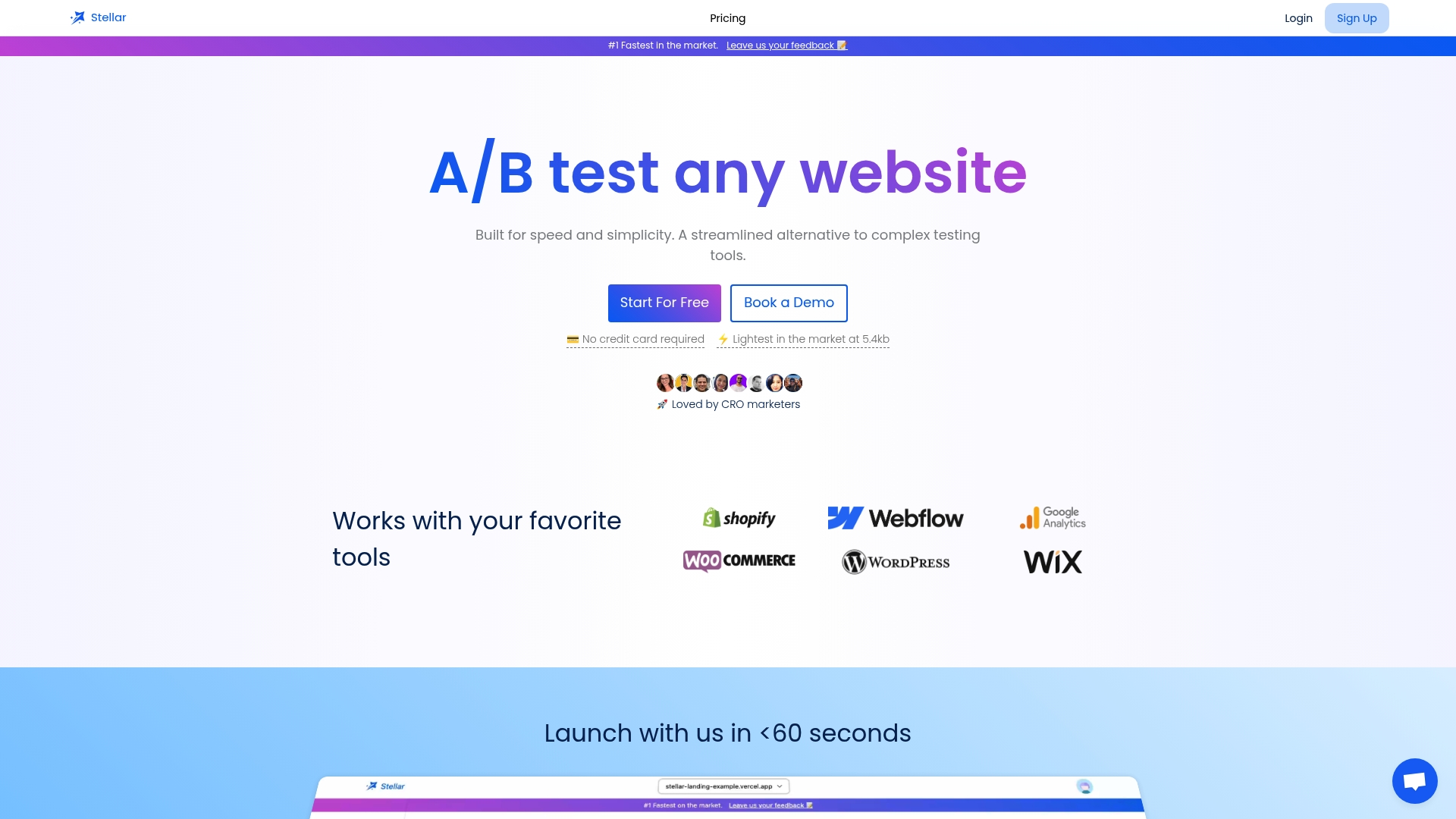
- Pair your load test results with real-user experiment data instead of relying on synthetic metrics alone.
- Launch a test variant without waiting on engineering time or writing a script.
- You can use a free tier if your monthly tracked users fall under the usage threshold.
We are not a distributed load generator and won't replace k6 or a hosted concurrency tester for finding your breaking point. What we do well is the next question: once your system holds up under load, does the change you shipped actually move the numbers that matter to real visitors? Explore Gostellar's plans to see if that fits alongside your existing testing stack.
FAQ
What is the difference between load testing and stress testing?
Load testing checks how a system performs at an expected traffic level, while a stress test intentionally pushes concurrency past that peak to find the actual breaking point and failure mode. AWS's guidance frames stress testing as the method for discovering degradation and recovery behavior, not just confirming normal performance.
How many virtual users should I simulate in a stress test?
Pull your real peak concurrency from production analytics, then apply a safety multiplier of 1.5x to 2x to account for growth and unexpected spikes. The exact number depends entirely on your own traffic patterns, so there's no universal target to copy.
Can I stress test a website for free?
Yes, hosted tools like Loader.io offer free checks for quick, small-scope URL tests, though free tiers typically cap total requests, requests per second, or test duration. For repeatable engineering tests at higher concurrency, open-source frameworks like k6 or Apache JMeter are free to run yourself, though you provide the infrastructure.
Is it legal to stress test a website?
You need explicit authorization from the system's owner before running any load against it, since unauthorized load generation can resemble a denial-of-service attack from the network's perspective. Follow precautions outlined in OWASP's Denial of Service cheat sheet, including testing only systems you own or have written permission to test.
Does Gostellar replace the need for load testing tools?
No, Gostellar is an A/B testing platform for validating UX and conversion changes under normal traffic, not a distributed load generator. Teams typically run it alongside tools like k6 or Loader.io rather than instead of them.
Sources
- Foundational planning for load testing
- Designing realistic test scenarios - Performance Testing on AWS
- Denial of Service - OWASP Cheat Sheet Series
- Free Load Testing Tools & Services
- Apache JMeter™
Recommended
Published: 10/6/2026