
Double Revenue Without More Traffic: Prioritize CRO & AOV for Shopify
The fastest, highest-leverage way to boost ecommerce sales is to extract more value from the traffic you already have by fixing conversion rate, average order value, and retention, in that order, before spending another dollar on new visitors. Nearly 70% of carts get abandoned, and simplifying checkout alone often recovers 10 to 15% of that lost revenue. What follows is a prioritized checklist and testing plan, not a wish list.
TL;DR:
- Fixing checkout issues such as simplifying forms and showing shipping costs early can recover 10 to 15% of abandoned carts quickly.
- Prioritize improving conversion rate and average order value over increasing traffic, as doubling conversion rate from 1.4% to around 2.8% can double revenue without new visitors.
- Optimizing product pages with user reviews and customer photos, especially on high-traffic SKUs, accelerates signification growth through testing.
- Using structured data and reviews to align with AI search tools is increasingly vital as AI-driven discovery traffic grows higher in quality and conversion rates.
- Running small, frequent tests on checkout and product pages with a focus on impact and ease can generate continuous improvement without major redesigns or increased ad spend.
Table of Contents
- How to Increase Ecommerce Sales: A Prioritized Checklist
- What Actually Moves Conversion Rate on Product Pages and at Checkout
- Which Traffic Channels Actually Pay Off in 2026?
- Designing Bundles, Upsells, and Shipping Thresholds That Lift AOV
- Turning One-Time Buyers Into Repeat Customers
- How to Build a Testing Roadmap That Actually Ships Results
- The KPIs Worth Checking Every Day
- Inventory Management and Its Impact on Sales
- Customer Journey Mapping and Optimizing Touchpoints
- Combining Online and Offline Channels Into One Strategy
- Internationalization and Localization: Selling Across Borders
- Pricing Strategy and Dynamic Pricing Models
- Managing Reviews and Social Proof for Maximum Trust
- Why Small, Repeatable Wins Beat Big Bets
- Speed Up the Testing Roadmap With Gostellar
- Sources
- FAQ
How to Increase Ecommerce Sales: A Prioritized Checklist
Most stores chase traffic when the real problem sits somewhere else in the funnel. Before spending on ads, run a quick diagnostic: look at traffic volume, conversion rate, AOV, and repeat purchase rate side by side, and find the one that's dragging the other three down. Fixing the weakest link first tends to produce the biggest return, because you stop pouring visitors into a leaky checkout.
Here's how the tactics stack up by growth lever, with a rough effort/impact rating for each. Use this to pick one to three starting points rather than trying everything at once.
Traffic and discovery:
- Optimize your Google Shopping and product feed data (medium effort, high impact for Shopify stores).
- Build category pages and buying guides targeting purchase-intent keywords (medium effort, medium to high impact).
- Run paid campaigns that test genuinely different creative angles, not just color swaps (low effort, medium impact).
- Structure product content and reviews so AI search tools can recommend you (medium effort, growing impact).
Conversion rate optimization:
- Simplify checkout: fewer fields, guest checkout enabled, shipping cost shown early (low effort, high impact).
- Add trust badges and security signals near the payment button (low effort, low to medium impact).
- Put user-generated photos and review excerpts on product pages (medium effort, high impact).
- Fix page speed issues, especially on mobile product pages (medium to high effort, high impact).
Average order value:
- Set a free shipping threshold above your current average order (low effort, medium to high impact).
- Build bundles priced below buying items separately (medium effort, medium impact).
- Add a one-click upsell on the order confirmation page (medium effort, medium impact).
- Test tiered pricing or volume discounts on consumables (medium effort, variable impact).
Retention:
- Launch a welcome email series segmented by first time versus returning buyer (low effort, high impact over time).
- Build an abandoned cart sequence across email and SMS (low effort, high impact).
- Add a loyalty program or subscribe and save option for repeat purchase categories (higher effort, high long-term impact).
A useful rule: if a tactic touches your checkout or product page, test it first. Those pages carry the most traffic and the clearest signal, so a change there shows results faster than a change buried three clicks deep. That's also where Scaling points teams to start, since checkout and product pages generate the lowest noise to signal ratio in most testing programs.
If you're only picking three things this month, start with checkout simplification, a free shipping threshold adjustment, and an abandoned cart flow. All three are low effort and touch the parts of the funnel where money is already leaking out.
What Actually Moves Conversion Rate on Product Pages and at Checkout
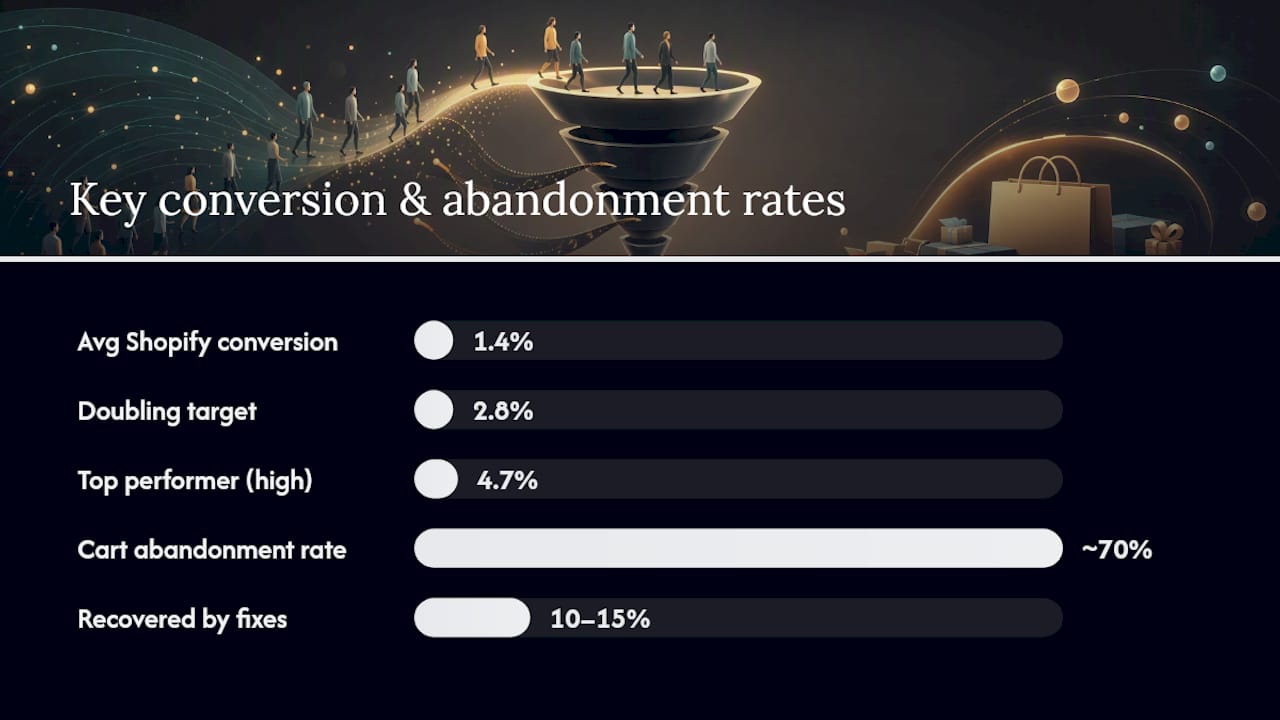
The average Shopify store converts at around 1.4%, while top performers hit 3.2% to 4.7%. Getting from 1.4% to 2.8% doubles revenue without adding a single new visitor, which is why conversion work belongs ahead of traffic spend on any priority list.
Checkout is the highest-leverage page in the store. Baymard's research on cart abandonment puts the average rate at roughly 70%, and much of that is self-inflicted: forced account creation, hidden shipping costs, and too many form fields. Fixing those three issues alone often recovers 10 to 15% of abandoned sales. A practical checklist:
- Offer guest checkout as the default, not an afterthought buried in a menu.
- Show shipping costs and estimated delivery dates before the final payment step.
- Cut form fields to the minimum needed to ship and bill the order.
- Add a progress indicator so shoppers know how many steps remain.
Cart recovery messaging works best on a schedule, not a single blast. A reminder within an hour of abandonment, a small incentive at the 24-hour mark, and an urgency message at 48 to 72 hours cover the three windows where shoppers are still warm enough to come back.
On product pages, the details that move the needle rarely have anything to do with a big redesign. Customer photos next to the studio shots, review counts placed above the fold, and copy that leads with a benefit instead of a spec sheet all pull their weight. Pro Tip: Run your first product page test on the highest traffic SKU in your catalog, not your newest launch. You'll hit statistical significance faster and the lesson usually applies across the rest of the line.
Prioritize A/B tests by traffic volume times expected impact: checkout step count, CTA wording, and shipping cost visibility are the three worth testing before anything cosmetic. For a deeper walkthrough of checkout mechanics, see this checkout optimization guide.
Which Traffic Channels Actually Pay Off in 2026?
Not all traffic is worth chasing equally. For Shopify merchants, optimizing the product feed for Google Shopping can lift qualified traffic by 20 to 40% while cutting cost per click by roughly 28% compared to an unoptimized feed. That's a bigger return than most paid social budgets deliver for the same spend.
A few channels consistently outperform generic traffic buying:
- Category pages and buying guides built around purchase-intent search terms, backed by clean product schema markup.
- Paid campaigns that test structurally different creative angles rather than minor variations on the same ad.
- Branded and high-intent search queries, which convert far better than broad top-of-funnel keywords.
- Product pages and reviews structured so AI-driven discovery tools can surface and recommend them accurately.
That last point matters more each year. AI-referred traffic to US retail sites has grown sharply and converts at a noticeably higher rate than typical search traffic, largely because shoppers arriving through an AI recommendation have already done comparison research. Getting ready for that channel means structured data, detailed product facts, and a visible base of reviews, the same fundamentals that help human shoppers decide. Some ecommerce teams are already documenting how AI tools reshape discovery and SEO in ways that reward stores with clean, structured product content.
Designing Bundles, Upsells, and Shipping Thresholds That Lift AOV
A free shipping threshold set 15 to 25% above your current average order value nudges shoppers to add one more item without feeling like a discount trick. Watch AOV for two to three weeks after adjusting it; if it doesn't move, the threshold may be set too high for your typical basket.
- Offer a higher-tier version of the product being viewed before checkout, not after.
- Add a one-click upsell on the post-purchase thank-you page, since that moment carries no cart abandonment risk.
- Test tiered pricing on consumables and refills where repeat purchase behavior is predictable.
- Compare a bundle offer against a straight percentage discount and a free shipping threshold to see which protects margin best; the answer usually depends on your category and current markup.
Product recommendations and personalization together account for up to 31% of ecommerce revenue at some brands, with personalization delivering a 10 to 15% average lift. That's a strong argument for pairing AOV tactics with a recommendation engine rather than treating them as separate projects.
Turning One-Time Buyers Into Repeat Customers
Retention tactics compound in a way acquisition spend never does, because each retained customer costs nothing to reacquire.
- Send a post-purchase sequence: order confirmation, a usage tip a few days later, a review request once the product has likely arrived, then a relevant cross-sell two to three weeks out.
- Run a welcome series for first-time buyers that differs from your messaging to returning customers, since a first-timer needs trust-building content while a repeat buyer responds better to new arrivals.
- Build a loyalty program or subscription option for anything consumable, where repeat purchase timing is predictable enough to automate.
- Launch win-back campaigns targeted at customers who haven't purchased within your category's typical repurchase window, using a modest incentive rather than a steep discount.
Email and SMS remain some of the highest ROI channels available because the audience already knows the brand. The list segmentation matters more than the design of any single email.
How to Build a Testing Roadmap That Actually Ships Results
Prioritize tests using potential impact multiplied by ease of implementation, and start with product pages and checkout, where traffic is highest and results surface fastest. A practical prioritization matrix built around this exact formula keeps teams from spending weeks on a low-traffic page redesign that never reaches significance.
Top-performing stores run 10 to 20 tests a month, which sounds aggressive until you realize most of those tests are small: a headline, a badge placement, a shipping message. Volume beats perfection here.
- Write a hypothesis before launching anything: "Adding a shipping cost estimate at the cart stage will reduce checkout abandonment."
- Calculate the sample size you need before starting, not after you're disappointed by the result.
- Set guardrail metrics, like revenue per visitor, so a test that lifts conversion but tanks AOV gets caught early.
- Use a consistent attribution window across every test so you're comparing uplift, not noise from a seasonal spike.
Pro Tip: Run parallel tests on unrelated pages, but never run two tests that touch the same page or flow simultaneously. Overlapping tests corrupt your data and make results impossible to trust. Tools like Gostellar's A/B testing guide for Shopify walk through setting up a testing cadence without needing a developer for every experiment.
The KPIs Worth Checking Every Day
Check sessions, conversion rate, and revenue per visit daily or weekly. Review AOV, lifetime value, customer acquisition cost, and repeat purchase rate monthly, since those metrics move slower and need more data to read accurately.
Site speed belongs on that dashboard too. The recommended targets are Largest Contentful Paint under 2.5 seconds and Cumulative Layout Shift under 0.1; missing either one quietly taxes every other metric on the list.
- Analytics: GA4 or your platform's native reporting.
- Session replay tools to see where shoppers hesitate or abandon.
- A/B testing software to validate changes before rolling them out.
- Feed management tools for Shopping campaigns.
- Email and SMS platforms with built-in segmentation.
A minimal dashboard checked weekly, with a deeper monthly review, catches problems before they become quarter-ending surprises.
Inventory Management and Its Impact on Sales
Stockouts don't just lose the sale in front of you, they push shoppers toward a competitor for their next purchase too. An out-of-stock badge on a popular product wastes every dollar spent driving traffic to that page, whether from SEO, paid ads, or an email campaign.
Overstocking carries its own cost. Cash tied up in slow-moving inventory can't fund the bundles, free shipping thresholds, or ad spend that actually move product. The stores that handle this well treat inventory data as a sales signal, not just a warehouse concern: a SKU with rising demand and shrinking stock is a candidate for a price adjustment or a temporary promotion pause, while slow-moving stock is a candidate for a bundle partner.
Syncing inventory data with your product feed matters more than most merchants realize. A Google Shopping ad pointing to an out-of-stock item burns budget and can hurt your feed's overall performance score. Real-time inventory visibility on the product page, showing "only 3 left" style urgency where it's genuinely true, also nudges conversion without any discount involved.
The practical fix is a regular inventory review tied to sales velocity, not just a reorder point set once and forgotten. Products trending up need buffer stock before they sell out; products trending down need a plan before they tie up capital for another quarter.
Customer Journey Mapping and Optimizing Touchpoints
A customer journey map lays out every touchpoint from first ad impression to post-purchase follow-up, and most stores are surprised by how many gaps show up once it's drawn out. A shopper might see a Facebook ad, land on a category page, leave, return through an email three days later, and finally convert on mobile at checkout. Each of those handoffs is a place where friction or inconsistency can quietly kill the sale.
Mapping the journey starts with pulling actual behavioral data, not assumptions: where do sessions drop off, which devices convert worse, and how many touchpoints does a typical buyer need before purchasing? Session replay tools and funnel reports in your analytics platform answer most of that.
Once mapped, the fix usually isn't a single big redesign. It's smaller consistency issues: pricing that doesn't match between the ad and the landing page, a mobile checkout that requires more taps than desktop, or a support channel that's hard to find right when a shopper has a shipping question. Each touchpoint should answer the specific question a shopper has at that stage, whether that's "is this legitimate" on a first visit or "where's my order" after purchase.
Treat the map as a living document. Revisit it whenever you add a channel, a new payment method, or a major product line, since each addition creates new paths through the funnel that deserve their own scrutiny.
Combining Online and Offline Channels Into One Strategy
Stores with a physical location have an advantage online-only competitors can't replicate: the ability to let customers buy online and pick up in store, or return an online order at a physical counter. That flexibility reduces the friction that causes cart abandonment, particularly around shipping cost and delivery time concerns.
Inventory visibility has to be shared across channels for this to work. A shopper who sees "in stock" online and drives to a store that's actually sold out won't come back for a second try. Point-of-sale and ecommerce inventory systems need to talk to each other in close to real time, not on a nightly batch update.
Marketing consistency matters just as much as inventory sync. A promotion running in-store should show up online, and loyalty points earned in person should apply to online purchases and vice versa. Treating the loyalty program as one unified system, rather than two separate ledgers, is what actually gets customers to use both channels instead of picking one and ignoring the other.
For brands without a physical footprint, the equivalent is popup shops, marketplace presence, or social commerce integrations that extend the brand beyond the primary site. The goal is the same either way: meet the customer wherever they already are, rather than forcing every interaction through one channel.
Internationalization and Localization: Selling Across Borders
Currency display alone can make or break a sale from an international visitor. Showing prices in a shopper's local currency, calculated at checkout rather than left in a foreign currency until the final screen, removes a common source of last-minute abandonment.
Language localization goes beyond a translated product description. Sizing charts, measurement units, and even color names carry different associations across regions, and a literal translation sometimes gets the meaning wrong. Reviews and UGC content should be localized too, since a page full of reviews in a language the shopper can't read loses most of its trust-building value.
Regional payment preferences vary more than most US-based merchants expect. Some markets favor bank transfers or region-specific wallets over credit cards, and a checkout that only offers card payment quietly excludes a chunk of otherwise willing buyers. Shipping cost and delivery time transparency matter even more internationally, where customs fees and longer transit times are common abandonment triggers if left unexplained.
Start localization with your highest-traffic international market rather than trying to launch every region at once. A single well-localized market, with the right currency, language, and payment options, usually outperforms a shallow rollout across a dozen countries.
Pricing Strategy and Dynamic Pricing Models
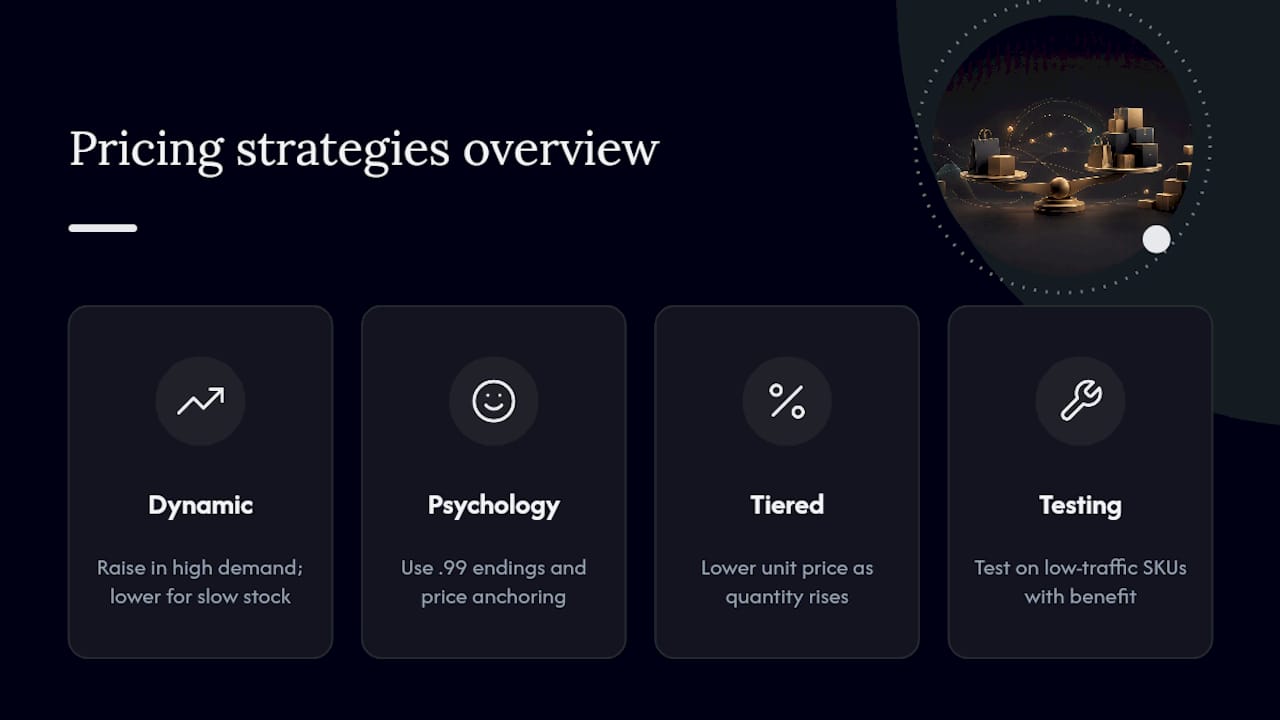
Pricing decisions carry more weight on AOV and margin than almost any other lever, yet many stores set prices once and never revisit them. Dynamic pricing, adjusting prices based on demand, inventory levels, or competitor movement, lets stores capture more margin during high-demand periods and move slow stock without a blanket sitewide sale.
Psychological pricing tactics, like ending prices in .99 or presenting a higher-priced anchor option next to the one you actually want to sell, still work because they change how a price is perceived before the shopper thinks it through logically. Tiered pricing, where cost per unit drops as quantity increases, pushes shoppers toward a larger order without a store wide discount code.
Testing price sensitivity requires care. A blunt price increase without messaging can tank conversion, while a modest increase paired with an added benefit, like a bundled accessory or extended warranty, often gets absorbed without pushback. Run price tests on lower-traffic SKUs first to limit the downside if a change backfires.
Competitor price monitoring matters for categories where shoppers comparison shop heavily, but chasing the lowest price in the market is rarely a sustainable strategy for a smaller store. Differentiating on bundled value, service, or exclusive product lines protects margin better than a price war a bigger competitor can win on volume alone.
Managing Reviews and Social Proof for Maximum Trust
Reviews do more than reassure a hesitant shopper, they directly shape whether a product page converts at all. A product with zero reviews reads as untested, even if the product itself is solid, which is why prompting for reviews right after delivery matters as much as the product page design itself.
Star ratings matter, but the written content of reviews matters more for conversion. Detailed reviews mentioning specific use cases, sizing accuracy, or durability answer the exact questions a hesitant shopper has before adding to cart. User-generated photos alongside those reviews add a layer of trust that studio photography can't replicate.
Managing negative reviews honestly, rather than hiding or deleting them, tends to build more trust than a suspiciously perfect five-star average. A thoughtful public response to a critical review often converts better than silence, since it signals a real business is paying attention.
Surfacing reviews beyond the product page extends their value. Pulling top reviews into ad creative, email campaigns, and category pages puts social proof in front of shoppers before they even reach the product itself, which shortens the path to conversion for anyone already primed by an authentic review from someone else.
Why Small, Repeatable Wins Beat Big Bets
The instinct to chase a dramatic redesign or a big traffic push is understandable, but the stores that grow steadily are the ones documenting small tests and sharing results across teams so nobody re-runs a failed experiment six months later. Conversion and AOV work should come before scaling traffic spend, because a leaky funnel just burns more money faster once traffic increases.
A monthly retrospective, reviewing what was tested, what won, and what's next, keeps the whole program honest and prevents the same idea from getting tested twice by two different people.
— Juan
Speed Up the Testing Roadmap With Gostellar
Every tactic in this playbook, from checkout tweaks to shipping thresholds to product page copy, depends on running fast, reliable tests instead of guessing. A no-code visual editor lets marketers launch experiments without pulling in a developer, and a lightweight script keeps the test itself from slowing down the page you're trying to improve.
Dynamic keyword insertion helps personalize landing pages for different traffic sources without building separate page versions by hand, and real-time analytics show whether a test is trending toward significance before you've committed weeks to it. Stores under 25,000 monthly tracked users can start on the Sandbox plan at $0 per month, which covers the basics needed to start testing checkout flows, product page copy, or shipping messaging today. Paid tiers, Plus, Pro, and Scale, unlock more tracked users and advanced goal tracking as testing volume grows. If social proof is your next quick win, the free FOMO popup generator is worth trying alongside your first test. Set up your first experiment on Gostellar this week and turn one item from the checklist above into a running test.
Sources
FAQ
What Is the Fastest Way to Increase Ecommerce Sales?
Simplifying checkout is usually the fastest win, since reducing steps and form fields can recover 10 to 15% of abandoned carts within weeks of launching the change.
How Does Checkout Design Affect Ecommerce Sales?
Checkout friction is a leading cause of the roughly 70% average cart abandonment rate; guest checkout, upfront shipping costs, and fewer fields directly reduce that drop-off.
How Should I Prioritize Which Tactics to Test First?
Rank tactics by potential revenue impact multiplied by ease of implementation, and start with checkout and product pages, since they carry the most traffic and the clearest test signal.
What KPIs Should I Track to Know If Sales Are Improving?
Watch conversion rate and revenue per visit weekly, and AOV, lifetime value, and repeat purchase rate monthly; a tool like Gostellar can help track conversion lift directly from live experiments.
How Can I Increase Ecommerce Sales Without Increasing Ad Spend?
Focus on conversion rate, average order value, and retention first, since doubling conversion rate from 1.4% to 2.8% doubles revenue without adding a single new visitor.
Recommended
Published: 9/16/2026