
Conversion Optimization SEO: A Practical Playbook
Conversion optimization SEO means increasing how many of your organic visitors take a real action, like requesting a demo or starting a trial, without touching the rankings that brought them there. Done right, it turns existing organic traffic into pipeline instead of requiring you to chase more of it.
- Who this is for: B2B marketers and growth teams already ranking, but leaking revenue on the click-through.
- Where to start: high-traffic organic landing pages, not your whole site.
- What powers it: GA4 segmentation to find the leak, Core Web Vitals to make sure fixes don't cost you rankings.
The first move is simple: find pages with strong organic sessions and weak conversion rates. That gap is where the money is.
Key Takeaways
SEO-aligned conversion optimization works by targeting high-traffic organic pages with low conversion rates first, then testing changes that respect search intent and technical performance standards.
| Point | Details |
|---|---|
| Prioritize by upside, not traffic alone | Multiply organic sessions by the gap between benchmark and current conversion rate to rank pages. |
| Protect Core Web Vitals during tests | Keep LCP under 2.5 seconds and CLS under 0.1 so speed fixes don't undo ranking gains. |
| Combine quantitative and qualitative data | Pair GA4 segmentation with heatmaps and session recordings to know both where and why visitors drop off. |
| Wait for statistical confidence | Reach roughly 95% confidence and adequate sample size before declaring a test winner. |
| Use a lightweight testing tool | Gostellar's 5.4KB script and no-code editor let teams launch SEO-safe tests without a performance tradeoff. |
Table of Contents
- What Conversion Rate Optimization Means for Organic Pages
- Why SEO and CRO Have to Work as One System
- A 6-Step Workflow for SEO-Safe Conversion Testing
- How to Prioritize Which Pages to Fix First
- What to Measure: GA4, Search Console, and Pipeline Metrics
- Reading the Signals Heatmaps and Recordings Reveal
- Getting the Statistics Right Before You Call a Winner
- On-Page Changes That Convert Without Hurting Rankings
- The Technical Foundation: Speed, Core Web Vitals, and Schema
- Structuring the Team So This Never Stops
- What Actually Moves the Needle (And What Doesn't)
- A Faster Way to Run These Tests
- Frequently Asked Questions
- Sources
What Conversion Rate Optimization Means for Organic Pages
Conversion rate optimization (CRO), applied to organic traffic, is the discipline of increasing the share of your search visitors who complete a defined action, filtered specifically to sessions that arrived through organic search rather than paid or direct. Moz defines the core formula as conversions divided by unique visitors, multiplied by 100.
Conversion rate = (Conversions ÷ Unique Visitors) × 100
A page with 5,000 organic visitors and 150 conversions converts at 3%. The trick is choosing the right conversion event for the page's intent. Common ones include:
- Demo or consultation requests
- Free trial signups
- Gated content downloads (whitepapers, templates)
- Direct purchases
- Email or newsletter captures
- Micro-conversions: click-to-call, video plays, CTA clicks
Why SEO and CRO Have to Work as One System
SEO gets people to the page. CRO decides what happens once they're there. Treat them as separate departments and you end up with pages that rank beautifully and convert at near zero, or pages tuned for conversion that quietly lose their rankings because someone stripped the content SEO needed. SEO and CRO function as a single system: the traffic-generation engine and the revenue engine share the same real estate.
That's not a traffic problem. It's a page-design problem sitting on top of traffic you already paid to earn through months of content and links.
Pro Tip: Before running a single test, pull your organic landing pages report and sort by sessions. The pages at the top of that list, if their conversion rate is weak, are your fastest path to revenue this quarter.
Pages with 1,000-plus monthly organic sessions and sub-1% conversion rates are the highest-leverage CRO targets in almost any B2B funnel.
A 6-Step Workflow for SEO-Safe Conversion Testing
- Set conversion goals per page intent. A comparison page should drive demo requests; a top-of-funnel blog post should drive email captures or content downloads, not a hard sales pitch.
- Identify high-leverage pages. Cross-reference organic sessions against conversion rate to find where traffic and underperformance overlap.
- Gather quantitative and qualitative data. Pull GA4 segments for the page, then layer in heatmaps and session recordings to see what visitors actually do.
- Form a hypothesis that respects intent. "Visitors bounce because the CTA doesn't match what they searched for" is testable. "Change the button color" usually isn't worth the effort.
- Run the experiment. Use A/B or multivariate testing with SEO-safe implementation, meaning no client-side rendering tricks that hide content from crawlers.
- Review, roll out, and iterate. Winning variants become the new baseline. Everything else feeds your next round of hypotheses.
Pro Tip: Document losing tests too. A test that shows a shorter headline doesn't help is still information; it stops your team from re-testing the same idea eighteen months from now.
This process mirrors standard CRO methodology: collect data, hypothesize, test in priority order, then analyze and refine.
How to Prioritize Which Pages to Fix First
Not every underperforming page deserves your team's time this month. Prioritize using a simple upside formula:
- Calculate the gap. Take your category benchmark conversion rate and subtract the page's current rate.
- Multiply by traffic. Organic sessions × (benchmark rate − current rate) = estimated monthly conversion upside.
- Rank and triage. A page with 8,000 sessions and a 2-point gap outranks a page with 1,200 sessions and a 4-point gap.
Example: a pricing page pulling 6,000 organic sessions a month at a 1.5% conversion rate, against a category benchmark of 5% for B2B SaaS pricing pages, has a 3.5-point gap. That's roughly 210 additional conversions a month sitting on the table.
Export your GA4 landing page report filtered to organic traffic, add conversion rate and device segment columns, and sort by this calculated upside instead of raw traffic. Pro Tip: Anything over 1,000 monthly organic sessions with a rate below your category benchmark goes to the top of the backlog, full stop.

What to Measure: GA4, Search Console, and Pipeline Metrics
Getting the metrics right matters as much as the test itself. Track these, filtered to organic where relevant:
- Organic sessions and engaged sessions per landing page
- Conversion rate, filtered strictly to organic traffic
- Assisted conversions (organic often opens the door; another channel closes)
- Click-through rate from the SERP, plus impressions and clicks in Search Console
- Conversion value per organic visitor
GA4's event-based tracking lets you scope goals precisely instead of relying on generic pageview counts, and exporting to BigQuery opens up path analysis you can't get from the standard interface.
Pro Tip: Build one recurring dashboard that walks straight through organic traffic to conversions to pipeline value to closed revenue. If a page's traffic is climbing but pipeline value isn't, you've found your next test candidate.
Roughly 70% of tracked B2B conversions involve some form of assisted path, which is exactly why single-touch attribution undersells organic's real contribution.
Reading the Signals Heatmaps and Recordings Reveal
Numbers tell you where visitors drop off. Heatmaps, scroll maps, click maps, session recordings, and on-page surveys tell you why.
- Scroll maps show whether visitors ever reach your CTA, or bail before it loads into view.
- Click maps reveal when people try to click something that isn't clickable, a sign your page structure is confusing them.
- Session recordings catch the exact moment someone hesitates on a form field and abandons.
- On-page surveys ask directly what's stopping someone from converting, which is faster than guessing.
Scroll depth, click concentration, and recorded hesitation points turn a vague "conversion rate is low" into a specific, testable hypothesis, like moving the CTA above a scroll threshold most visitors never cross.
Getting the Statistics Right Before You Call a Winner
The single most expensive CRO mistake is declaring a winner too early. Aim for 95% statistical confidence before you trust a result, and plan for roughly 1,000 visitors per variant where traffic allows it.
Success metrics need to map to revenue, not clicks.
Avoid these common testing mistakes:
- Stopping a test the moment it looks good, before it reaches significance
- Running tests on pages with too little traffic to ever reach meaningful sample size
- Ignoring device and traffic-source segmentation, which can hide a losing variant inside a winning average
- Skipping seasonality checks on pages with cyclical demand
- Making DOM changes so aggressive that search crawlers see something different from what visitors see
That last one is where CRO quietly becomes an SEO liability, so any test touching headline structure or core content needs a rollback plan.
On-Page Changes That Convert Without Hurting Rankings
Your H1 should lead with the benefit the searcher wants, not a restatement of the product name. If someone searched "reduce cart abandonment," your headline should promise exactly that outcome, not describe your software category.
Stick to one primary call to action per page, repeated at the top, mid-page, and again at the end, using direct action language rather than vague phrases like "learn more." For informational content that isn't ready for a hard CTA, offer a lighter micro-conversion instead, like a content download.
Trust signals, client logos, certifications, review counts, work best placed near the fold and rendered as real crawlable HTML rather than an image, so they support both visitor confidence and E-E-A-T signals.
Forms convert better with fewer fields. If you need more data over time, use progressive profiling instead of a ten-field form on the first visit, and track exactly where visitors abandon the form to find the specific friction point.
Pro Tip: Test your primary CTA copy before you touch anything visual. Copy changes tend to move conversion rate more than color or button shape ever will.

The Technical Foundation: Speed, Core Web Vitals, and Schema
Site speed is a conversion variable dressed up as a technical one. Core Web Vitals thresholds, Largest Contentful Paint under 2.5 seconds, input delay under 100 milliseconds, and Cumulative Layout Shift under 0.1, protect rankings and patience in the same move.
- Compress and lazy-load images above and below the fold
- Enable browser caching and serve assets through a CDN
- Minify CSS and JavaScript to cut render-blocking time
- Add FAQ or Product schema so the SERP snippet itself pre-qualifies clicks before they even land
A one-second delay in load time is often enough to noticeably drag down conversion rate on mobile, where patience runs shortest. Check your technical checklist against both rankings and revenue, not just PageSpeed scores.
Structuring the Team So This Never Stops
CRO dies when it's treated as a quarterly sprint instead of a habit. Assign clear ownership: SEO flags pages by traffic and intent risk, content and design build hypotheses, product or engineering runs experiments, and analytics validates results before rollout.
- SEO and analytics jointly identify the monthly priority list.
- Content and design draft two to three testable hypotheses per page.
- Engineering implements with SEO-safe code, no hidden content, no cloaking.
- Analytics reports results against the 95% confidence threshold.
- The group reviews together and rolls winners into the backlog for the next cycle.
Your monthly dashboard should track experiment velocity, win rate, and revenue impact, not just how many tests ran. That reporting rhythm is what keeps SEO and CRO working as one motion instead of two teams fighting over the same page.
What Actually Moves the Needle (And What Doesn't)
The mistake I see most often is teams testing cosmetic changes on pages that were never going to convert regardless of button color, while the actual problem, a three-second mobile load time or a headline that doesn't match search intent, sits untouched. Fix the boring stuff first.
Ignoring assisted conversions is the second big one. A blog post that never directly converts but shows up in 40% of paths to a closed deal isn't a failure. It's doing exactly its job, and killing it because a shallow attribution model marks it as zero-value is a real mistake.
The moves that consistently pay off: pick pages with real commercial intent and real traffic, fix mobile speed before anything else, and get GA4 attribution accurate before you trust any test result. When you present results upward, tie every win to pipeline or revenue. A stakeholder remembers "12 more demo requests a month" far longer than "conversion rate improved."
A Faster Way to Run These Tests
Everything in this playbook, prioritizing pages, forming hypotheses, running clean A/B tests, hinges on having a testing tool that doesn't fight you on setup speed or page performance. That's the exact gap Gostellar was built to close: a 5.4KB script light enough to avoid dragging down the Core Web Vitals scores you just spent a section fixing.
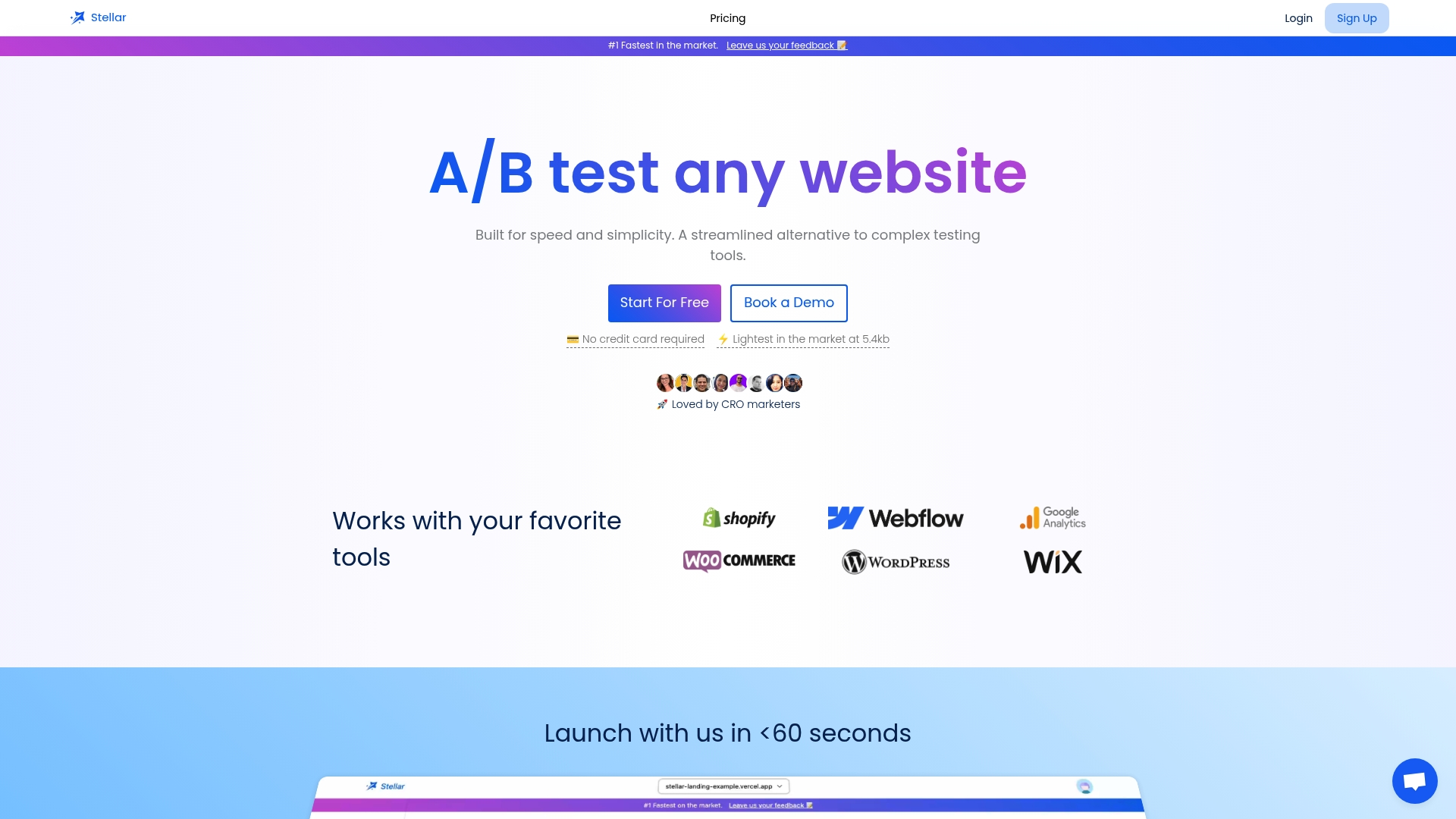
The no-code visual editor means a marketer can launch a headline or CTA test without waiting on an engineering sprint, and dynamic keyword insertion lets you personalize landing pages to match search intent without building a separate URL for every variant. Goal tracking connects directly to the conversion events you're already measuring in GA4, so results show up in real time instead of buried in a weekly export. Businesses under 25,000 monthly tracked users can run this on Gostellar's free plan. If your prioritization list from earlier in this article has three pages ready to test, start a free trial and get the first one live this week.
Frequently Asked Questions
What is conversion optimization SEO? It's the practice of improving how many organic visitors convert on a page while keeping the content and technical elements search engines reward intact. The goal is more revenue from the traffic you already rank for, not more traffic.
How do you calculate conversion rate for organic pages? Divide organic conversions by unique organic visitors, then multiply by 100. Always filter the underlying report to organic sessions specifically, since blending in paid or direct traffic skews the number.
Will A/B testing hurt my SEO rankings? Not if it's implemented correctly. Avoid cloaking, keep content visible to crawlers during the test, and use a lightweight testing script so page speed and Core Web Vitals stay stable.
Which pages should I optimize first? Pages with strong organic traffic and conversion rates below your category benchmark. A high-traffic page converting poorly represents faster upside than a low-traffic page converting well.
What tools do I need for SEO-safe CRO? GA4 for quantitative measurement, a heatmap or session recording tool for qualitative insight, and an A/B testing platform with a minimal script footprint so testing itself doesn't become a speed liability.
Sources
- SEO Conversion Optimization: A Framework for Turning Search Traffic Into Revenue
- What Is Conversion Rate Optimization? How To Calculate CRO - Moz
- SEO conversion rate optimization: strategies for CRO success
- Google Analytics
Recommended
Published: 8/15/2026