
How to Increase Online Sales with A/B Testing Tools
Finding the real roadblocks to online sales growth can often feel like trying to navigate an unfamiliar city in the dark. For digital marketers and growth hackers, understanding how your website truly performs is the first vital step to smarter A/B testing. By focusing on systematic performance evaluation across core metrics and harnessing proven, no-code solutions, you gain the clarity needed to turn insights into increased conversions and lasting results.
Table of Contents
- Step 1: Assess Current Website Performance
- Step 2: Identify High-Impact Sales Opportunities
- Step 3: Implement A/B Testing for Key Pages
- Step 4: Optimize User Experience and Personalization
- Step 5: Analyze Results and Refine Strategies
Quick Summary
| Key Point | Explanation |
|---|---|
| 1. Assess Website Performance | Analyze load time, response time, and user metrics to establish a baseline for improvement. |
| 2. Identify Sales Opportunities | Focus on conversion rates and customer behavior to find key areas for revenue growth. |
| 3. Implement A/B Testing | Conduct controlled experiments on vital pages to discover effective design and content changes. |
| 4. Optimize User Experience | Personalize content based on user data to enhance engagement and increase conversions. |
| 5. Analyze and Refine Results | Systematically interpret A/B test data to inform future strategies and improve sales outcomes. |
Step 1: Assess Current Website Performance
Successfully increasing online sales starts with a comprehensive understanding of your current website performance. Your goal in this step is to establish a baseline of metrics that will guide your A/B testing strategy.
Begin by analyzing critical performance indicators across multiple dimensions. Systematic performance evaluation requires examining key metrics that directly impact user experience and conversion potential:
- Load Time: Measure how quickly your pages render
- Page Size: Assess total data transferred
- Response Time: Track server reaction speed
- User Experience Metrics: Evaluate navigation ease and interaction quality
To conduct a thorough assessment, utilize professional web analytics tools that provide comprehensive insights. These tools help you understand:
Here's how essential website performance metrics influence sales outcomes:
| Performance Metric | Business Impact | Improvement Example |
|---|---|---|
| Load Time | Lower bounce rates | Optimize image sizes |
| Page Size | Faster mobile experience | Minimize resource files |
| Response Time | Enhanced trust | Upgrade server infrastructure |
| User Experience Metrics | Increased conversions | Simplify navigation layout |
- Current conversion rates
- Traffic sources and user behavior
- Mobile vs desktop performance
- Potential bottlenecks in user journey
Website performance isn't just about speed—it's about creating a seamless, trustworthy experience that encourages visitors to convert.
Consider benchmarking your website against industry standards to identify areas for improvement. Professional performance assessment involves examining strategic, functional, and experiential quality factors.
Pro tip: Run multiple performance tests at different times of day to get a comprehensive view of your website's consistent performance and identify potential variability.
Step 2: Identify High-Impact Sales Opportunities
Identifying high-impact sales opportunities is crucial for maximizing your online conversion potential. In this step, you'll learn strategic approaches to pinpoint the most promising areas for driving revenue growth through targeted A/B testing.
Start by analyzing your current sales funnel and identifying predictive sales patterns. Focus on metrics that reveal critical conversion points:
- Conversion Rate: Track percentage of visitors becoming customers
- Average Order Value: Measure typical transaction size
- Abandoned Cart Rate: Understand potential revenue loss points
- Customer Lifetime Value: Assess long-term revenue potential
To uncover high-impact opportunities, leverage advanced analytics techniques:
- Review user behavior heat maps
- Analyze conversion funnels
- Segment customer data by demographics
- Identify highest-performing product categories
Not all sales opportunities are created equal. Strategic focus matters more than broad-based approaches.
AI-driven opportunity identification can help you discover nuanced insights about potential high-value prospects. Modern sales strategies require dynamic, data-informed approaches that adapt to changing digital engagement patterns.
Pro tip: Cross-reference multiple data sources to validate potential sales opportunities and avoid making decisions based on isolated metrics.
Step 3: Implement A/B Testing for Key Pages
Implementing A/B testing for your most critical website pages is a strategic approach to systematically improve online sales performance. Your goal is to create controlled experiments that reveal exactly what design and content changes drive higher conversion rates.
Advanced A/B testing methodologies require careful planning and precise execution. Focus on testing key website elements that directly impact user decision-making:
- Product Pages: Test image layouts, description formats, and call-to-action placements
- Checkout Process: Experiment with form designs and payment options
- Landing Pages: Modify headline structures and visual hierarchies
- Navigation Menus: Refine label clarity and positioning
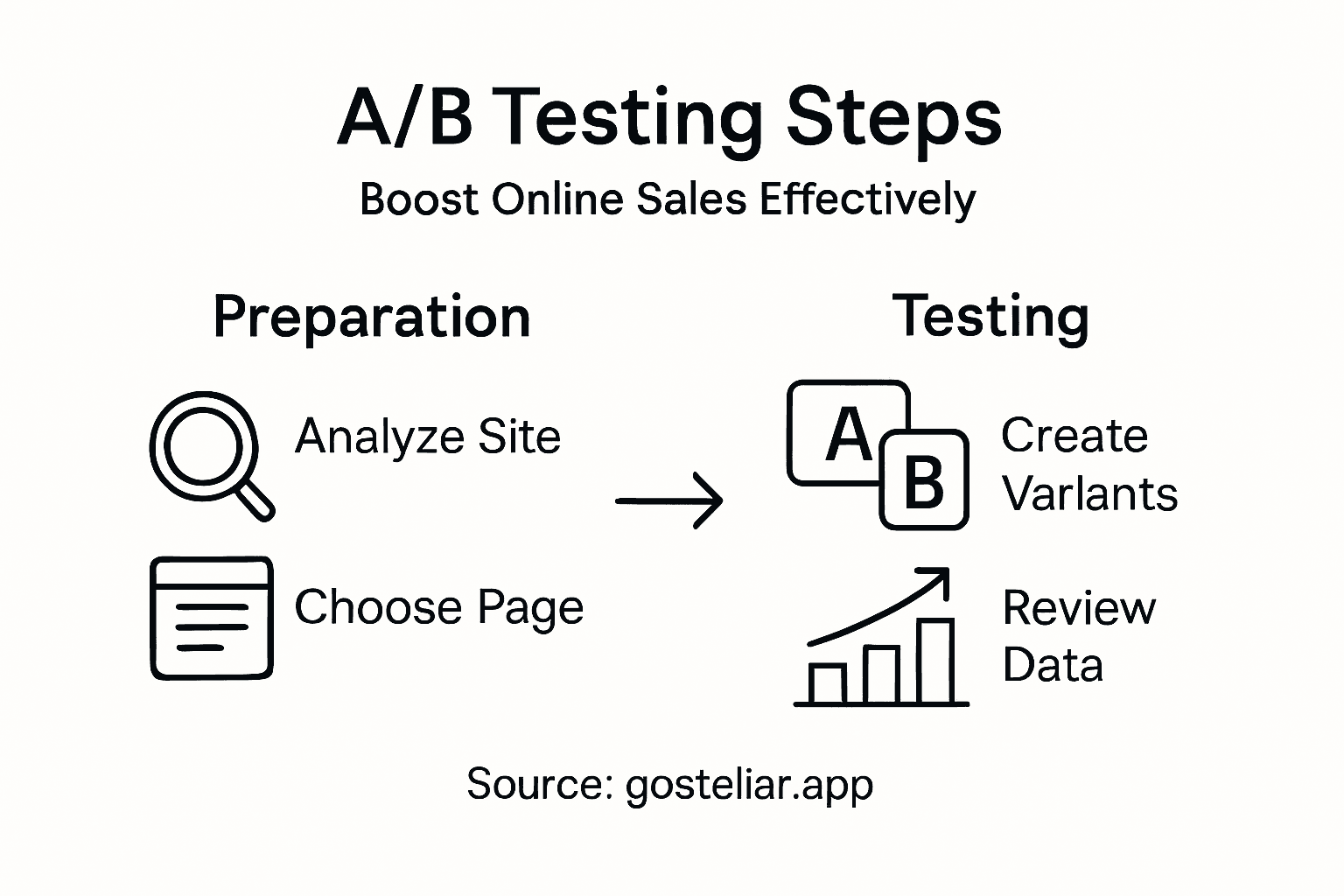
To conduct effective A/B tests, follow these structured steps:
- Select a specific page or element to test
- Develop a clear hypothesis about potential improvements
- Create two distinct versions (A and B)
- Define precise success metrics
- Determine statistical significance thresholds
Successful A/B testing is about strategic experimentation, not random guesswork.
Anytime-valid inference techniques can help you monitor test results more dynamically, allowing for more flexible and accurate optimization strategies. This approach enables continuous learning and rapid adaptation of your website's performance.
Below is a summary of advanced A/B testing techniques versus traditional methods:
| Approach | Key Benefit | Data Analysis Style |
|---|---|---|
| Traditional A/B Test | Clear pass/fail outcome | Fixed test duration |
| Anytime-Valid Inference | Dynamic optimization | Ongoing test monitoring |
| Segment Analysis | Tailored insights | Group-specific results |
Pro tip: Run tests for a minimum of one complete business cycle to account for potential variations in user behavior across different days and times.
Step 4: Optimize User Experience and Personalization
Optimizing user experience through strategic personalization is crucial for transforming website visitors into loyal customers. Your mission is to create a tailored digital environment that speaks directly to individual user preferences and behaviors.
AI-driven personalization strategies enable remarkable improvements in customer engagement and conversion rates. Focus on implementing personalization across multiple dimensions:
- Product Recommendations: Leverage machine learning algorithms
- Dynamic Content: Adapt page elements based on user history
- Personalized Search: Customize search results for individual users
- Targeted Messaging: Craft contextually relevant communication
To effectively personalize user experiences, follow these key strategies:
- Collect and analyze comprehensive user data
- Segment your audience into distinct persona groups
- Create tailored content for each segment
- Continuously refine personalization algorithms
- Maintain transparent data usage policies
Personalization is not about overwhelming users with information, but delivering precisely what they need.
Personalized ranking techniques can transform your approach to customer engagement, extending beyond simple product recommendations to create holistic, individualized user journeys.

Pro tip: Always provide clear opt-out mechanisms and be transparent about data collection to build user trust while personalizing experiences.
Step 5: Analyze Results and Refine Strategies
Analyzing A/B testing results is a critical process that transforms raw data into actionable insights for increasing online sales. Your goal is to interpret test outcomes systematically and develop strategic refinements that drive meaningful performance improvements.
Comprehensive result analysis requires a structured approach to understanding test performance. Break down your analysis into key strategic dimensions:
- Statistical Significance: Validate result reliability
- Conversion Rate Impact: Measure direct performance changes
- Segment-Level Insights: Uncover nuanced user behavior patterns
- Comparative Performance: Evaluate variant effectiveness
To effectively interpret and act on your A/B test results, follow these essential steps:
- Calculate statistical significance
- Compare key performance indicators
- Identify unexpected insights
- Document learnings for future tests
- Implement winning variations
Data without interpretation is just noise. True optimization comes from understanding the story behind the numbers.
Advanced testing metrics provide deeper insights into test performance, helping you move beyond simple win/lose scenarios to understand complex user interaction dynamics.
Pro tip: Always run multiple test iterations and avoid making permanent changes based on a single experiment's results.
Unlock Higher Online Sales with Stellar's Fast and Easy A/B Testing Solutions
The article highlights the challenge marketers face when trying to increase online sales through A/B testing without compromising website performance or spending excessive time on setup and analysis. Key pain points include tracking meaningful conversion goals, minimizing load times to prevent user drop-off, and personalizing experiences to boost customer engagement. If you want to simplify experimentation with a powerful yet lightweight tool designed specifically for small to medium-sized businesses, the Stellar A/B Testing Tool answers that call.
Stellar combines a user-friendly visual editor, dynamic keyword insertion, and advanced goal tracking to help you run precise A/B tests effortlessly. Its 5.4KB lightweight script ensures your site stays fast while delivering real-time analytics so you can confidently identify winning variants and optimize your sales funnel. Don’t settle for slow or complicated platforms when you can enhance your user experience and conversion rates now with Stellar.
Looking to put the insights from this article into action? Try Stellar at https://gostellar.app and see how smooth and effective A/B testing can be.
Start increasing your online sales today with Stellar’s fast, no-code solutions. Visit Stellar to begin your free plan and unlock your website’s full potential.
Frequently Asked Questions
How can A/B testing tools help increase online sales?
A/B testing tools enable you to compare different versions of web pages to determine which performs better in driving conversions. Start by testing key elements like headlines or call-to-action buttons to optimize user engagement and improve sales results within weeks.
What metrics should I focus on when conducting A/B testing for sales?
Focus on metrics such as conversion rate, average order value, and abandoned cart rate. By measuring these key performance indicators, you can identify areas for improvement and increase your online sales by analyzing changes in user behavior.
How do I determine which web pages to A/B test?
Identify critical web pages that play a significant role in your sales funnel, such as product pages and the checkout process. Prioritize testing for these pages to maximize impact and potentially increase conversions by 10-30% based on test outcomes.
What is the ideal duration for running an A/B test?
Run A/B tests for at least one complete business cycle to gather sufficient data on user behavior over time. This allows you to make informed decisions and ensures that the results are statistically valid and reliable.
How do I analyze the results of A/B testing effectively?
Analyze results by calculating statistical significance and comparing key metrics between the variants tested. Ensure you document learnings and insights to refine future experiments and improve your overall online sales strategy.
How can I personalize user experiences using A/B testing?
Personalize user experiences by using A/B testing to experiment with tailored content, product recommendations, and targeted messaging. Implement changes based on user data to enhance engagement and potentially boost sales by effectively meeting individual customer needs.
Recommended
Published: 2/3/2026