
Interpreting Conversion Metrics: Complete Guide
Over 80 percent of business leaders say conversion rates directly impact their marketing ROI. Yet many still struggle to define which metrics truly matter and how to measure them correctly. In digital marketing, understanding conversion metrics is essential for tracking progress and making informed decisions. This guide breaks down the key concepts, reveals different types of conversion metrics, and helps you discover meaningful ways to analyze and apply these numbers for stronger results.
Table of Contents
- Defining Conversion Metrics And Key Concepts
- Types Of Conversion Metrics Explained
- How To Calculate And Analyze Conversions
- Extracting Actionable Insights From Data
- Common Pitfalls When Interpreting Metrics
Key Takeaways
| Point | Details |
|---|---|
| Importance of Conversion Metrics | Conversion metrics provide critical insights into user engagement and business performance, guiding marketing strategies. |
| Types of Conversion Metrics | Key categories include performance, financial, and growth-oriented metrics that enable nuanced analysis of user behavior. |
| Calculation of Conversion Rates | Accurately calculating conversion rates involves defining goals, tracking traffic, and segmenting data for deeper insights. |
| Common Pitfalls in Analysis | Businesses should be cautious of channel misattribution and focus on both quality and context of conversions to avoid misguided strategies. |
Defining Conversion Metrics and Key Concepts
In the dynamic world of digital marketing, conversion metrics serve as the compass guiding businesses toward understanding user engagement and business performance. According to GeekforGeeks, conversion rate measures the percentage of users who complete a desired action out of the total number exposed to a product or service.
At its core, a conversion represents a meaningful interaction that transforms a passive website visitor into an active participant. MetricHQ explains that conversions are strategic actions users take during a specific period, indicating a transition from mere browsing to purposeful engagement. These actions could range from purchasing a product and signing up for a newsletter to downloading a resource or completing a form.
Key conversion metrics typically track several critical interactions:
- Purchase Conversions: Tracking completed sales transactions
- Lead Generation: Measuring form submissions or contact requests
- Engagement Metrics: Monitoring newsletter sign-ups, content downloads, or webinar registrations
- Sign-up Conversions: Tracking new account or trial registrations
Understanding these metrics requires a nuanced approach. While raw numbers provide insight, the true value lies in contextualizing these metrics against specific business goals. Conversion Tracking for Beginners: 2025 Guide for Marketers can offer deeper strategies for interpreting these crucial performance indicators effectively.
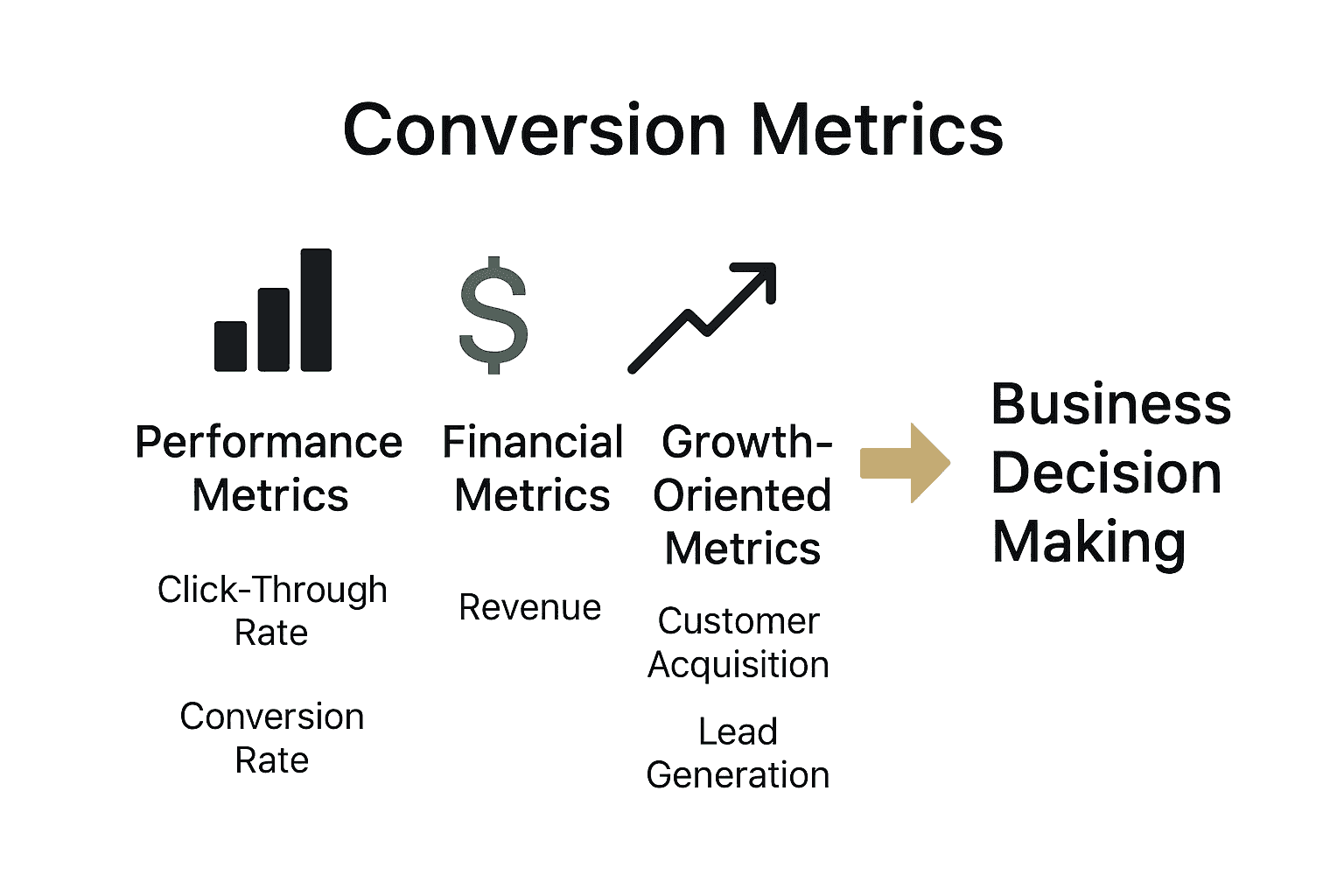
Types of Conversion Metrics Explained
Conversion metrics represent a diverse toolkit for understanding user behavior and marketing effectiveness. According to GeekforGeeks, these metrics encompass several critical dimensions that help businesses track performance across different stages of user interaction.
Based on GeekforGeeks' research on user acquisition metrics, key conversion metrics can be categorized into several essential types:
- Performance Conversion Metrics:
- Sales Conversion Rate: Percentage of leads transformed into actual customers
- Lead Conversion Rate: Number of potential customers becoming qualified leads
- Click-Through Rate (CTR): Ratio of users clicking on a specific link to total users viewing
- Financial Conversion Metrics:
- Customer Acquisition Cost (CAC): Total expense of acquiring a new customer
- Cost Per Click (CPC): Amount spent for each click in digital advertising
- Cost Per Impression (CPM): Marketing cost per thousand potential customer views
- Growth-Oriented Conversion Metrics:
- User Growth Rate: Speed and scale of new user acquisition
- Channel Attribution: Understanding which marketing channels drive most conversions
- Subscriber Conversion Rate: Percentage of visitors becoming email or service subscribers
While these metrics provide valuable insights, the real power lies in understanding how they interconnect.
 Conversion Rate Benchmarks 2025: What Marketers Must Know offers deeper strategies for interpreting and leveraging these performance indicators effectively.
How to Calculate and Analyze Conversions
Calculating conversion rates is a fundamental skill for understanding marketing performance. According to GeekforGeeks, the basic formula is straightforward: divide the number of conversions by total visitors and multiply by 100. For instance, if 10,000 website visitors generate 500 sign-ups, your conversion rate would be (500 / 10,000) × 100 = 5%.
MetricHQ emphasizes that conversion calculations extend beyond simple percentages. They involve comprehensively summing conversion events during specific time periods, which provides deeper insights into campaign effectiveness and user behavior.
Key steps for accurate conversion analysis include:
- Define Conversion Goals: Clearly outline what constitutes a conversion for your business
- Track Total Traffic: Measure all potential visitors across channels
- Count Conversion Events: Precisely document successful interactions
- Calculate Percentage: Use the standard conversion rate formula
 5. Segment Data: Break down conversions by traffic source, demographics, and user behavior
To streamline this complex process, Sample Size Calculators: How to Power Your CRO Success offers advanced techniques for interpreting these critical performance metrics with greater precision.
Extracting Actionable Insights From Data
MetricHQ emphasizes that conversion data analysis goes far beyond simple number crunching. By systematically examining metrics, businesses can measure campaign effectiveness, understand nuanced user behaviors, and make strategic decisions that drive meaningful growth.
According to GeekforGeeks' research on user acquisition metrics, successful insight extraction involves several critical dimensions. Product managers can leverage metrics like Customer Acquisition Cost (CAC), user growth rate, and channel attribution to identify cost-effective strategies and align marketing efforts with broader organizational objectives.
Key strategies for transforming raw data into actionable insights include:
- Contextual Analysis: Compare metrics against industry benchmarks
- Segmentation: Break down data by user demographics, traffic sources, and behavior patterns
- Trend Identification: Look for recurring patterns and anomalies
- Predictive Modeling: Use historical data to forecast future performance
To dive deeper into interpreting complex test results, A/B Test Result Reporting: How to Analyze and Present Data (2025) provides advanced techniques for translating data into compelling, strategic narratives that drive informed decision-making.
Common Pitfalls When Interpreting Metrics
According to GeekforGeeks, one of the most significant challenges in conversion analysis is misattributing conversions to incorrect channels. This seemingly minor error can dramatically skew strategic decision-making and lead businesses down ineffective marketing paths.
MetricHQ highlights that misinterpreting conversion data can result in fundamentally misguided strategies. The key is to align conversions meticulously with specific business objectives and understand the nuanced differences between macro and micro-conversions.
Critical pitfalls to watch for include:
- Channel Misattribution: Incorrectly crediting conversion sources
- Quantity Over Quality: Focusing solely on conversion numbers without assessing conversion value
- Narrow Perspective: Ignoring external factors influencing user behavior
- Incomplete Tracking: Failing to measure both primary and secondary conversion events
- Statistical Significance Ignorance: Drawing conclusions from insufficient data samples
To develop a more sophisticated approach to metric interpretation, Analyzing Split Test Results: Proven Methods for CRO Marketers 2025 offers advanced techniques for navigating the complex landscape of conversion analytics.
Unlock the Full Potential of Your Conversion Metrics Today
Struggling to make sense of complex conversion data and extract actionable insights can leave your marketing efforts feeling aimless. This article highlights the challenges of accurate conversion tracking, channel attribution, and data segmentation—key hurdles that often hold back growth. If you want to transform your conversion tracking into a powerful growth engine while avoiding common pitfalls, you need tools designed for clarity and precision.

Experience how Stellar, the fastest A/B testing platform with a lightweight script and intuitive visual editor, can simplify your conversion analysis. With features like advanced goal tracking and real-time analytics, Stellar helps marketers and growth hackers confidently interpret their data and optimize campaigns without technical headaches.
VIDEO:video_content] Don't wait until confusion slows your progress. Explore how easy conversion optimization can be with [Stellar’s A/B Testing Tool and start turning every click into valuable insight now.
Frequently Asked Questions
What are conversion metrics?
Conversion metrics are quantifiable measures that help businesses understand user engagement and effectiveness of their marketing strategies. They indicate how many users complete a desired action, such as making a purchase or signing up for a newsletter.
How do you calculate conversion rates?
To calculate conversion rates, use the formula: (Number of conversions / Total visitors) × 100. For example, if you have 500 conversions from 10,000 visitors, the conversion rate would be (500 / 10,000) × 100 = 5%.
What are the different types of conversion metrics?
Different types of conversion metrics include performance metrics (like sales conversion rate), financial metrics (such as customer acquisition cost), and growth-oriented metrics (like user growth rate). Each type provides insights into distinct aspects of user behavior and marketing effectiveness.
How can I extract actionable insights from conversion data?
To extract actionable insights, perform contextual analysis by comparing your metrics against industry benchmarks, segment your data by demographics and traffic sources, identify trends, and utilize predictive modeling to forecast future performance.
Recommended
- Conversion Metric Benchmarks: Complete Guide 2025
- Conversion Tracking for Beginners: 2025 Guide for Marketers
- How to Benchmark Conversion Rates Effectively in 2025
- Conversion Rate Benchmarks 2025: What Marketers Must Know
- How to Improve Ecommerce Conversion Rates: A Guide to Measurable Growth | Reddog Consulting Group
- Understanding Ecommerce Conversion: Boosting Online Sales - ApusNest Blog | ApusNest
Published: 11/13/2025