
SEO testing techniques that actually grow your traffic
TL;DR:
- SEO testing replaces guesswork by systematically evaluating and measuring changes.
- Proper methodology and timing are crucial for reliable, actionable results.
- Most SMBs neglect testing due to perceived complexity but it enhances growth and competitiveness.
Most marketers treat SEO like a vending machine: input effort, receive rankings. That mental model is exactly why so many well-resourced businesses plateau while scrappier competitors quietly climb the search results page. SEO is not predictable without experimentation. Algorithm changes shift the playing field constantly, user behavior evolves, and what worked six months ago may be quietly dragging your pages down today. SEO testing is the scientific discipline that replaces guesswork with evidence. This article breaks down the core methodologies, practical setup steps, and critical mistakes to avoid so you can build a testing workflow that actually compounds over time.
Table of Contents
- What is SEO testing and why does it matter?
- Main SEO testing methodologies explained
- Setting up and running successful SEO tests
- Common pitfalls and mistakes in SEO testing
- What most SMBs get wrong about SEO testing
- Simplify your SEO testing with Stellar
- Frequently asked questions
Key Takeaways
| Point | Details |
|---|---|
| SEO testing is essential | Systematic testing enables data-driven improvement in organic growth and rankings. |
| Use the right methods | Choose A/B, pre/post, or multivariate testing based on your page types and hypotheses. |
| Watch for common pitfalls | Avoid duplicate content, cloaking, and confounding factors that can undermine results. |
| Plan for patience | Expect to wait 4-8 weeks per test for valid, actionable findings. |
| Iterate for success | Continuous testing on high-traffic pages delivers faster learning and growth. |
What is SEO testing and why does it matter?
At its core, SEO testing is "the process of systematically evaluating changes and measuring if they improve search metrics." That definition sounds simple, but the implications are significant. Instead of rolling out a site-wide title tag update and hoping for the best, you test it on a subset of pages, measure the organic impact, and only scale what works. That shift from hope to hypothesis is what separates high-growth teams from the rest.
Think of it this way: every time Google updates its algorithm, every time a competitor refreshes their content strategy, your page's relative performance changes. Without testing, you have no idea whether your latest changes helped, hurt, or did nothing at all. With testing, you know. And knowing is a serious competitive advantage.
SEO testing helps you isolate cause and effect in a channel that is notoriously slow to show results. Some measurable outcomes you can reasonably pursue through structured testing include:
- Organic traffic increases driven by better relevance signals in your content
- Higher page rankings from optimized title tags, headers, and internal linking
- Improved click-through rates (CTR) by rewriting meta descriptions to be more compelling
- Lower bounce rates after above-the-fold content or page speed improvements
- Longer average session durations tied to better content structure and internal links
The tools most commonly used to measure these outcomes are Google Search Console (which gives you impression data, CTR, and ranking position) and Google Analytics (which gives you behavioral and traffic data). Both are free, widely accessible, and provide the baseline data you need to evaluate any test.
"If you're not testing, you're not doing SEO. You're just publishing content and hoping the algorithm agrees with your instincts."
That perspective might sting a little, but it reflects a genuine truth. For SMBs especially, where every piece of content and every optimization represents a real investment of limited time and budget, winging it is expensive. Structured testing is how you make sure that investment compounds rather than evaporates.
Main SEO testing methodologies explained
Core methodologies include A/B split testing (control vs. variant pages), pre/post testing (before/after change on the same pages), and multivariate testing (multiple changes simultaneously). Each approach suits a different scenario, and understanding when to use each one is half the battle.
A/B split testing divides similar pages into two groups. The control group stays unchanged, and the variant group receives the experimental change. This is the cleanest method for isolating the effect of a single variable because the pages are compared simultaneously, reducing the impact of seasonal fluctuations or algorithm updates.
Pre/post testing applies a change to the same pages and compares performance before and after. It is easier to set up but more vulnerable to external confounding factors like algorithm updates or market shifts. It works best for lower-traffic sites where you cannot build statistically meaningful page cohorts.

Multivariate testing lets you test several changes at once across multiple page elements. It is powerful but requires high traffic volumes to reach statistical significance, which is why most SMBs should avoid it until they have a mature testing practice in place.
| Method | Pros | Cons | Best used for |
|---|---|---|---|
| A/B split testing | Clean isolation, lower bias | Needs similar page cohorts | Title tags, meta descriptions, H1s |
| Pre/post testing | Easy setup, works with fewer pages | Vulnerable to external changes | Small sites, early-stage testing |
| Multivariate testing | Tests multiple variables | Needs high traffic, complex analysis | Large sites with stable traffic |
Here is how to set up a basic SEO test from scratch:
- Pick your variable. Choose one thing to change: a title tag, an H1, a meta description, or an internal linking pattern.
- Select your page cohort. Group similar pages by traffic volume, topic, and existing performance.
- Write your hypothesis. State what you expect to change and why. Example: "Rewriting title tags to include the target keyword in the first three words will increase CTR by 10%."
- Apply the change. Roll out the variant to your test group only, leaving the control group untouched.
- Set your timeline. Plan to measure results after a minimum of four to eight weeks.
- Analyze and decide. Compare the control and variant using your pre-defined success metrics.
For anyone exploring essential SEO split testing tips, the distinction between these methods is the foundation. Understanding what split testing means in an SEO context, as opposed to a conversion rate optimization context, also matters because the timelines, mechanics, and success signals differ significantly.
Pro Tip: Pre-register your hypothesis before you run any test. Write it down, date it, and store it somewhere your team can reference. This prevents the very human tendency to reframe what you were "testing for" after you see the results.
Setting up and running successful SEO tests
Knowing the methodology is one thing. Executing a valid test with limited resources is another. For SMBs, the biggest challenge is usually traffic volume. Low-traffic pages generate too little data to draw meaningful conclusions, which is why you should always start with your highest-traffic pages.
Tests require 4 to 8 weeks minimum due to crawl and index delays. Google needs time to discover your changes, re-crawl the affected pages, and reflect those updates in its ranking systems. Any analysis done before this window closes risks measuring noise instead of signal.
Here is a practical step-by-step process for running a legitimate test:
- Audit your page inventory. Use Google Search Console to identify pages with at least 500 monthly impressions. These give you enough data to work with.
- Build your cohort. Group pages that are topically similar and have comparable traffic levels. Aim for at least 10 pages per group.
- Document your baseline. Pull 90 days of data for your control and variant groups before making any changes.
- Make your change. Apply the experimental variable to the variant group only. Keep a detailed change log.
- Wait the full testing window. Resist the urge to peek at results after two weeks. Premature analysis is how false positives happen.
- Compare and conclude. Use SEO A/B test strategies built around statistical comparison to judge whether the change made a meaningful difference.
The table below shows the key metrics you should track and what each one actually tells you:
| Metric | What it measures | Why it matters |
|---|---|---|
| Organic clicks | User visits from search | Direct indicator of traffic impact |
| Impressions | How often pages appear in search | Measures visibility and index coverage |
| CTR | Clicks divided by impressions | Signals how compelling your title/meta are |
| Average position | Mean ranking for target keywords | Tracks ranking changes over time |
| Bounce rate | Single-page sessions | Indicates content relevance and quality |
| Session duration | Time spent on site | Signals engagement and content depth |
Tools worth knowing: Google Search Console handles ranking and CTR data natively. For more sophisticated impact analysis, CausalImpact (an open-source tool from Google) uses Bayesian time-series modeling to estimate the effect of an intervention compared to a counterfactual baseline. It is particularly useful when running pre/post tests where you need to account for unrelated trends in your data.
Pro Tip: Be patient with your timelines. Four to eight weeks per test might feel slow when you are eager for results, but testing timelines matter because rushing this window is one of the single most common reasons teams draw wrong conclusions and make changes that actually hurt performance.
Common pitfalls and mistakes in SEO testing
Even well-intentioned teams make mistakes that quietly invalidate their tests. Knowing what to avoid is just as important as knowing what to do.
The most serious risks sit at the intersection of technical implementation and Google's webmaster guidelines. Cloaking and duplicate content risks are real: if Googlebot sees different content than your users, you risk a manual penalty. Duplicate content created during testing without proper canonical tag management can dilute your ranking signals and confuse Google about which version of a page to index.
Beyond the technical risks, here are the most common mistakes SEO testers make:
- Testing too many variables at once. Changing the title tag, H1, meta description, and internal links simultaneously makes it impossible to know which change drove the result.
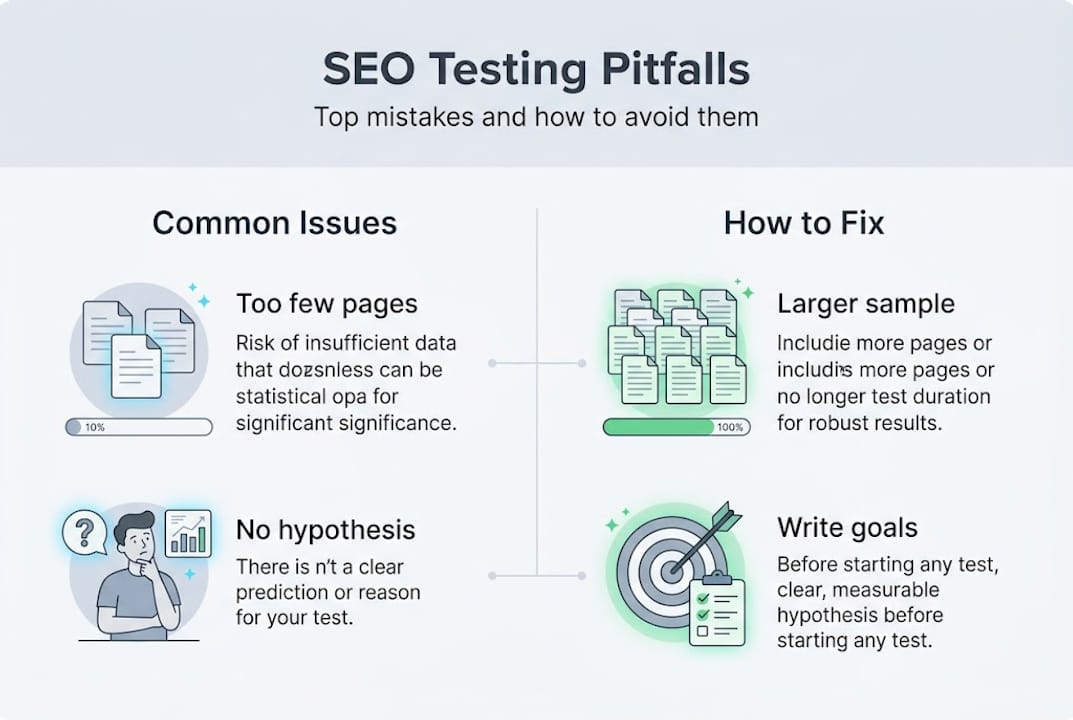
- Using underpowered page cohorts. Testing with five pages instead of twenty means you need far more time to reach any statistically meaningful conclusion.
- Ignoring seasonality. A traffic jump in November might be holiday demand, not your brilliant new title tag. Always contextualize your data against seasonal trends.
- Not accounting for algorithm updates. Google releases core algorithm updates multiple times a year. If one drops during your test window, your results are compromised.
- Failing to verify Googlebot behavior. After implementing changes, confirm that Googlebot is actually crawling and indexing the variant pages correctly. Use the URL Inspection tool in Google Search Console.
- Skipping statistical power calculations. Before running a test, estimate how much traffic and time you need to detect a meaningful difference. Running tests that are structurally too small just wastes everyone's time.
"Confounding variables are the silent killers of SEO experiments. A test that runs cleanly for six weeks can be completely undermined by a single algorithm update or a viral competitor post that distorts the data."
White-hat practices matter here beyond just ethics. Google is explicit about cloaking being a violation of its guidelines, and some JavaScript-based testing implementations can accidentally serve different content to Googlebot than to users. Server-side rendering and careful canonical tag management are your safeguards. When in doubt, implement changes in ways that are completely transparent to both users and search engines.
Statistical power is the unglamorous backbone of all of this. If your test group does not have enough traffic, even a real improvement in performance may not register as statistically significant. Underpowered tests lead to false negatives, where you abandon a change that would have worked at scale. Use a statistical significance calculator before committing to a test design.
What most SMBs get wrong about SEO testing
Here is the honest truth: most small and mid-sized businesses avoid SEO testing because it feels too complicated, too slow, or too resource-intensive. That avoidance is itself the biggest mistake.
You do not need a data science team to run a valid SEO test. You need a clear hypothesis, a group of similar pages, and the discipline to wait long enough for meaningful data. The businesses that move fastest in organic search are not the ones with the largest budgets. They are the ones that run the most disciplined experiments on the highest-impact pages.
Conventional wisdom often leads SMBs to test the wrong things first. Teams obsess over minor visual tweaks or low-traffic blog posts while ignoring the five product pages that drive 80% of their conversions. High-impact pages should always come first. One successful test on a high-traffic category page can outperform a year's worth of incremental blog optimizations.
The mindset shift we have seen make the biggest difference is moving from "big campaign" thinking to "monthly growth sprint" thinking. Instead of running one major test per quarter, build testing into your regular marketing cadence. Small, consistent experiments generate faster learning cycles and create an institutional knowledge base that compounds over time.
Learning to properly analyze test results is what separates teams that iterate and grow from teams that run tests and then wonder what to do next. The analysis is not the end of the process. It is the beginning of the next hypothesis.
Simplify your SEO testing with Stellar
Running structured SEO tests sounds like a lot of moving parts, because it is. Tracking cohorts, managing changes, pulling data, and maintaining clean test conditions all take real time. That is exactly why having the right platform underneath your workflow matters so much.
Stellar is built for marketers who want to run fast, clean experiments without needing a developer on standby. The no-code visual editor lets you make and deploy changes in minutes. Real-time analytics surface the metrics that matter without requiring you to build custom reports from scratch. With a 5.4KB script that barely touches your page load time, you get all the testing infrastructure without the performance trade-off. Whether you are running your first title tag split test or building a monthly growth sprint cadence, Stellar gives your team the tools to move quickly and make decisions you can actually trust.
Frequently asked questions
How long should you run an SEO test for valid results?
Most SEO tests need at least 4 to 8 weeks to account for indexing delays and get reliable data. Cutting the window short increases the risk of drawing conclusions from noise rather than real performance shifts.
What tools are best for tracking SEO test outcomes?
Google Search Console and Analytics are the primary tools for measuring traffic, CTR, rankings, and impressions. For more advanced causal analysis, CausalImpact provides a statistical framework for estimating true impact.
Are there risks of Google penalties with SEO testing?
Yes. Cloaking and duplicate content are the biggest risks. Using server-side implementation methods and managing canonical tags carefully helps prevent unintended guideline violations during testing.
Which types of web pages should you test first?
Always prioritize high-traffic pages with similar characteristics for your first cohorts. Higher traffic means faster data accumulation, better statistical power, and a greater potential impact when successful changes are scaled.
Recommended
Published: 4/26/2026