
Visual Editors for Marketers: Driving Fast, No-Code Growth
Finding a visual editor that empowers marketers without slowing down your workflow can feel like an endless search. For digital teams at growing ecommerce businesses, the right tool is not just about ease but also about maximizing marketing agility. With user-friendly interfaces and real-time experimentation features, visual editors now let non-technical marketers quickly test new ideas and optimize conversion rates, all while keeping your campaigns responsive to fast-changing market demands.
Table of Contents
- Defining Visual Editors For Marketers Today
- Types Of Visual Editors And Their Distinctions
- Essential Features Enabling Marketing Agility
- Practical Applications In Modern Marketing
- Potential Pitfalls And Choosing The Right Tool
Key Takeaways
| Point | Details |
|---|---|
| Importance of Visual Editors | Visual editors empower marketers to make real-time modifications without coding, enhancing agility and responsiveness in campaigns. |
| Types of Visual Editors | Understanding the differences between platform-first and code-first editors is essential for selecting the right tool matching team skills. |
| Features Driving Marketing Agility | Key features like real-time data integration and iterative workflows are vital for adapting to market changes swiftly and efficiently. |
| Practical Applications | Visual content strategies are crucial for enhancing brand storytelling and consumer engagement across various digital platforms. |
Defining Visual Editors for Marketers Today
A visual editor represents a transformative tool that allows digital marketers to modify web pages, landing pages, and digital experiences without writing a single line of code. These intuitive interfaces empower marketing teams to make real-time design changes, experiment with layouts, and optimize conversion paths through drag-and-drop functionality.
Visual editors have become critical for modern marketing professionals seeking agile experimentation. They provide a user-friendly environment where non-technical team members can:
- Modify page elements quickly
- Test different design variations
- Implement A/B testing scenarios
- Personalize user experiences
- Track performance metrics
Understanding the core mechanics of visual editors is essential. Visual Editor Explained: Understanding Its Importance and Use reveals that these tools typically offer point-and-click interfaces allowing marketers to alter text, images, colors, and layout configurations without developer intervention. This democratization of design means faster iteration and more responsive marketing strategies.

Marketing teams increasingly recognize visual editors as powerful instruments for growth. By removing technical barriers, these platforms enable rapid experimentation and data-driven optimization. The ability to make instant modifications translates directly into more agile, responsive marketing campaigns that can quickly adapt to user feedback and emerging trends.
Pro tip: Start with small, incremental changes when first using a visual editor to understand its capabilities and measure precise impact on user engagement.
Types of Visual Editors and Their Distinctions
Visual editors are not one-size-fits-all tools, but rather sophisticated platforms with distinct architectural approaches. Types of visual editor architectures fundamentally divide into two primary categories: platform-first and code-first visual editors, each offering unique capabilities for marketing teams.
In the platform-first approach, visual editors provide comprehensive web interfaces that:
- Connect multiple data sources seamlessly
- Offer preconfigured design patterns
- Support drag-and-drop content assembly
- Enable visual configuration of website components
- Prioritize ease of use for non-technical marketers
Conversely, code-first visual editors maintain a different philosophy. These tools provide visual editing capabilities while keeping websites independent from the platform. They give marketers direct control through front-end code management, offering greater flexibility but requiring more technical understanding.
Composable digital experience platforms represent the next evolution of visual editing. Visual editors in modern content management increasingly support modular, API-first approaches that promote omni-channel content creation. These advanced platforms enable marketers to design experiences that can be deployed across multiple channels with unprecedented speed and consistency.
Pro tip: Evaluate your team's technical skills and content complexity before selecting a visual editor to ensure the best fit for your marketing workflow.
Here's a comparison of the main types of visual editors and their marketing suitability:
| Editor Type | Best For | Technical Skill Needed | Flexibility Level |
|---|---|---|---|
| Platform-First | Fast campaign iteration | Basic | Moderate custom options |
| Code-First | Advanced customization | Moderate to high | Maximum, with dev input |
| Composable DXP | Omnichannel deployment | Moderate | High, modular structure |
Essential Features Enabling Marketing Agility
Marketing agility represents a transformative approach that enables organizations to rapidly adapt and respond to dynamic market conditions. Marketing agility capabilities have become increasingly critical in volatile business environments, where traditional slow-moving strategies fail to deliver competitive advantage.
The core features enabling marketing agility include:
- Real-time data integration and analysis
- Cross-functional team collaboration
- Iterative workflow and rapid experimentation
- Customer-centric strategy development
- Flexible technology platforms
- Adaptive resource allocation
Modern marketing teams must develop six essential capabilities to drive organizational agility. Modern marketing team capabilities highlight the importance of building integrated technological ecosystems that enable fast, personalized customer experiences. These capabilities demand a holistic approach that combines data insights, collaborative technologies, and innovative strategic thinking.
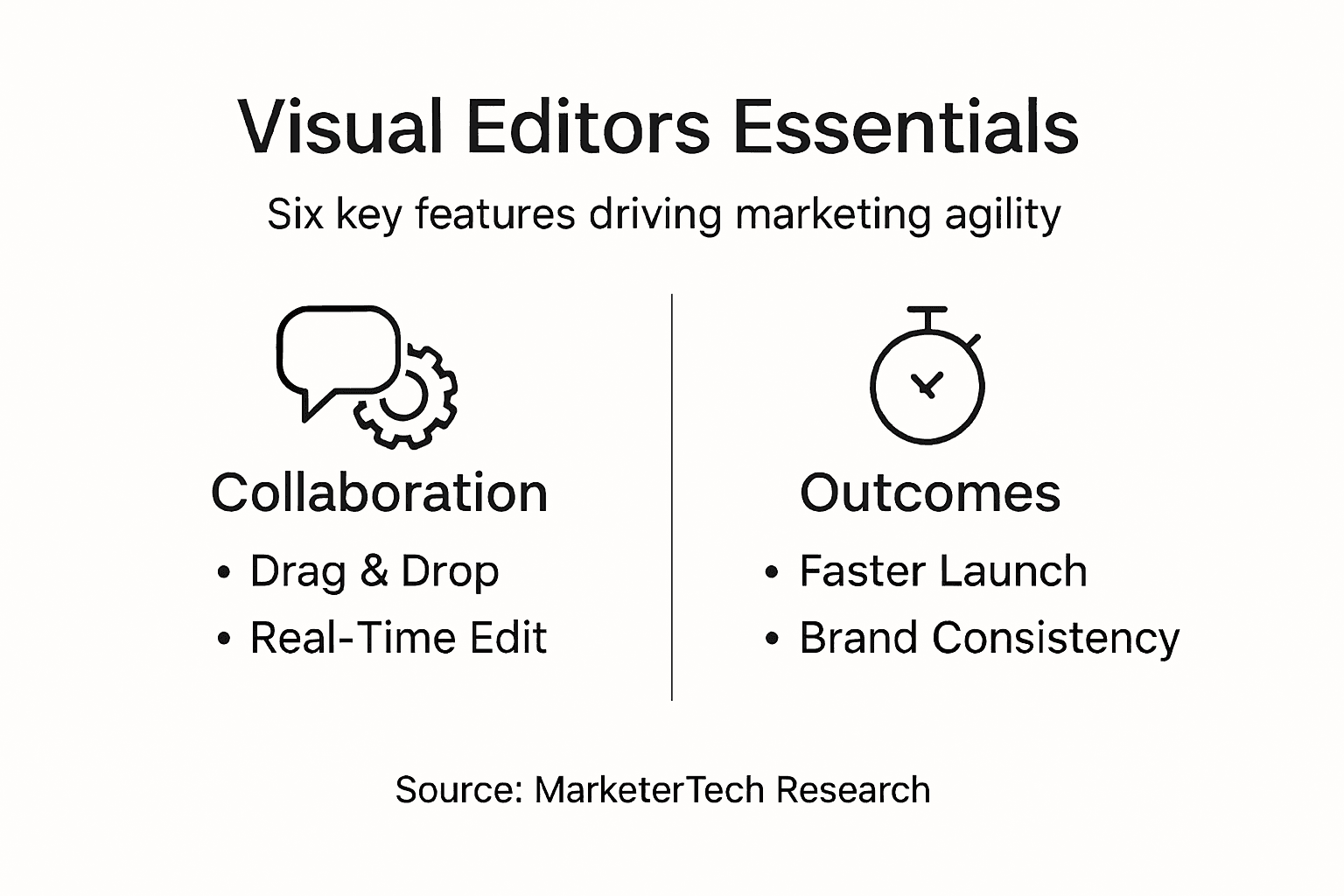
Technology plays a pivotal role in marketing agility, serving as the critical infrastructure that allows teams to experiment, learn, and optimize rapidly. Visual editors, A/B testing tools, and integrated analytics platforms are no longer optional—they are essential components that empower marketers to make data-driven decisions with unprecedented speed and precision.
Pro tip: Create a quarterly review process that evaluates your team's marketing agility, identifying technological gaps and opportunities for faster, more responsive strategies.
This summary outlines how visual editors impact marketing agility and outcomes:
| Feature | Agility Impact | Marketing Outcome |
|---|---|---|
| Rapid Experimentation | Enables swift A/B tests | Faster campaign tweaks |
| Real-Time Editing | Speeds up content updates | Timely user engagement |
| Cross-Team Collaboration | Streamlines feedback sharing | More cohesive branding |
| Integrated Analytics | Instant performance insights | Data-driven decisions |
Practical Applications in Modern Marketing
Visual methods have transformed marketing from static communication to dynamic, interactive experiences. Visual research methods in marketing demonstrate how strategic visual content can revolutionize brand storytelling, consumer engagement, and campaign effectiveness.
Practical applications of visual marketing strategies include:
- Social media campaign design
- Product demonstration videos
- Interactive website experiences
- User journey mapping
- Infographic content creation
- Personalized visual storytelling
Marketing teams now leverage visual content as a critical communication tool. Visual content strategies integrate psychological insights and advanced technologies like AI to optimize message delivery, transforming how brands connect with audiences across digital platforms.
Technology has elevated visual marketing from optional to essential. Modern visual editors enable marketers to rapidly prototype, test, and deploy complex visual experiences without extensive coding knowledge. These tools democratize design, allowing teams to experiment quickly, measure performance, and iterate in real-time, driving more responsive and data-informed marketing strategies.
Pro tip: Develop a visual content library that categorizes successful visual assets by performance metrics, enabling your team to replicate and improve winning design strategies.
Potential Pitfalls and Choosing the Right Tool
Selecting the right visual editor requires careful evaluation of potential challenges and organizational needs. Choosing the right visual editor demands a strategic approach that considers multiple critical factors to avoid common implementation pitfalls.
Key potential pitfalls marketers must navigate include:
- Platform vendor lock-in
- Limited customization options
- Complex integration challenges
- Misalignment with marketing objectives
- Steep learning curves
- Performance and scalability limitations
- Inconsistent visual output quality
Companies must critically assess visual editor capabilities across several dimensions. Visual representation challenges reveal that tools producing inconsistent or unclear visual outputs can significantly hamper marketing effectiveness. Smart selection requires evaluating factors like user interface intuitiveness, data management capabilities, integration flexibility, and alignment with team skill levels.
The selection process should prioritize tools that balance ease of use with technical flexibility. Marketing teams need visual editors that democratize design without sacrificing precision, enabling rapid experimentation while maintaining brand consistency and message clarity. Understanding the nuanced trade-offs between platform-first and code-first editors becomes crucial in making an informed decision.
Pro tip: Conduct a comprehensive pilot test with your core marketing team, evaluating the visual editor across real-world scenarios to assess its true practical value and alignment with your specific workflow requirements.
Accelerate Your Marketing Agility with Stellar’s No-Code Visual Editor
Marketers today face the challenge of rapidly iterating campaigns without relying on developer resources. The article highlights key pain points such as the need for real-time editing, easy A/B testing, and seamless personalization to drive fast growth. Stellar addresses these challenges by offering the fastest A/B Testing Tool with a lightweight script that does not compromise website performance. Its intuitive no-code Visual Editor empowers marketers to swiftly implement design changes and experiment effectively, exactly as discussed in the article.
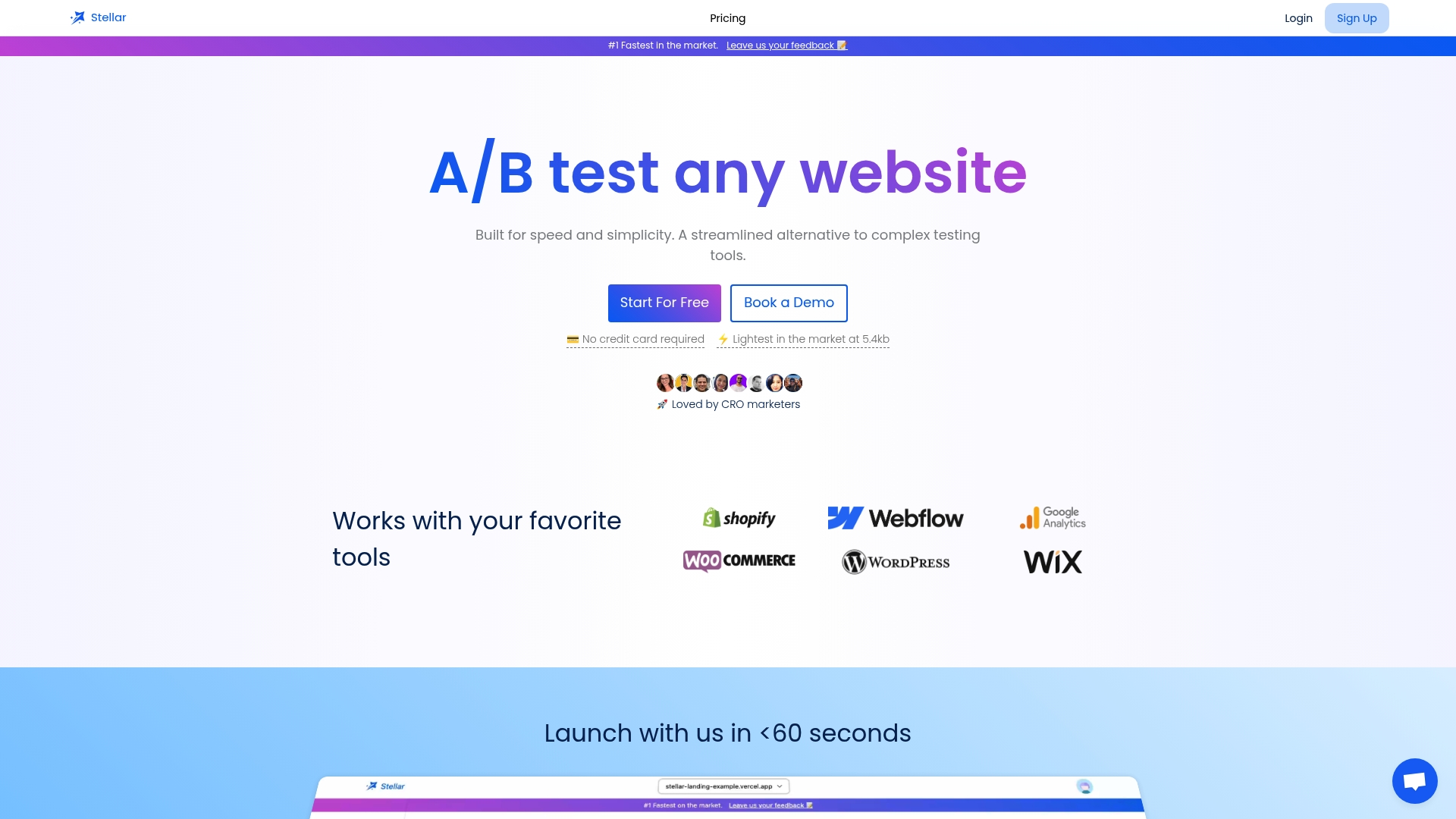
Don’t let technical hurdles slow down your marketing momentum. Discover how Stellar’s dynamic keyword insertion and advanced goal tracking deliver actionable insights to fuel data-driven decisions. Visit Stellar's website now to unlock powerful tools for small to medium-sized businesses eager to boost conversion rates and optimize experiences quickly. Start your growth journey today and experience marketing agility at its finest.
Frequently Asked Questions
What is a visual editor in marketing?
A visual editor is a tool that allows marketers to modify digital content and web pages without any coding knowledge. It offers a user-friendly interface for making real-time design changes, testing variations, and optimizing conversion paths through drag-and-drop functionality.
What are the different types of visual editors?
There are primarily two types of visual editors: platform-first and code-first. Platform-first visual editors provide comprehensive interfaces for non-technical users, while code-first editors allow for greater customization and require some technical understanding. Additionally, composable digital experience platforms support modular, API-first approaches for omnichannel content.
How can visual editors improve marketing agility?
Visual editors enhance marketing agility by enabling real-time editing, rapid experimentation, and cross-functional collaboration. They facilitate quick adjustments based on data insights, allowing marketing teams to respond rapidly to user feedback and market trends.
What should I consider when choosing a visual editor?
When selecting a visual editor, consider factors such as ease of use, customization options, integration capabilities, alignment with marketing objectives, and the technical skill levels of your team. Conducting a pilot test can help assess its practical value before making a decision.
Recommended
Published: 1/30/2026