
A/B Split Testing Explained for Marketers in 2026
TL;DR:
- A/B split testing compares two webpage versions to identify which performs better using real user data.
- It requires sufficient sample size, proper duration, and disciplined execution to yield reliable insights.
A/B split testing is defined as a controlled experiment that shows two versions of a webpage or marketing element to separate groups of visitors to determine which version drives better results. Marketers and business owners use it to make decisions based on real user behavior, not assumptions. The industry standard for a valid test requires a 95% confidence level and 80% statistical power, with the Nielsen Norman Group and organizations like Shopify and Amplitude consistently reinforcing these thresholds. Key metrics include conversion rate, click-through rate, and revenue per visitor. Understanding what is a b split testing, and applying it correctly, is the difference between growing a business on data and growing it on luck.
What is A/B split testing and how does it work?
A/B split testing, also called split testing or simply an A/B test, compares two versions of a single marketing asset by randomly assigning visitors to each version. Version A is the control, meaning the original. Version B is the variation, meaning the modified version. The test measures which version performs better on a defined metric, such as conversion rate or click-through rate.

Random assignment is the backbone of a valid test. Each visitor sees only one version, and that assignment stays consistent across their sessions to protect data integrity. Without this consistency, the same user could influence results in both groups, making the data unreliable.
The three most common types of A/B tests are:
- Standard A/B test: One variable changes between control and variation, such as a headline or button color.
- Multivariate test: Multiple elements change simultaneously, revealing how combinations of changes interact.
- Split URL test: Two entirely different page URLs compete, useful for testing major redesigns.
Each type serves a different purpose. Standard A/B tests are best for isolating the effect of a single change. Multivariate tests suit teams with high traffic who need to test complex interactions. Split URL tests work well when the variation is too different to implement on the same page.
Pro Tip: Start with standard A/B tests before moving to multivariate. Isolating one variable gives you a clear cause-and-effect relationship that multivariate tests cannot always provide.
To run a statistically sound test, each variation needs at least 1,000 unique visitors and the test should run for a minimum of two weeks. That two-week window captures both weekday and weekend traffic patterns, which often behave very differently.
What are the statistical pitfalls that kill A/B test results?
Statistical rigor separates useful A/B tests from expensive noise. The most common failure point is stopping a test too early because early results look promising. Stopping tests prematurely misses full traffic cycles and produces conclusions that do not reflect actual user behavior.
The standard confidence threshold in the industry is 95%. That means you accept a 5% chance the result is due to random variation. Reaching this threshold requires adequate sample size. For eCommerce tests targeting a 5% minimum detectable effect, 300–400 conversions per variant are required at 95% confidence and 80% power. Running a test on 200 total conversions and declaring a winner is a common and costly mistake.
The five most damaging pitfalls in A/B testing are:
- Stopping early: A test that looks like a winner on day three may reverse by day ten.
- Insufficient sample size: Low traffic produces high variance, making small differences look significant.
- Testing too many variables: Changing the headline, image, and CTA at once makes it impossible to know what drove the result.
- Ignoring seasonality: A test running during a holiday sale will not reflect normal user behavior.
- Using 301 redirects in split URL tests: 301 redirects harm SEO because search engines treat them as permanent. Use 302 temporary redirects to preserve indexing during the test.
Testing programs fail most often not because of bad ideas, but because they expand faster than their statistical discipline. The result is a pile of tests discarded due to gut feelings and noisy, short-term data.
Pro Tip: Schedule your tests to always include at least two full weekends. Weekend traffic behaves differently from weekday traffic, and missing it skews your results toward a segment that does not represent your full audience.
Small performance differences between variants can easily be caused by chance or external factors like a news event or a competitor's promotion. The 95% confidence threshold reduces this risk but does not eliminate it. Constant iteration and retesting remain necessary, especially when seasonality is a factor. For a deeper look at reading test results correctly, the guide on interpreting statistical significance covers the mechanics in detail.
How to conduct A/B testing that actually moves the needle
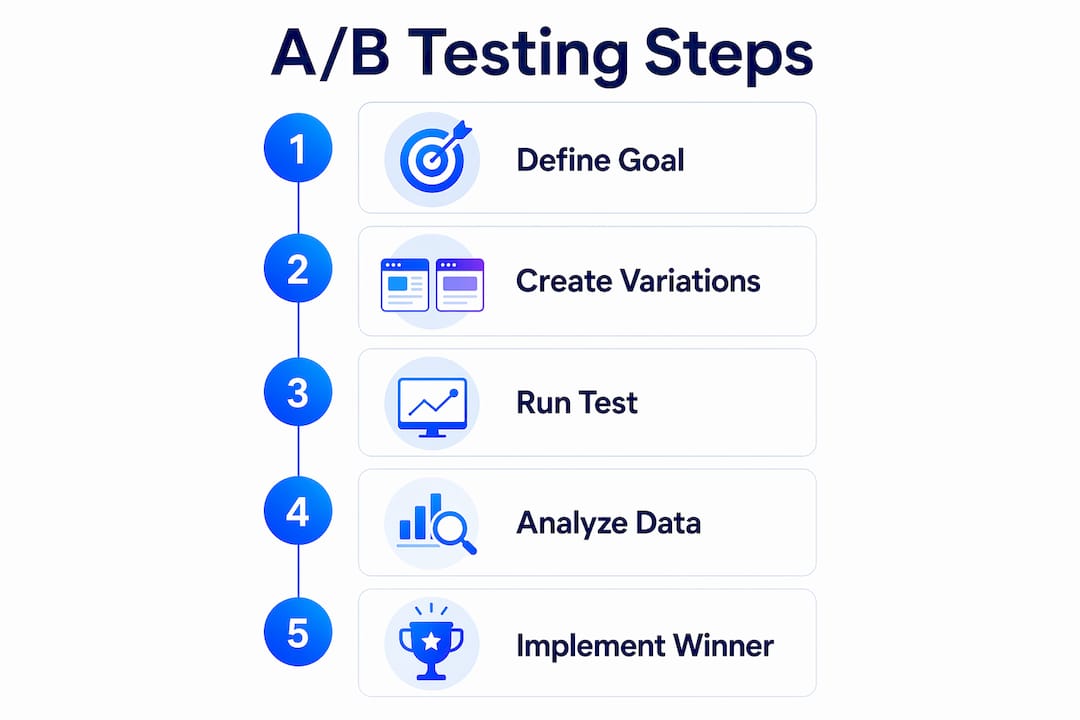
Effective A/B testing follows a repeatable process. Skipping any step increases the chance of a misleading result.
- Define a hypothesis: State what you expect to happen and why. "Changing the CTA button from gray to orange will increase clicks because it creates stronger visual contrast" is a testable hypothesis. "Let's try a new button" is not.
- Choose one primary metric: Pick the metric that directly reflects your business goal. For a landing page, that is usually conversion rate. For an email, it is click-through rate.
- Create the variation: Change only the element your hypothesis targets. Every other element stays identical between control and variation.
- Calculate required sample size: Use a sample size calculator before launching. Launching without this step is the single most common reason tests produce meaningless results.
- Run the test for the full duration: Commit to the minimum two-week window regardless of early results.
- Analyze and act: If the variation wins at 95% confidence, implement it. If it loses, document what you learned and form a new hypothesis. If results are inconclusive, extend the test or redesign it.
Audience segmentation adds another layer of value. Running the same test across your full audience and then breaking results down by device type, traffic source, or geography often reveals that a variation wins for mobile users but loses for desktop users. That insight shapes a more targeted rollout.
Pro Tip: Build a testing log. Record every test, its hypothesis, duration, result, and what you did next. After six months, patterns emerge that tell you which types of changes consistently move the needle for your specific audience.
A/B testing reduces wasted spend by validating changes with a segmented cohort before rolling them out to your full audience. That validation step alone justifies the time investment. For practical applications in eCommerce, the eCommerce optimization guide covers how to apply these steps to product pages and checkout flows. Broader conversion rate strategy is also covered in this digital marketer's guide to CRO.
What are the best use cases for A/B testing in marketing?
A/B testing applies across nearly every digital marketing channel. The highest-impact use cases share one trait: they test elements that directly influence a visitor's decision to convert.
| Channel | Element Tested | Metric |
|---|---|---|
| Email marketing | Subject line | Open rate |
| Landing pages | CTA button text or color | Conversion rate |
| Paid ads | Ad headline or image | Click-through rate |
| eCommerce product pages | Price display or trust badges | Add-to-cart rate |
| Checkout flow | Number of form fields | Completion rate |
Email subject lines are one of the fastest A/B tests to run because results arrive within 24–48 hours and sample sizes are easy to control. Testing "Get 20% off today" against "Your exclusive discount is waiting" on a list of 10,000 subscribers gives a clear winner quickly.
Landing page tests take longer but deliver larger revenue impact. Testing a single-column layout against a two-column layout, or a short-form CTA against a long-form CTA, can shift conversion rates by several percentage points. Even a modest lift on a high-traffic page compounds into significant revenue over time.
Ad creative testing works best when run within a single ad set to control for audience targeting. Changing the headline while keeping the image constant isolates the effect of the copy. Changing both at once makes the result uninterpretable.
Multivariate testing complements standard A/B testing when you need to understand how multiple elements interact. A product page test might examine three headline options and two image options simultaneously. This requires substantially more traffic to reach significance, but it reveals interaction effects that sequential A/B tests would miss. For teams focused on eCommerce revenue growth, multivariate testing is worth adding once the standard A/B testing process is established.
Key Takeaways
A/B split testing produces reliable results only when statistical discipline, adequate sample size, and full test duration are applied without exception.
| Point | Details |
|---|---|
| Define the standard threshold | Use 95% confidence and 80% power as your baseline for every test. |
| Meet minimum sample requirements | Run tests until each variant reaches at least 1,000 visitors and 300–400 conversions. |
| Never stop a test early | Commit to at least two weeks to capture full weekly traffic cycles. |
| Isolate one variable per test | Changing one element at a time makes it clear what caused the result. |
| Use 302 redirects for split URL tests | Permanent 301 redirects damage SEO; temporary 302 redirects preserve indexing. |
The discipline gap most marketers never close
The hardest part of A/B testing is not the setup. It is the patience. Every marketer I have worked with has stopped a test early at least once because the numbers looked good and the pressure to ship was real. Every single time, the result either reversed or turned out to be statistically meaningless.
The uncomfortable truth about A/B testing is that most programs fail not because the ideas are bad, but because the execution lacks discipline. Testing programs that expand faster than their statistical rigor produce a backlog of inconclusive tests that erode trust in the entire process. Teams stop believing in the data, revert to gut decisions, and the testing program quietly dies.
What actually works is treating each test like a small scientific study. Write the hypothesis before you build the variation. Calculate the sample size before you launch. Set a calendar reminder for the end date and do not check results daily. That last point sounds trivial, but peeking at results and making decisions based on incomplete data is one of the most common sources of false positives in marketing experimentation.
The marketers who get the most out of A/B testing are not the ones running the most tests. They are the ones running the fewest tests with the most rigor. A single well-designed test that produces a clear, actionable result is worth more than ten rushed tests that leave you guessing. Build the habit of managing seasonality in your tests and your results will become far more trustworthy over time.
— Juan
How Gostellar fits into your testing workflow
Running statistically sound A/B tests requires the right infrastructure. Gostellar is built specifically for marketers and small to medium-sized businesses who need a fast, no-code testing platform without the overhead of enterprise tools.
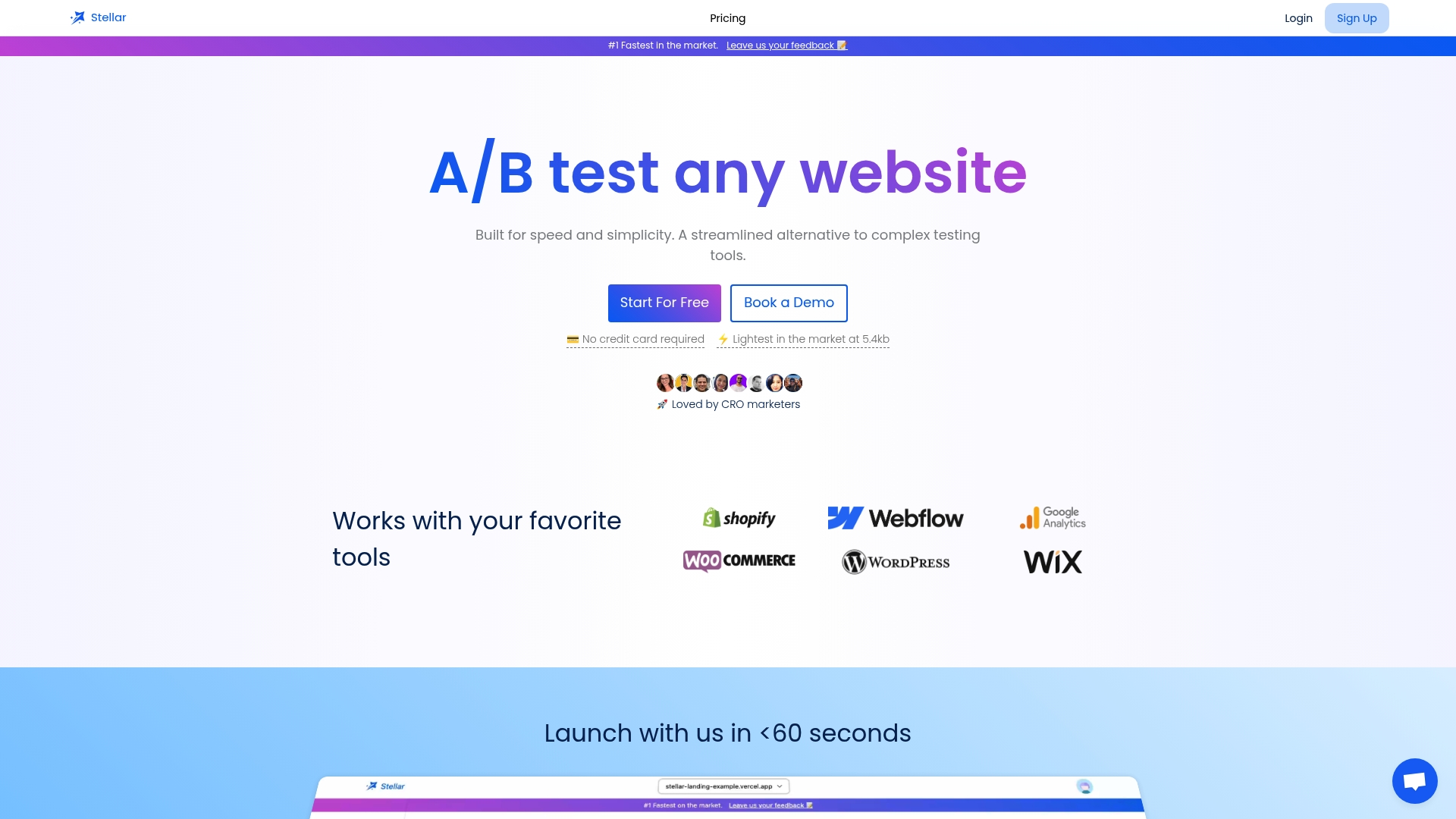
Gostellar's no-code visual editor lets you build and launch variations without touching code. Its 5.4KB script keeps page load times fast, which matters because slow pages distort test results. Real-time analytics surface results as they accumulate, and advanced goal tracking ties test outcomes directly to revenue metrics. Gostellar also offers a free plan for businesses with under 25,000 monthly tracked users, making it accessible from day one. Start your first test at Gostellar and put your conversion rate decisions on a data foundation.
FAQ
What is the ab testing definition in simple terms?
A/B testing is a controlled experiment that compares two versions of a webpage or marketing element to determine which one performs better on a specific metric like conversion rate or click-through rate.
How many visitors does a B split test need?
Each variation needs at least 1,000 unique visitors, and eCommerce tests targeting a 5% detectable effect require 300–400 conversions per variant at 95% confidence.
How long should an A/B test run?
Tests should run for a minimum of two weeks to capture full weekly traffic cycles, including weekends, which often behave differently from weekday traffic.
What is the difference between A/B testing and multivariate testing?
A/B testing changes one variable between two versions, while multivariate testing changes multiple elements simultaneously to measure how combinations of changes interact.
Does A/B testing hurt SEO?
Standard A/B tests do not harm SEO. Split URL tests can cause SEO damage if 301 permanent redirects are used; always use 302 temporary redirects to preserve proper indexing during the test.
Recommended
Published: 7/12/2026