
Ads Test Page: The Marketer's Guide to Better Campaigns
TL;DR:
- An ads test page validates ad creatives for platform compliance and tests landing page variants through controlled experiments. It emphasizes the importance of technical validation, systematic A/B testing, and emotional resonance measurement to improve campaign performance and brand impact. Proper documentation and predefined thresholds are essential to avoid wasting budgets and ensure meaningful results.
An ads test page is a structured environment where marketers validate ad creatives, test landing page variants, and measure performance before spending real budget at scale. The term covers two distinct practices: technical validation (checking that ad files meet platform specs) and A/B testing (comparing creative or page variants to find the better performer). Both are non-negotiable for teams that want to improve conversion rates without burning through budget on guesswork. This guide covers every layer of an effective ad evaluation platform, from HTML5 compliance checks to emotional resonance measurement.
1. What does an ads test page technically validate?
Technical validation is the first gate every ad creative must pass. Automated validation tools check HTML5 banner ads for file size, dimensions, click tags, metadata, and script restrictions required by platforms like Google Ads and DV360. Skipping this step leads to rejected creatives, delayed campaigns, and wasted production hours.
A complete ad website test covers these requirements at minimum:
- File size limits: Most display networks cap HTML5 ads at 150KB initial load.
- Click tag formatting: Tags must follow platform-specific syntax or the ad will not track clicks.
- Metadata compliance: Ad units need correct MIME types and declared dimensions.
- Script restrictions: Third-party scripts are often blocked or must be declared.
- Animation duration: Google Ads limits looping animations to 30 seconds.
Beyond platform validators, ad test pages also verify ad block efficacy by loading scripts from 50+ advertising and tracking services without initializing tracking. That distinction matters: you learn whether your ad loads correctly without polluting your analytics with test data.
Pro Tip: Use a local ad simulator to validate ad creatives and click tag behavior entirely within the browser. Simulators replicate runtime behaviors without hitting live networks, so you avoid invalid click traffic during the testing phase.

2. How to run effective A/B tests on an advertisement testing page
A/B testing for ads means changing one variable at a time and measuring the outcome against a control. The most common mistake teams make is changing headlines, images, and calls to action simultaneously. That approach makes it impossible to know which change drove the result.
Follow these steps to set up a controlled ad page test:
- Define one hypothesis. State what you expect to change and why. "Changing the headline from benefit-focused to urgency-focused will increase CTR by 10%."
- Set your sample size before launching. Pre-defining sample size prevents you from stopping a test early when results look promising but are not yet reliable.
- Run for 7–14 days minimum. Landing page A/B tests typically need 7–14 days and at least 50 conversions per variant to reach statistical confidence. Shorter tests produce false positives.
- Use separate ad sets for landing page tests on Meta. Split testing on Meta works best with distinct URLs in separate ad sets. Redirect-based testing hides URL differences from Meta's algorithm, which assigns signals at the ad set level. That masking corrupts your results.
- Resist eyeballing CTR differences. A 0.5% CTR gap that looks meaningful in a dashboard is often statistical noise. Wait for your pre-defined end date and conversion count before calling a winner.
- Document the result, win or loss. Every test outcome is a data point. Teams that skip documentation repeat the same experiments six months later.
Landing page A/B testing strategies that follow this structure consistently produce 30–50% conversion rate improvements. That range reflects the gap between teams that test systematically and those that test reactively.
3. What role does emotional testing play in ad optimization?
Emotional testing measures how consumers feel during ad exposure, not just what they click. Emotion-based ad testing provides predictive insights into long-term brand growth that traditional performance metrics like CTR and CPA cannot capture. A high-CTR ad can still damage brand perception if the emotional response is negative or confusing.
"Measuring emotional resonance is crucial to predict brand growth, unlike traditional performance-only metrics." — System1 Group
Traditional metrics tell you what happened. Emotional metrics tell you why. A campaign with a strong CPA in week one can plateau by week four if the creative generates low emotional engagement. Emotion-based testing catches that signal early, before you scale a creative that will burn out fast.
Integrating emotional insights alongside A/B testing reduces creative waste. Teams that test emotional resonance before scaling a creative avoid investing production budget in ads that perform adequately in the short term but fail to build brand equity. The combination of quantitative A/B data and emotional feedback gives you a complete picture of creative performance.
4. How to interpret ads performance analysis and apply results
Data from an ad evaluation platform only creates value when you act on it correctly. The most common misread is treating statistical significance as business significance. A 2% CPA improvement might be statistically significant but still not justify rebuilding your creative workflow. The lift must be large enough to matter to the business.
Apply these principles when reading test results:
- Pre-define kill rules. Set spend thresholds at 1x to 2x your target CPA with a minimum conversion count before you scale or kill an ad. This prevents you from running underperforming tests past the point of recovery.
- Separate statistical significance from practical impact. A result can be statistically significant and still be too small to act on. Ask: does this lift change a budget decision?
- Build a testing log. Document the hypothesis, variables, results, and decision for every test. Teams with structured logs make better decisions faster because they are not starting from zero each time.
- Balance test frequency with production costs. Running 10 simultaneous tests sounds productive. If your creative team cannot produce 10 quality variants, you are testing low-quality assets and learning nothing useful.
- Diagnose campaign health before scaling. A winning variant on a campaign with poor audience targeting will still underperform. Fix structural issues before declaring a creative the winner.
Pro Tip: When reviewing A/B testing best practices, pay attention to the difference between a test that reaches significance and a test that reaches your pre-defined business threshold. Set both thresholds before the test starts.
5. Comparing ad testing approaches by feature and use case
Not every team needs the same testing setup. The right approach depends on your budget, creative volume, and compliance requirements. The table below maps common feature categories to the testing method that handles them best.
| Feature category | Automated validator | Manual A/B test | Emotion measurement |
|---|---|---|---|
| Technical compliance | Best fit | Not applicable | Not applicable |
| Creative performance | Limited | Best fit | Complementary |
| Brand impact prediction | None | Indirect | Best fit |
| Platform integration | Strong | Moderate | Varies |
| Budget planning | Low cost | Moderate cost | Higher cost |
| Speed of insight | Immediate | 7–14 days | Fast (survey-based) |
Teams with a technical compliance focus should prioritize automated validators as their first layer. Creative-heavy campaigns benefit most from structured A/B testing with a documented hypothesis for each variant. Brands running awareness campaigns at scale should add emotional measurement to understand whether their creative is building the right associations.
Key decision factors when setting up your ad testing framework:
- Small-budget teams should start with automated validators and one A/B test per campaign cycle. Limit variables and extend test duration to compensate for lower traffic volume.
- Creative-heavy campaigns need a clear testing backlog. Prioritize tests by expected business impact, not by ease of execution.
- Technical compliance focus requires validator tools that check against the specific platforms you use. Google Ads, Meta, and DV360 each have different spec requirements.
For teams building their first complete A/B testing process, starting with one layer and adding complexity over time produces better results than trying to run all three methods simultaneously from day one.
Key takeaways
Effective ad testing combines technical validation, controlled A/B experiments, and emotional insight to produce results that hold up at scale.
| Point | Details |
|---|---|
| Validate before you launch | Check file size, click tags, and metadata compliance before submitting any creative to a live platform. |
| Test one variable at a time | Changing multiple elements in a single test makes it impossible to identify what drove the result. |
| Require 50+ conversions per variant | Statistical confidence requires at least 50 conversions per variant over 7–14 days before calling a winner. |
| Set kill rules before testing | Pre-define spend thresholds at 1x to 2x target CPA to prevent budget waste on underperforming variants. |
| Add emotional measurement for brand campaigns | Emotional resonance predicts long-term brand growth in ways that CTR and CPA data cannot. |
What I've learned from years of watching ad tests fail
Most ad testing failures are not measurement failures. They are discipline failures. Teams run tests without a written hypothesis. They stop tests early because the dashboard looks good. They call a 1.5% CTR lift a winner without checking whether it clears their CPA threshold. The process breaks down before the data even enters the picture.
The balance between technical validation and emotional feedback is where I see the biggest gap. Teams obsess over click tags and file sizes, which is correct, but then they scale creatives based purely on short-term CPA without asking whether the ad is building or eroding brand trust. Those two things are not in conflict. They belong in the same testing framework.
Documentation is the most overlooked part of the entire process. A testing log that records every hypothesis, result, and decision turns individual experiments into institutional knowledge. Without it, teams repeat the same tests, make the same mistakes, and wonder why their results do not compound over time.
One more thing: a statistically significant result is not a mandate to act. A 2% lift that does not justify a workflow change should be noted and filed, not celebrated. Treat your testing program as a learning system, not a scoreboard.
— Juan
How Gostellar fits into your ad testing workflow
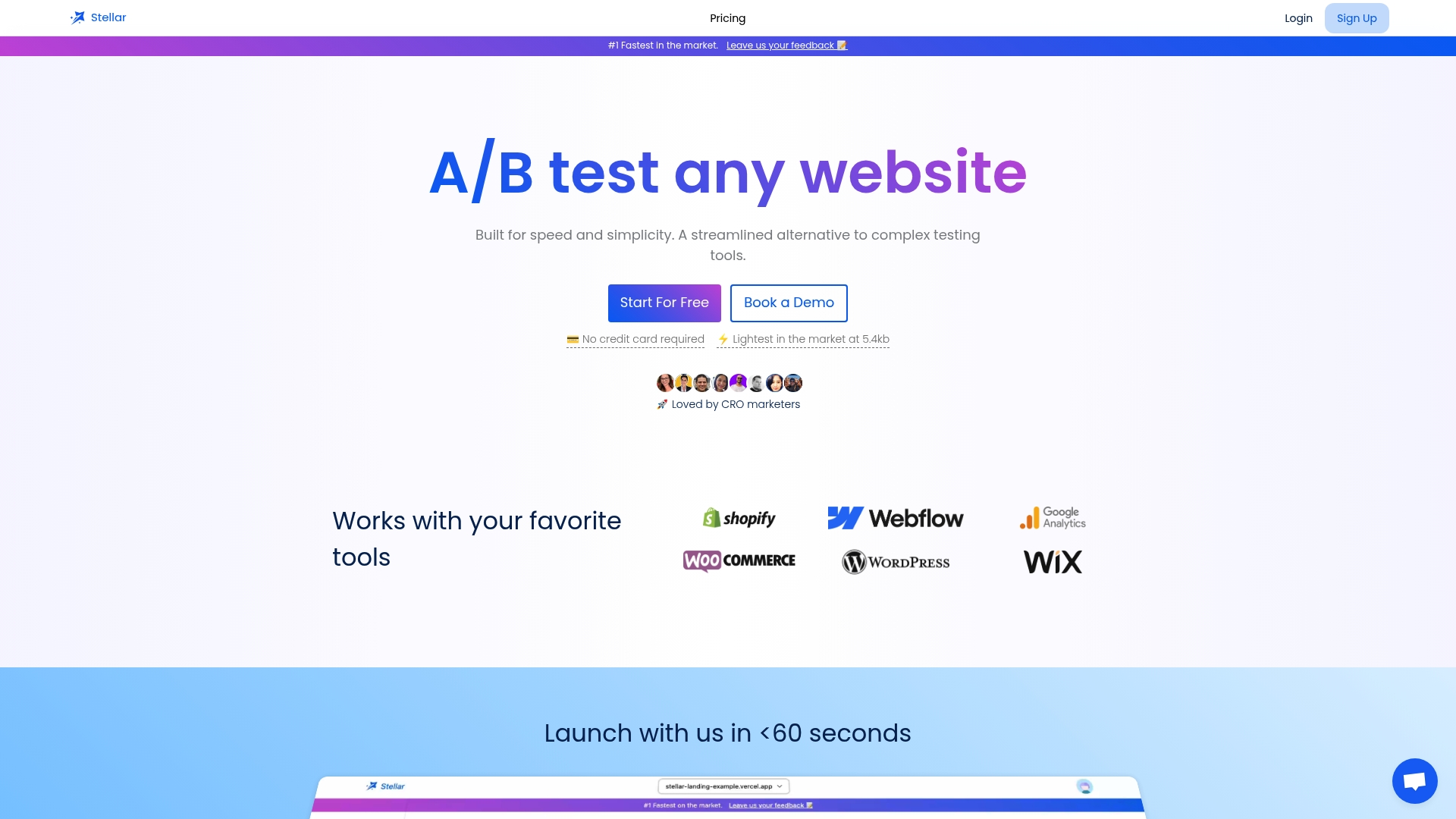
Gostellar is built for marketers and product teams who need fast, reliable A/B testing without the complexity of enterprise platforms. The platform runs on a 5.4KB script that adds no meaningful load time to your pages, which matters when page speed is itself a conversion variable. Its no-code visual editor lets you create test variants without engineering support, and real-time analytics surface results as they accumulate.
Teams running landing page experiments can set up goal tracking, monitor conversion data by variant, and use dynamic keyword insertion to personalize pages for different ad audiences. Gostellar offers a free plan for sites with under 25,000 monthly tracked users, making it a practical starting point for teams that want to test before committing to a paid tier.
FAQ
What is an ads test page used for?
An ads test page validates ad creatives for technical compliance and tests landing page variants through A/B experiments to improve conversion rates and campaign performance.
How many conversions do I need before ending an A/B test?
Most testing frameworks require at least 50 conversions per variant over a 7–14 day period before results reach statistical confidence.
Why should I use separate ad sets for landing page tests on Meta?
Meta's algorithm assigns optimization signals at the ad set level. Testing with separate ad sets and distinct URLs preserves those signals and produces more reliable results than redirect-based testing.
What is the difference between statistical and business significance?
Statistical significance means the result is unlikely to be random. Business significance means the lift is large enough to justify a change in creative or workflow. A test can achieve one without the other.
How do I avoid wasting budget during ad testing?
Pre-define kill rules at 1x to 2x your target CPA with a minimum conversion count. Stop tests that reach the spend threshold without hitting the conversion floor, and document the result before moving on.
Recommended
Published: 6/27/2026