
Complete Guide to Multichannel Conversion Tracking
More than 80 percent of marketers struggle to connect the dots between digital and offline customer actions. Tracking conversions across multiple platforms has become a challenge as users interact with brands in more ways than ever before. Multichannel conversion tracking offers a way to bring everything together, making sense of these scattered touchpoints so businesses can finally measure what truly drives results.
Table of Contents
- Defining Multichannel Conversion Tracking
- Common Tracking Methods And Technologies
- Key Metrics And Attribution Models Explained
- Integrating Tools Across Marketing Channels
- Common Pitfalls And How To Avoid Them
Key Takeaways
| Point | Details |
|---|---|
| Comprehensive Customer Insights | Multichannel conversion tracking provides a holistic view of customer interactions across various platforms, enabling accurate attribution and optimization of marketing strategies. |
| Advanced Tracking Technologies | Employing sophisticated tracking methods like cross-device tracking and click tracking is essential for creating detailed user profiles and understanding the complete customer journey. |
| Importance of Attribution Models | Recognizing various attribution models is crucial for assessing channel contributions to conversions and making informed marketing decisions. |
| Integration of Marketing Tools | Effective tracking requires integrating multiple marketing tools to centralize data and eliminate silos, facilitating comprehensive performance analysis across channels. |
Defining Multichannel Conversion Tracking
Multichannel conversion tracking is a strategic approach that enables businesses to understand and analyze customer interactions across multiple digital and physical touchpoints. According to research from iiste.org, these strategies have evolved to create a comprehensive system for managing complex customer journeys.
Multichannel tracking goes beyond traditional single-channel measurement by mapping how customers engage with a brand through various platforms and devices. This might include interactions via websites, mobile apps, social media channels, email marketing, paid advertising, physical stores, and call centers. The goal is to create a holistic view of the customer experience, understanding how different channels contribute to the ultimate conversion.
The technical foundation of multichannel tracking relies on sophisticated technologies that enable cross-device and cross-platform user identification. As explained by Wikipedia, this process often involves utilizing unique identifiers and advanced tracking mechanisms like cookies to create comprehensive user profiles. These technologies allow marketers to:
- Track user interactions across different devices
- Understand the complete customer journey
- Attribute conversions accurately
- Optimize marketing strategies based on comprehensive data
By implementing robust multichannel conversion tracking, businesses can gain deep insights into how different marketing efforts interconnect and influence customer decision-making. Learn more about interpreting these complex conversion metrics in our comprehensive guide on conversion tracking.
Common Tracking Methods and Technologies
Multichannel tracking encompasses several sophisticated technologies and methods designed to capture comprehensive user interactions across digital platforms. Wikipedia highlights that web analytics involves intricate measurement and collection techniques to understand and optimize user behavior across various digital touchpoints.
Click tracking represents one of the fundamental methods for understanding user engagement. As detailed by Wikipedia, this technique captures precise user navigation patterns through multiple mechanisms:
- Server log analysis
- JavaScript-based tracking scripts
- Event tracking pixels
- Client-side interaction monitoring
Modern multichannel tracking technologies typically leverage several core methodologies to create comprehensive user profiles.
 These include cross-device tracking, which uses unique identifiers to connect user interactions across smartphones, tablets, desktop computers, and other digital platforms. Marketers can employ technologies like:
- Persistent cookie tracking
- User account authentication
- Device fingerprinting
- Email and phone number matching
By integrating these advanced tracking approaches, businesses can develop a nuanced understanding of customer journeys. Learn more about tracking ecommerce conversions with our comprehensive strategies guide to enhance your multichannel tracking capabilities.
Key Metrics and Attribution Models Explained
Multichannel conversion tracking requires a sophisticated approach to measuring marketing performance across different platforms. According to Martech.org, understanding key metrics and attribution models is crucial for making data-driven marketing decisions.
Attribution models help marketers understand how different touchpoints contribute to the final conversion. The most common models include:
- First-click attribution: Credits the initial interaction
- Last-click attribution: Gives full credit to the final touchpoint
- Linear attribution: Distributes credit equally across all interactions
- Time decay attribution: Weights recent interactions more heavily
- Position-based attribution: Allocates more credit to critical touchpoints
Research from Ideas RePEC reveals that different product categories may require unique attribution approaches. Key conversion metrics marketers should track include:
- Conversion rate
- Cost per conversion
- Revenue per conversion
- Conversion value
- Multi-channel conversion paths
By carefully analyzing these metrics, businesses can optimize their marketing strategies and understand the true impact of each channel.
Explore our guide on conversion metric benchmarks for deeper insights to refine your multichannel tracking approach.
Integrating Tools Across Marketing Channels
Effective multichannel conversion tracking requires a strategic approach to integrating various marketing tools and technologies. Research from IJFMR highlights the critical importance of sophisticated tracking systems that can seamlessly connect different marketing platforms and data sources.
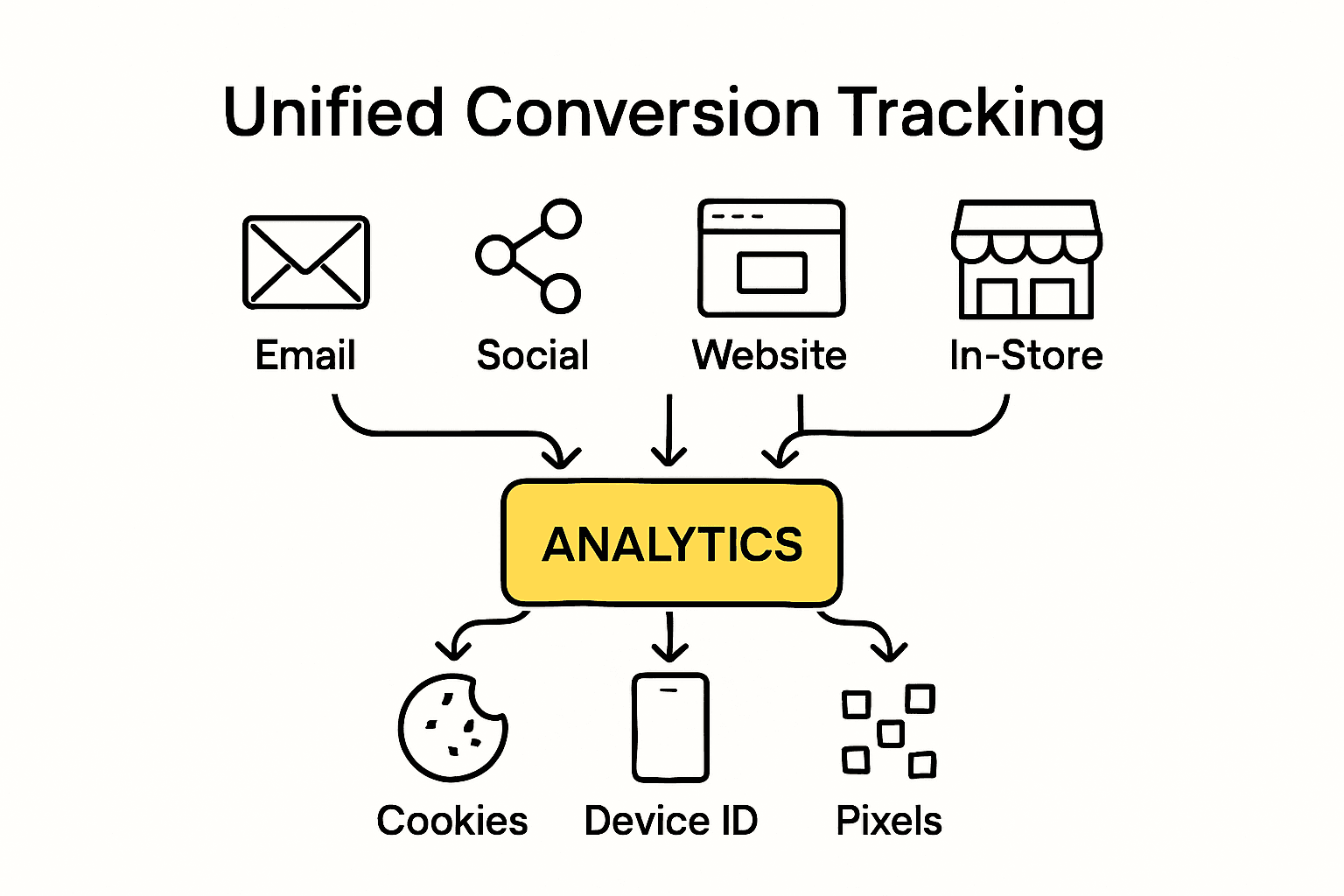
Tool integration involves creating a unified ecosystem that allows marketers to:
- Centralize data collection
- Eliminate data silos
- Enable cross-channel performance analysis
- Synchronize marketing efforts
- Provide comprehensive customer insights
A cutting-edge approach to integration involves implementing advanced analytics frameworks. According to EJAET, session-based analytics can dramatically improve the ability to track and understand user interactions across multiple channels. Key strategies for successful tool integration include:
- Implementing API connections
- Using universal tracking tags
- Establishing common data standards
- Creating unified customer identifiers
- Developing centralized reporting dashboards
By breaking down technological barriers between different marketing platforms, businesses can create a more holistic view of their customer journey.
 Learn more about integrating analytics tools for marketing success to optimize your multichannel tracking approach.
Common Pitfalls and How to Avoid Them
Multichannel conversion tracking is fraught with potential challenges that can significantly undermine marketing efforts. Research from arXiv highlights critical issues in tracking, particularly the lack of principled utilization of pre-conversion user actions and failure to model complex sequential behavior patterns.
The most common tracking pitfalls marketers encounter include:
- Incomplete data collection
- Inadequate cross-channel integration
- Over-reliance on last-click attribution
- Ignoring time-dependent user interactions
- Failing to account for user characteristics
Advanced research suggests implementing sophisticated tracking methodologies to mitigate these challenges. According to arXiv, deep learning-based attribution algorithms can help assess advertising channel impacts by addressing complex interaction dynamics. Key strategies to avoid tracking pitfalls involve:
- Implementing comprehensive data collection protocols
- Using advanced machine learning attribution models
- Developing unified customer identification systems
- Creating holistic cross-channel tracking frameworks
- Continuously validating and refining tracking mechanisms
By proactively addressing these potential tracking challenges, businesses can develop more robust and accurate multichannel conversion measurement strategies. Explore our guide on digital marketing mistakes to further refine your approach.
Optimize Your Multichannel Conversion Tracking with Stellar
Multichannel conversion tracking can feel overwhelming when trying to piece together data from multiple sources and devices. Challenges like incomplete data collection, inaccurate attribution, and fragmented reporting make it hard to see the true impact of each marketing channel. This article highlights the importance of integrating advanced tools and accurate goal tracking to fully understand customer journeys and optimize marketing efforts.
With Stellar, you gain a lightweight, user-friendly platform designed to simplify this complexity. Our no-code visual editor and advanced goal tracking empower marketers to capture precise conversion data across channels without slowing down your site. Experience real-time analytics and dynamic keyword insertion that help you personalize landing pages and make data-driven decisions faster.

Ready to take control of your multichannel tracking challenges? Discover how Stellar’s streamlined A/B testing and goal tracking can boost your marketing performance today. Visit Stellar's homepage to get started. Learn more about leveraging advanced goal tracking and explore strategies for tracking ecommerce conversions to make every interaction count.
Frequently Asked Questions
What is multichannel conversion tracking?
Multichannel conversion tracking is a method that enables businesses to analyze customer interactions across various digital and physical touchpoints, helping to understand the complete customer journey and how different channels contribute to conversions.
What are the common metrics used in multichannel conversion tracking?
Common conversion metrics include conversion rate, cost per conversion, revenue per conversion, conversion value, and multi-channel conversion paths. These metrics help businesses assess the effectiveness of their marketing strategies across different channels.
How do attribution models work in multichannel conversion tracking?
Attribution models assign credit to different touchpoints in the customer journey when a conversion occurs. Models include first-click attribution, last-click attribution, linear attribution, time decay attribution, and position-based attribution, each providing a unique perspective on how interactions lead to conversions.
What are the common pitfalls of multichannel conversion tracking?
Common pitfalls include incomplete data collection, inadequate cross-channel integration, over-reliance on last-click attribution, and failing to account for user characteristics. Addressing these issues requires comprehensive tracking protocols and methodologies to ensure accurate measurement of marketing performance.
Recommended
Published: 11/16/2025