
Optimizely Landing Page: Conversion Best Practices 2026
TL;DR:
- Optimizely landing pages are data-driven web pages designed to increase conversions through experimentation tools like A/B testing and dynamic content. Prioritizing message match and page speed before testing layout or design yields the highest returns. Many marketers fail by testing in the wrong order and stopping experiments too early, reducing their effectiveness.
An Optimizely landing page is a dedicated web page built and refined through Optimizely's experimentation platform to increase conversion rates using data, not guesswork. Marketers use Optimizely Web Experimentation to run A/B tests, apply dynamic content, and segment audiences, turning a static page into a living experiment. The median dedicated landing page converts at 6.6%, while top performers exceed 11%. That gap is where Optimizely earns its place. This guide covers the features, best practices, and testing strategies that move you from average to top-tier performance.
What are the key Optimizely landing page features?
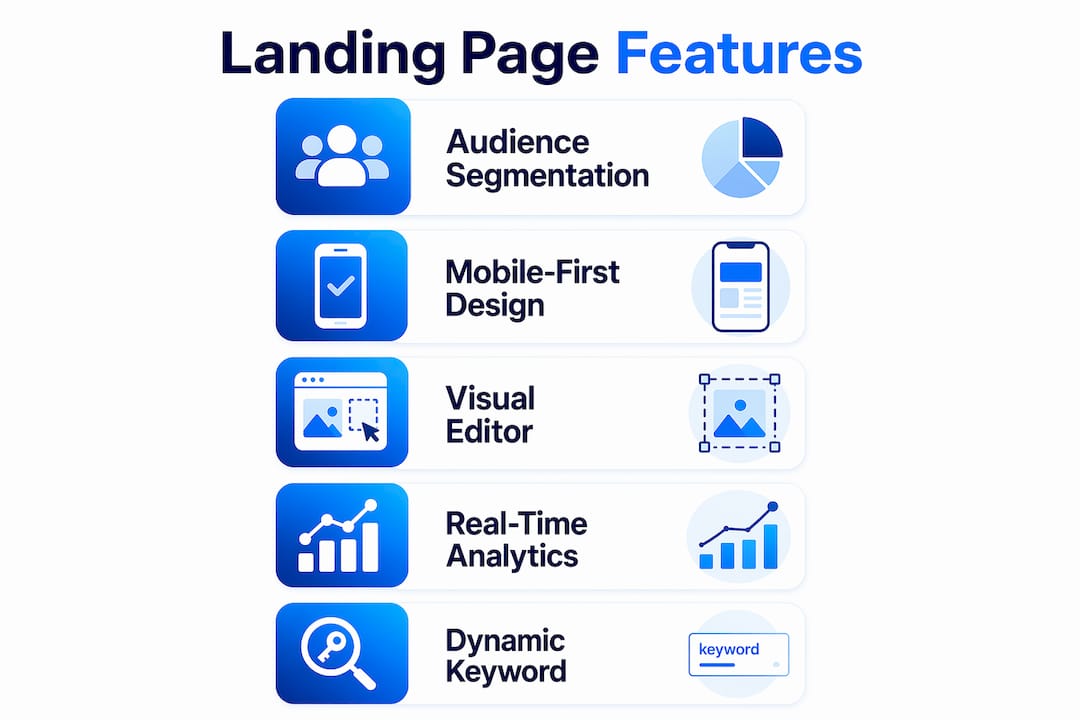
Optimizely Web Experimentation gives marketers direct control over page elements without requiring a developer for every change. Optimizely supports A/B testing, multivariate testing, dynamic content control, and audience targeting, all from a single dashboard. Each of these tools serves a specific role in landing page optimization.
Here is what each core feature does in practice:
- A/B testing: Pit two versions of a headline, CTA, or layout against each other with split traffic. You get statistically valid results without running separate campaigns.
- Multivariate testing: Test multiple elements simultaneously. Instead of running five sequential A/B tests, you test headline plus image plus CTA in one experiment.
- Dynamic content: Swap page copy, images, or offers based on audience segment, traffic source, or device type. A visitor from a Google Ads campaign sees different messaging than one arriving from email.
- Audience segmentation: Target specific visitor groups by geography, behavior, or referral source. This makes personalization precise rather than generic.
- Analytics integration: Optimizely connects with Google Analytics 4 and other data platforms, so your test results feed directly into your existing reporting stack.
Pro Tip: Use Optimizely's audience segmentation to create separate experiments for paid and organic traffic. The optimization priorities differ significantly between those two groups, and mixing them muddies your results.
Optimizely also supports mobile-first design testing, which matters more in 2026 than it did even two years ago. You can test mobile-specific layouts independently from desktop, giving you clean data on how each device type responds to your page changes.
What landing page best practices align with Optimizely?
The most effective landing page optimization follows a clear hierarchy. Fix message match first, then page speed, then design details. This order is not arbitrary. Message congruence between ad and page has a higher conversion impact than any color change or font swap you will ever run.
Here are the eight practices that consistently produce results inside Optimizely:
- Match your headline to your ad copy. If your Google Ad says "Free CRM Trial for Startups," your landing page headline must say the same thing. Any mismatch creates cognitive friction and kills conversions before the visitor reads another word.
- Use one CTA per page. A single CTA with no competing navigation links keeps the visitor's decision path simple. Remove the header nav entirely on dedicated landing pages.
- Hit the 3-second headline test. A visitor should understand your offer within three seconds of landing. Test this with real users before running any Optimizely experiment.
- Limit form fields to four or fewer. Forms with more than four fields see measurable drops in completion rates. If you need more data, collect it post-conversion.
- Place social proof near your CTA. A testimonial, review count, or trust badge directly above or below the CTA button reduces hesitation at the exact moment it matters most.
- Write benefit-led headlines. Lead with what the visitor gains, not what your product does. "Cut your ad spend by 30%" outperforms "Advanced Bid Management Software" every time.
- Add video where relevant. Video on landing pages can improve conversions by approximately 60%. Use a short explainer or testimonial clip above the fold.
- Balance SEO and conversion goals. Paid traffic pages should prioritize conversion over keyword density. Organic traffic pages need keyword targeting alongside a single conversion goal.
Pro Tip: Before you run your first Optimizely test, audit your landing page against this list manually. Fixing a broken message match costs nothing and often produces a bigger lift than any A/B test you will run afterward.
For a faster audit process, the 15-minute optimization guide from Gostellar walks you through the highest-impact checks in a single session.

How does Optimizely A/B testing improve conversion rates?
Optimizely A/B testing works by splitting your page traffic between two or more variants and measuring which version drives more of your target action. Optimizely's experimentation dashboard lets you test multiple variables simultaneously with split traffic control, giving you precise performance data without waiting months for sequential tests to conclude.
The elements worth testing, ranked by typical impact:
- Headlines: The single highest-leverage test on any landing page. A headline change can move conversion rates by double digits.
- CTA copy and color: "Start Free Trial" versus "Get My Free Account" often produces surprising differences. Test both the words and the button color.
- Form length: Test a three-field form against a five-field form. The data will tell you exactly what your audience tolerates.
- Page layout: Above-the-fold content arrangement, hero image versus no image, and single-column versus two-column layouts all produce measurable differences.
- Social proof placement: Test testimonials above the fold versus below the CTA. Position matters as much as content.
| Test Element | Typical Conversion Impact | Priority |
|---|---|---|
| Headline and message match | High | Test first |
| Page load speed | High | Fix before testing |
| CTA copy and placement | Medium to high | Test second |
| Form field count | Medium | Test third |
| Color and visual design | Low to medium | Test last |
Setting up a test in Optimizely takes under 20 minutes for a basic A/B experiment. Create your variant in the visual editor, define your goal metric, set your traffic split, and launch. Optimizely calculates statistical significance automatically and flags when a result is reliable enough to act on. The key discipline is not stopping a test early because one variant looks promising after 48 hours. Wait for significance.
For a deeper look at landing page testing strategy, Gostellar's resource library covers the methodology behind structuring experiments that produce trustworthy data.
How to optimize your Optimizely landing page for AI search and mobile in 2026
AI-generated search results from tools like Google's AI Overviews, Perplexity, and ChatGPT now send traffic to landing pages differently than traditional organic search. Visitors arriving from AI citations often have higher intent but shorter patience. They have already read a summary. They want confirmation and a clear next step, not a long sales pitch.
Mobile performance is equally non-negotiable. Mobile pages must load in under 1.5 seconds to avoid significant bounce rates. Every additional second of load time costs you visitors who will not come back. For mobile-specific optimization tactics, the approach differs from desktop in several important ways.
Key priorities for AI search and mobile optimization in 2026:
- Lead with your answer. AI search visitors already know the category. Your headline must confirm you are the right solution immediately, not after a paragraph of context.
- Compress and lazy-load images. Large image files are the most common cause of slow mobile load times. Use WebP format and defer off-screen images.
- Use structured data markup. Schema markup helps AI systems understand your page content and increases the likelihood of citation in AI-generated answers.
- Personalize with dynamic content. Optimizely's dynamic content tools let you swap headlines and offers based on the traffic source. A visitor from an AI citation sees different copy than one from a paid ad.
- Test thumb-friendly CTAs. Mobile buttons need to be large enough to tap without zooming. Test button size and placement separately from desktop experiments.
Page speed directly affects your landing page performance scores in Google's Core Web Vitals, which influence both paid Quality Scores and organic rankings. Gostellar's 5.4KB script adds testing capability without adding meaningful load time, which matters when every millisecond counts.
Key takeaways
Optimizely landing page optimization produces the highest returns when you fix message match and page speed before running any design experiments.
| Point | Details |
|---|---|
| Fix message match first | Align your headline with your ad copy before testing any other element. |
| Limit form fields | Keep forms to four fields or fewer to maximize completion rates. |
| Test in priority order | Run headline and CTA tests before color or layout experiments. |
| Optimize for mobile speed | Target a load time under 1.5 seconds to prevent bounce on mobile devices. |
| Use dynamic content | Personalize page copy by traffic source to increase relevance for each visitor segment. |
What I've learned from watching marketers use Optimizely wrong
Most marketers who underperform with Optimizely are not running bad tests. They are running the right tests in the wrong order. I have watched teams spend three weeks A/B testing button colors on a page where the headline does not match the ad that sent the traffic. The test produces a winner. The winner still converts at 3%. Nobody asks why.
The hierarchy matters more than the tool. Optimizely is genuinely powerful, but it amplifies whatever foundation you give it. A well-structured page with strong message match will produce meaningful test results. A page with a broken value proposition will produce meaningless ones, regardless of how sophisticated your experiment setup is.
The other mistake I see constantly is stopping tests too early. Optimizely shows you live data, and that live data is seductive. A variant that looks 40% better after day two often regresses to parity by day ten. Statistical significance is not a bureaucratic hurdle. It is the difference between a real insight and an expensive mistake.
My honest advice: treat Optimizely as a confirmation engine, not a discovery engine. Do the strategic thinking first. Decide what you believe is wrong with your page and why. Then use Optimizely to confirm or disprove that belief with data. Teams that approach it this way consistently outperform teams that run random tests hoping something sticks.
Balancing experimentation with creative instinct is also real. Data tells you what happened. It does not always tell you why. The best marketers I know use Optimizely results as a prompt for deeper thinking, not as a replacement for it.
— Juan
Take your landing page testing further with Gostellar
If you are running Optimizely experiments and want a faster, lighter testing layer for your landing pages, Gostellar is built for exactly that. Gostellar's 5.4KB script adds A/B testing to any page without slowing it down, which directly protects the load speed benchmarks you are working to hit.
The platform includes a no-code visual editor, dynamic keyword insertion for personalized pages, and real-time analytics that show results as they happen. For small to medium-sized businesses that need experimentation without a full development team, Gostellar offers a free plan for sites under 25,000 monthly tracked users. It pairs naturally with Optimizely workflows, giving you a lightweight option for high-frequency tests where speed matters most. Explore A/B test ideas to start your next experiment today.
FAQ
What is an Optimizely landing page?
An Optimizely landing page is a web page created and optimized using Optimizely's experimentation tools, including A/B testing, dynamic content, and audience segmentation, to improve conversion rates through data-driven decisions.
What conversion rate should I target for my landing page?
The median dedicated landing page converts at 6.6%. Top-performing pages exceed 11%, so use 6.6% as your baseline and 11% as a realistic improvement target.
How many fields should a landing page form have?
Limit your form to four fields or fewer. Forms with more than four fields see measurable drops in completion rates, regardless of the traffic source.
What should I test first in Optimizely?
Test your headline and message match before anything else. Fixing the alignment between your ad copy and page headline consistently produces larger conversion lifts than design or color changes.
Does page load speed affect Optimizely landing page performance?
Yes. Mobile landing pages must load in under 1.5 seconds to avoid significant bounce rates. Page speed also affects Google's Quality Score for paid campaigns and Core Web Vitals for organic rankings.
Recommended
Published: 6/16/2026