
Split Testing Strategies: Top 10 Tactics for 2026
TL;DR:
- Split testing compares different marketing versions to identify which drives better results through real user behavior.
- It requires testing one variable at a time, running for at least two weeks, with a minimum of 1,000 visitors per variation to ensure statistical significance.
Split testing is defined as the practice of showing two or more versions of a marketing element to separate audience segments simultaneously to determine which version drives better results. Marketers also call this A/B testing, and the two terms are interchangeable in practice. The core value is simple: real user behavior beats assumptions every time. Industry best practices require at least 1,000 visitors per variation and a minimum two-week test duration to reach statistical significance. Without those thresholds, your data is noise, not signal.

1. What is split testing and why does it matter?
Split testing meaning starts with one question: which version converts better? You create a control (version A) and a challenger (version B), split your traffic between them, and measure the outcome. The method removes opinion from the equation. Conversion rate optimization built on split tests produces decisions grounded in evidence, not instinct.
2. Test one variable at a time
Testing one variable at a time isolates cause and effect. If you change the headline and the button color in the same test, you cannot know which change drove the result. Pick a single element, create one challenger version, and run the test to completion. This discipline is what separates reliable data from interesting noise.
Pro Tip: Write your hypothesis before you build the variant. "Changing the CTA from 'Submit' to 'Get My Free Report' will increase clicks because it communicates value" is a testable hypothesis. "Let's try a new button" is not.
3. Hit the minimum sample size
Statistically significant results require at least 1,000 visitors per variation. That number is not arbitrary. Below it, random fluctuations in user behavior can look like real differences. If your landing page gets 200 visitors a week, you need five weeks minimum before you can trust the data. Plan your test calendar around your actual traffic volume.
4. Run tests for a full two weeks
A two-week test duration captures both weekday and weekend behavior patterns. User intent shifts across the week. A Monday visitor researching a B2B tool behaves differently than a Saturday visitor browsing casually. Running a split test for only three days during a high-traffic promotion skews results toward an unrepresentative audience segment. Two weeks is the floor, not the ceiling.
5. Prioritize high-impact elements first
Not all page elements are equal. Headlines, calls to action, hero images, and pricing displays drive the most measurable lift when tested. A button color change on a page with a weak headline produces marginal gains at best. Start with the element that has the most influence on the decision your visitor needs to make. That focus produces faster, larger wins and builds a stronger conversion rate over time.
6. Use split URL testing for major redesigns
Split URL testing sends visitors to two entirely different URLs rather than swapping elements on a single page. This method suits major redesigns, new landing page layouts, or completely different value propositions. It is the right tool when the changes are too extensive for a standard element swap. The tradeoff is that you learn which page wins, but not which specific element caused the difference.
7. Apply AI-driven traffic allocation
AI-powered dynamic traffic allocation shifts more visitors toward the better-performing variant in real time. Traditional split tests split traffic 50/50 for the entire duration. AI-driven systems reduce the traffic sent to underperforming variants as evidence accumulates. This accelerates learning and reduces the conversion cost of running the test. Gostellar uses this approach to help marketers reach conclusions faster without sacrificing statistical rigor.
8. Add qualitative data to your quantitative results
Numbers tell you what happened. Qualitative feedback tells you why. Session recordings, heatmaps, and short user surveys reveal the friction points that your conversion data only hints at. If variant B wins but users still drop off at the pricing section, your next test has a clear target. Pairing behavioral data with qualitative insight produces a complete picture, not just a winner.
9. Avoid simultaneous multi-variable tests without a framework
Testing multiple variables at once without a multivariate design disables attribution. You cannot tell which change caused the lift. Multivariate testing is a legitimate method, but it requires significantly more traffic to reach significance across all variable combinations. For most small and mid-sized marketing teams, standard A/B split tests with one variable produce cleaner, faster results. Reserve multivariate methods for high-traffic pages where you have the volume to support them.
Pro Tip: If you feel the urge to test five things at once, prioritize them by expected impact and run them sequentially. You will get cleaner data and a roadmap of wins.
10. Segment your results by audience group
A variant that wins overall can lose badly for a specific segment. A headline that resonates with mobile users may underperform for desktop visitors. Segmenting results by device, traffic source, geography, or new versus returning visitors reveals performance differences that aggregate data hides. Use split test segmentation to find the audience group where your variant performs best, then personalize accordingly.
11. Validate wins with follow-up tests
Novelty effects can temporarily inflate engagement after a change goes live. Users notice something different and interact with it out of curiosity, not genuine preference. That initial lift fades. Run a follow-up validation test four to six weeks after implementing a winner to confirm the gain holds. Sustainable conversion rate optimization requires confirmed wins, not one-time spikes.
Common pitfalls in split testing
The most damaging mistake is stopping a test early. Peeking at results and declaring a winner before the predetermined end date inflates false positives. A variant that leads after three days often loses its edge by day fourteen.
Other frequent errors include:
- Ignoring random assignment. If your traffic split is not truly random, your results reflect a sampling bias, not a real difference.
- Skipping the hypothesis. Tests without a defined success metric produce data you cannot act on.
- Misreading external factors. A sale, a news event, or a seasonal spike during your test window corrupts the data. Note external events and account for them in your analysis.
- Treating every metric equally. Click-through rate and revenue per visitor are not the same signal. Define your primary metric before the test starts.
Pro Tip: Set your test end date before you launch. Write it down. Do not check results daily. Checking daily creates pressure to stop early, which is the single fastest way to generate false conclusions.
How to analyze and interpret split test results
Statistical significance at the 95% confidence level means there is only a 5% chance your result is due to random variation. That is the standard threshold before declaring a winner. A p-value below 0.05 clears that bar. Most testing platforms calculate this automatically, but understanding what it means prevents misinterpretation.
Beyond the primary conversion metric, track these supporting signals:
- Bounce rate by variant. A higher conversion rate paired with a higher bounce rate can indicate a misleading CTA.
- Revenue per visitor. A variant with fewer conversions but higher order value can outperform on revenue.
- Time on page. Significant drops may indicate a confusing layout even when conversion rates look stable.
For a deeper breakdown of result interpretation methods, the CRO analysis guide covers confidence intervals, segmentation analysis, and common misreads in detail.
Choosing the right split testing platform
The right tool depends on your traffic volume, technical resources, and testing goals. Three categories cover most marketing teams.
Entry-level platforms offer basic A/B testing with a visual editor and simple reporting. They suit teams running fewer than five tests per month on moderate traffic. Setup requires minimal technical knowledge.
Mid-tier platforms add segmentation, goal tracking, and integrations with analytics and CRM tools. They suit growing teams that need to test across multiple pages and audience segments simultaneously.
Enterprise platforms include multivariate testing, AI-driven traffic allocation, and advanced statistical modeling. They require more technical setup but deliver faster results at high traffic volumes.
Key features to evaluate in any platform: no-code visual editing, real-time analytics, statistical significance calculators, traffic segmentation, and integration with your existing marketing stack. For a full breakdown of what to look for, the split testing platform guide covers each category in depth.
Key takeaways
Split testing produces reliable conversion gains only when tests run to statistical significance, isolate one variable at a time, and validate wins with follow-up experiments.
| Point | Details |
|---|---|
| Minimum sample size | Run at least 1,000 visitors per variation before reading results. |
| One variable per test | Changing one element at a time keeps attribution clean and results trustworthy. |
| Two-week minimum duration | Shorter tests miss behavioral variation across weekdays and weekends. |
| 95% confidence threshold | Declare a winner only when statistical significance clears the 95% confidence level. |
| Validate initial wins | Follow-up tests confirm whether novelty effects inflated early performance gains. |
What most split testing advice gets wrong
I have run split tests for marketing teams ranging from solo founders to mid-sized SaaS companies, and the pattern I see most often is impatience dressed up as urgency. A marketer launches a test on monday, checks results by wednesday, sees variant B leading by 12%, and ships it. Three weeks later, conversions are flat or lower. The test was never finished. The "winner" was a statistical artifact.
The discipline that separates good testers from great ones is not technical. It is behavioral. You have to commit to the end date before you start, treat early results as irrelevant, and resist the organizational pressure to show wins quickly. That is harder than it sounds when a VP is asking for weekly updates.
The second thing I have learned is that qualitative feedback is not the enemy of quantitative rigor. It is the compass. Numbers tell you variant B won. A five-minute user interview tells you it won because the new headline finally matched what the visitor was already thinking. That insight generates your next three test hypotheses. Teams that skip qualitative research run out of good ideas fast.
Finally, AI-driven traffic allocation is genuinely worth adopting. It is not a gimmick. Shifting traffic toward a leading variant in real time reduces the conversion cost of testing and shortens the learning cycle. For teams with limited traffic, that efficiency matters enormously.
— Juan
Gostellar makes split testing faster and simpler
Running well-structured split tests should not require a developer or a statistics degree. Gostellar is built for marketers who want to move fast without breaking their data.
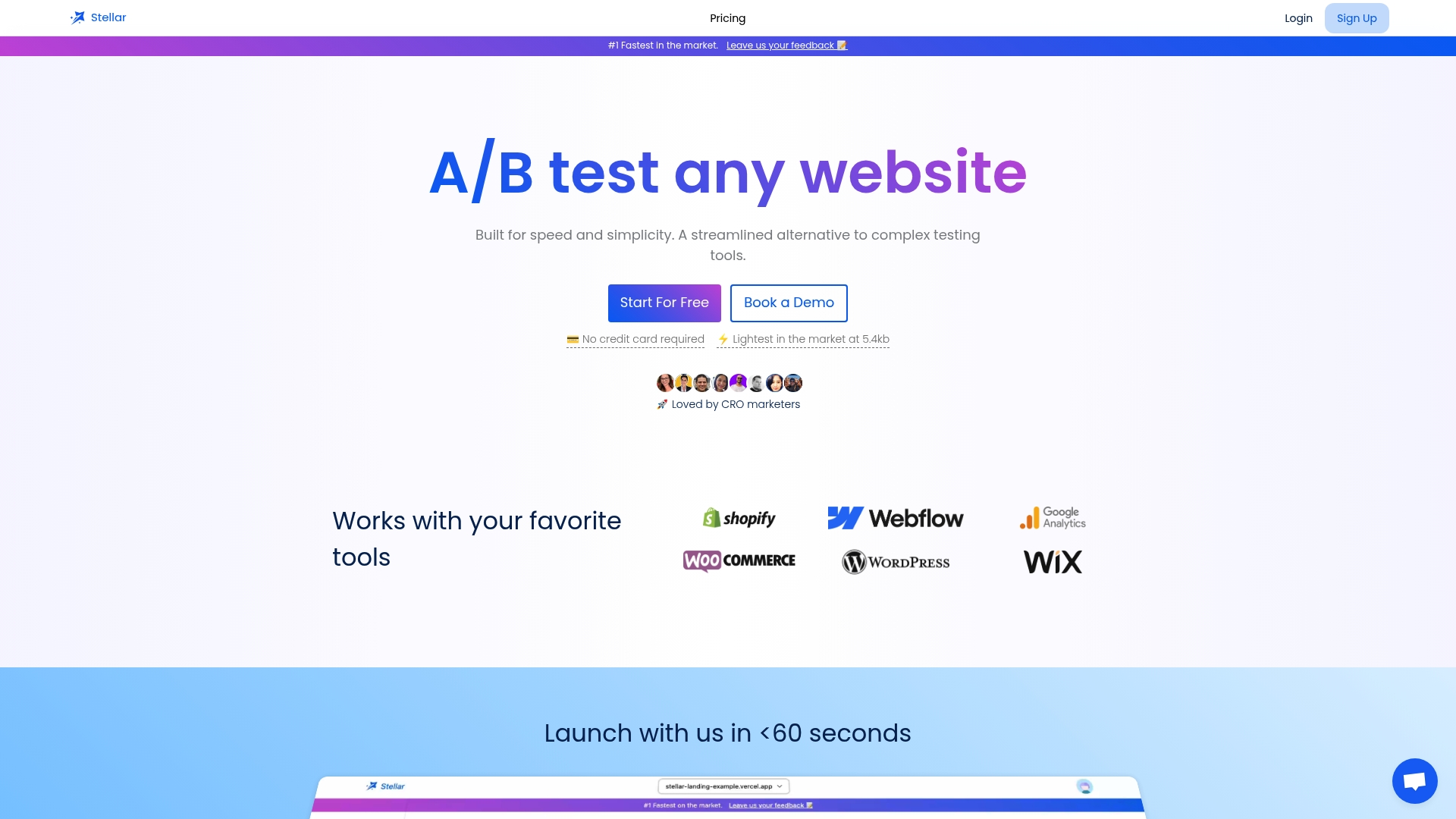
Gostellar's no-code visual editor lets you build and launch variants in minutes. Its 5.4KB script adds no meaningful load time to your pages. Real-time analytics surface results as they accumulate, and the platform's goal tracking covers everything from clicks to revenue. A free plan covers businesses with under 25,000 monthly tracked users, so you can start split testing without a budget commitment. For teams ready to put these strategies into practice, Gostellar removes the friction between a good hypothesis and a live test.
FAQ
What is a split test in marketing?
A split test compares two or more versions of a marketing element, such as a headline or CTA, by showing each version to a separate audience segment and measuring which drives better results.
How many visitors do I need for a valid split test?
Industry best practice requires at least 1,000 visitors per variation before results are statistically reliable. Lower traffic volumes produce data that reflects random variation rather than real differences.
What does statistical significance mean in split testing?
Statistical significance at the 95% confidence level means there is only a 5% probability the result occurred by chance. Most testing platforms calculate this automatically using p-values.
How long should a split test run?
A split test should run for a minimum of two weeks to capture both weekday and weekend behavior. Stopping earlier risks declaring a winner based on an unrepresentative traffic sample.
What is the difference between split testing and multivariate testing?
Split testing compares one variable across two versions. Multivariate testing tests multiple variables simultaneously but requires significantly more traffic to reach valid conclusions across all combinations.
Recommended
Published: 7/7/2026