
Split Testing Platform Guide for Marketers in 2026
TL;DR:
- A split testing platform divides website traffic between multiple page variants to measure which performs better. Effective platforms support reliable traffic splitting, statistical analysis, and seamless integration, ensuring accurate experiment results. Gostellar offers a lightweight, no-code testing tool suitable for small and medium businesses aiming for fast, reliable results.
A split testing platform is a tool that randomly divides live website traffic between two or more page variants and measures which version drives better results. This is the standard definition of A/B testing, the controlled experiment method that sits at the core of conversion rate optimization. Choosing the right platform determines whether your experiments produce reliable data or misleading noise. This guide covers what to look for, how platform categories differ, and how to match a tool to your business needs.
What makes a split testing platform effective?
The best split testing platforms share five core capabilities: reliable traffic splitting, statistical analysis support, flexible variant rendering, tech stack integration, and low performance impact. Each capability affects the quality of your test data and the speed of your site. Missing even one can compromise your entire experimentation program.

Traffic splitting and sample consistency are the foundation. A/B testing splits live traffic randomly and evenly between variants while measuring defined target metrics. Any platform that allows uneven assignment or session inconsistency will corrupt your results before you even analyze them.
Statistical rigor separates serious platforms from toys. A valid eCommerce A/B test requires roughly 300 to 400 conversions per variant to detect a 5% minimum effect at 95% confidence and 80% power. Platforms that show you results without surfacing confidence intervals or required sample sizes are actively dangerous to your decision-making.
Variant rendering method matters more than most marketers realize. Client-side JavaScript tools inject variants after the page loads, which causes flicker and adds latency. Server-side and edge-based rendering eliminate both problems. Edge-level rendering can reduce JavaScript bundle weight from 80–200KB down to 0KB, cutting setup time from days to minutes.
Integration with your analytics stack is non-negotiable. Tech stack compatibility determines whether experiment data flows cleanly into your reporting tools or requires manual reconciliation. Platforms that connect natively to Google Analytics 4, Segment, or your CRM save hours of data wrangling per test.
Pro Tip: Before signing up for any platform, check whether it fires its tracking script synchronously or asynchronously. Synchronous scripts block page rendering and hurt Core Web Vitals scores, even if the tool claims to be lightweight.
1. Entry-level platforms with visual editors
Entry-level platforms target marketing teams with no developer resources. They use no-code visual editors that let you click on page elements and swap copy, images, or layouts without touching code. Setup takes minutes, not days. The tradeoff is that these tools rely on client-side JavaScript, which adds script weight to every page load. For teams running simple copy or layout tests on moderate traffic, this category delivers fast results at low cost.
2. Mid-market platforms with multivariate support
Mid-market tools add multivariate testing to the standard A/B feature set. Multivariate testing requires significantly more traffic than A/B testing because it tests combinations of changes rather than single isolated changes. A test with three headline variants and three image variants creates nine combinations, each needing its own sample. These platforms suit teams with consistent monthly traffic above 50,000 sessions who want to test multiple page elements simultaneously.
3. Enterprise platforms with server-side testing
Enterprise platforms move experiment logic off the browser and onto the server or CDN. This approach eliminates flicker entirely and gives engineering teams precise control over which users see which variants. Server-side and feature-flag-driven platforms suit larger organizations running complex experiments across authenticated user sessions, mobile apps, and APIs. The cost is higher, and implementation requires developer involvement, but the data quality is superior.
4. Edge-computing platforms using Cloudflare Workers
Edge-level testing is the most technically advanced category available in 2026. Cloudflare Workers handle traffic splits and variant rendering at the edge, achieving zero flicker and near-zero additional latency compared to traditional client-side JavaScript approaches. This architecture preserves Core Web Vitals scores while running experiments at scale. Teams with engineering resources and performance-sensitive pages benefit most from this setup.
5. Open-source and self-hosted solutions
Open-source testing frameworks give technical teams full control over data, logic, and infrastructure. There are no per-seat or per-event fees, which makes them attractive for high-traffic sites with tight budgets. The real cost is engineering time: someone on your team must maintain the codebase, manage deployments, and build the statistical analysis layer. This category works well for product engineering teams who treat experimentation as a core infrastructure component.
6. Platforms built for eCommerce conversion optimization
eCommerce-specific platforms pre-build the metrics that matter most to online retailers: add-to-cart rate, checkout completion, and revenue per visitor. They integrate directly with Shopify, WooCommerce, and similar platforms, pulling product and order data without custom event tracking. For conversion rate optimization focused teams, this reduces setup time and keeps experiment goals tied directly to revenue outcomes.
7. Lightweight SaaS platforms for small and medium businesses
Small and medium businesses need testing tools that do not slow down their sites or require a dedicated data team. Gostellar fits this category precisely. Gostellar's script weighs only 5.4KB, which is among the smallest footprints of any commercial A/B testing tool. It includes a no-code visual editor, dynamic keyword insertion for personalized landing pages, advanced goal tracking, and real-time analytics. Gostellar offers a free plan for businesses with under 25,000 monthly tracked users, making it accessible without upfront commitment.
8. Platforms with dynamic personalization features
Some testing tools extend beyond pure experimentation into personalization. Dynamic keyword insertion, for example, rewrites landing page headlines to match the search term a visitor used before clicking your ad. This feature sits at the intersection of A/B testing and audience segmentation. Platforms that combine both capabilities let you test personalized variants against generic ones, which often produces larger conversion lifts than standard copy tests.
9. Platforms with built-in statistical significance calculators
Statistical significance calculators built into the platform dashboard prevent the most common testing mistake: calling a winner too early. Prematurely ending A/B tests based on early temporary lifts misleads marketers. A false 12% lift on day three can disappear entirely once the full sample is reached. Platforms that surface confidence levels, p-values, and required sample sizes in the main dashboard make it harder to act on incomplete data.
10. Platforms with feature flag and rollout management
Feature flag platforms blur the line between A/B testing and product deployment. They let engineering teams release new features to a percentage of users, monitor performance, and roll back instantly if something breaks. This capability is valuable for product teams running experiments on application behavior rather than page content. The best platforms in this category combine feature flags with statistical analysis so product managers can make rollout decisions based on measured outcomes, not gut feel.
Comparison of platform categories by key capabilities
The table below maps platform categories to the factors that matter most when choosing a web testing tool.
| Platform category | Traffic splitting method | Statistical rigor | Performance impact | Best for |
|---|---|---|---|---|
| Entry-level visual editor | Client-side JavaScript | Basic significance display | Moderate script weight | Small teams, simple tests |
| Mid-market multivariate | Client-side JavaScript | Confidence intervals included | Moderate to high script weight | Growing teams, multi-element tests |
| Enterprise server-side | Server or CDN layer | Full statistical controls | Near zero | Large orgs, complex experiments |
| Edge computing | Cloudflare Workers or equivalent | Varies by implementation | Zero flicker, near-zero latency | Performance-critical sites |
| Open-source self-hosted | Custom implementation | Custom-built | Depends on setup | Engineering-led teams |
| Lightweight SaaS (e.g., Gostellar) | Client-side, 5.4KB script | Real-time analytics | Minimal | SMBs, marketers without developers |
Pro Tip: Ask any vendor for their script's impact on Largest Contentful Paint (LCP) before committing. A tool that adds 300ms to LCP on mobile will cost you more in lost conversions than it saves through testing.
How to choose the right platform for your business
Choosing a testing platform starts with an honest assessment of your team's technical skills. A no-code visual editor is the right starting point if your marketing team runs tests without developer support. If your engineering team owns the experimentation roadmap, server-side or edge-based tools give you more control and better data quality.
Traffic volume is the second filter. Effective A/B testing requires waiting for the full designated sample size to avoid misleading conclusions from short-term fluctuations. Sites with fewer than 10,000 monthly visitors will struggle to reach statistical significance on most tests within a reasonable timeframe. Low-traffic sites should run fewer, higher-impact tests rather than spreading attention across many small experiments.
Budget and integration requirements narrow the field further. Consider these questions before making a final decision:
- Does the platform connect natively to your analytics tool (Google Analytics 4, Mixpanel, Segment)?
- Does the pricing model charge by traffic volume, test count, or seat?
- Does the platform expose raw experiment data via API for custom reporting?
- Does the vendor publish documentation on script performance impact?
- Does the free tier or trial period give you enough runway to run one complete test?
Experimentation discipline matters as much as platform features. Expanding a testing program faster than you can maintain statistical discipline produces unreliable results. The right platform supports your current testing cadence and grows with your program, rather than pushing you to run more tests than your traffic can support.
Key takeaways
The most effective split testing platform balances statistical rigor, minimal performance impact, and integration with your existing analytics stack to produce reliable conversion data.
| Point | Details |
|---|---|
| Statistical rigor is non-negotiable | Require 300–400 conversions per variant before calling a winner at 95% confidence. |
| Script weight affects conversion rates | Choose platforms with lightweight scripts; Gostellar's 5.4KB footprint sets a strong benchmark. |
| Match platform complexity to team skills | No-code tools suit marketing-led teams; server-side tools suit engineering-led programs. |
| Integration determines data quality | Platforms that connect natively to your analytics stack reduce manual data reconciliation. |
| Edge rendering eliminates flicker | Edge-level tools like Cloudflare Workers-based setups achieve zero flicker and near-zero latency. |
What I've learned after years of watching teams pick the wrong tool
Most teams pick a testing platform the wrong way. They choose based on a demo, a pricing page, or a recommendation from someone in a Slack community. Then they spend six months running tests that produce no actionable conclusions, and they blame their hypotheses instead of their setup.
The real problem is almost always one of three things. First, the platform's script is too heavy, and the variant flickers on load, which biases user behavior before the test even starts. Second, the team calls winners too early because the platform's dashboard shows a green checkmark at 70% confidence instead of 95%. Third, the platform does not integrate with the analytics tool the team actually uses, so experiment data lives in a silo and never influences broader marketing decisions.
I've seen teams run experiment results analysis correctly and still draw wrong conclusions because their platform assigned traffic unevenly across device types. Mobile users behaved completely differently from desktop users, and the platform lumped them together. Segment-level analysis only became possible after switching to a tool that exposed raw assignment data via API.
My honest recommendation: start with the lightest tool that supports your current test volume and has native integration with your analytics stack. Do not pay for multivariate capabilities until you have run at least 20 clean A/B tests and built the internal discipline to see them through to full sample size. Platform features do not matter if your team does not have the process to use them correctly. Read through A/B testing best practices before you even open a vendor's pricing page. The methodology comes first.
— Juan
Gostellar: a fast, focused platform for marketing teams
Marketers who want to run clean experiments without slowing down their sites have a direct option in Gostellar.
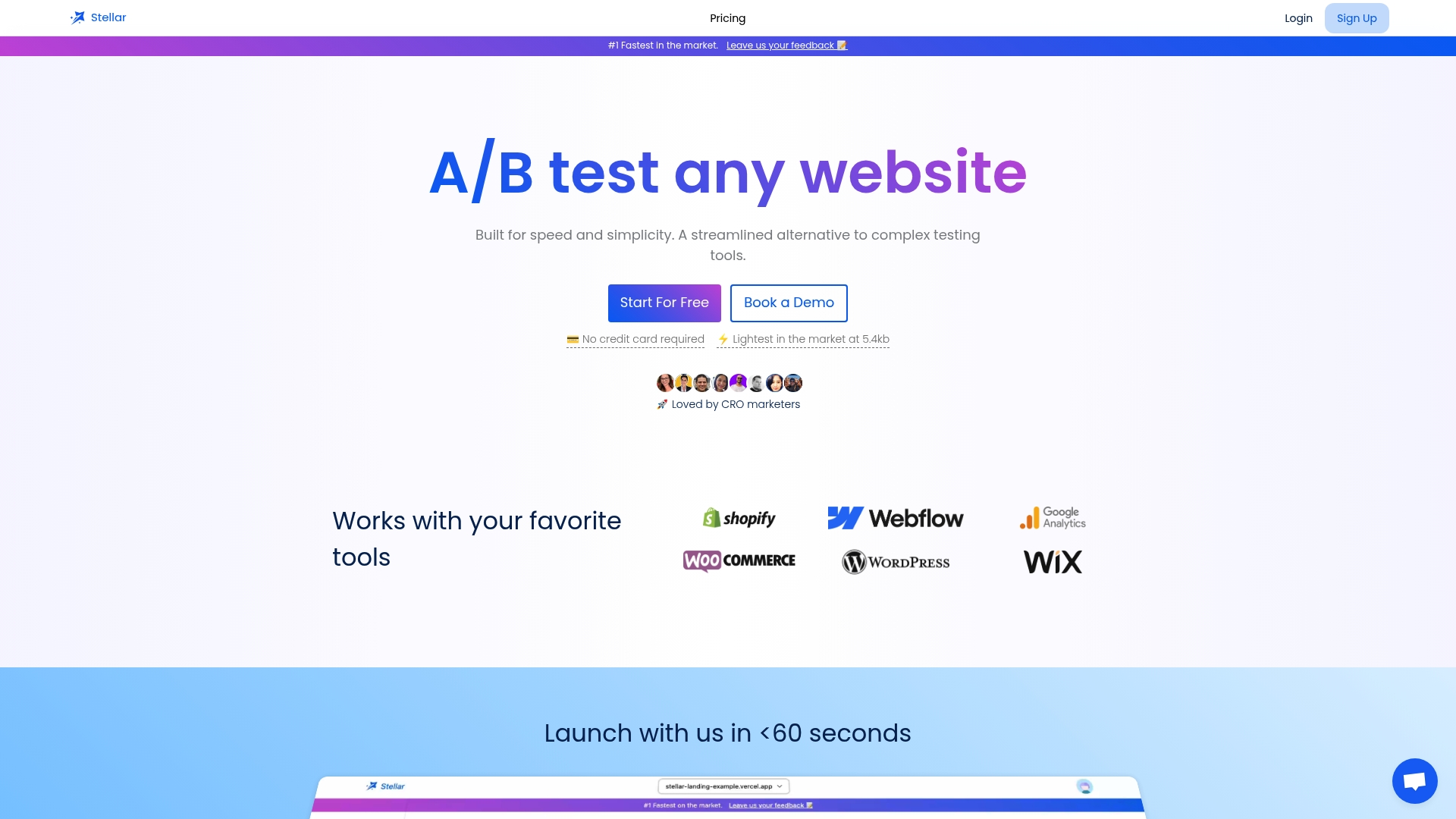
Gostellar's 5.4KB script delivers one of the smallest performance footprints available in any commercial A/B testing tool. The no-code visual editor lets you build and launch variants without writing a line of code. Dynamic keyword insertion personalizes landing pages to match visitor search intent, and real-time analytics surface results as traffic accumulates. Gostellar's free plan covers businesses with up to 25,000 monthly tracked users, making it a practical starting point for small and medium businesses that want to test without a large upfront investment. Paid tiers scale with traffic and feature needs as your program grows.
FAQ
What is a split testing platform?
A split testing platform is a tool that divides website traffic between two or more page variants and measures which version performs better on a defined metric. The industry standard term for this method is A/B testing.
How many conversions do I need for a valid A/B test?
A defensible A/B test requires roughly 300 to 400 conversions per variant to detect a 5% minimum effect at 95% confidence and 80% statistical power.
What is the difference between client-side and server-side testing?
Client-side testing injects variants via JavaScript after the page loads, which can cause flicker and add script weight. Server-side testing renders the correct variant before the page reaches the browser, eliminating flicker and reducing performance impact.
How does script size affect A/B testing results?
Heavy testing scripts slow page load times, which can alter user behavior and bias your test results. Lightweight scripts like Gostellar's 5.4KB implementation minimize this effect and preserve Core Web Vitals scores.
When should I use multivariate testing instead of A/B testing?
Use multivariate testing when you need to test combinations of multiple page elements simultaneously and your site has enough traffic to reach statistical significance across all combinations. Multivariate tests require significantly more traffic than standard A/B tests.
Recommended
Published: 6/25/2026