
Types of Web Testing: A Practical Guide for Marketers
TL;DR:
- Choosing the wrong web testing types poses a significant business risk by potentially damaging user experience and conversion rates.
- Most teams overlook the importance of comprehensive planning and real-user data, relying solely on lab scores and automated tools.
Choosing the wrong types of web testing for your project is not just a technical mistake. It's a business risk. A site that looks perfect in one browser but breaks in another, loads in four seconds on mobile, or exposes user data through an unpatched form can silently drain your conversion rate while your team celebrates a successful launch. This guide walks through the full range of web testing methods available, explains what each one actually does, and helps you decide which combination makes sense for your goals.
Table of Contents
- Key Takeaways
- Types of web testing and how to choose between them
- 1. Smoke testing
- 2. Sanity testing
- 3. Regression testing
- 4. Acceptance testing
- 5. Performance testing
- 6. Security testing for websites
- 7. Usability testing
- 8. Accessibility testing
- 9. Compatibility testing
- 10. Black-box, white-box, and experience-based testing
- How to choose the right testing mix
- My take on what most teams get wrong about web testing
- Put your testing insights to work with Gostellar
- FAQ
Key Takeaways
| Point | Details |
|---|---|
| Functional vs. non-functional | Functional testing checks if features work; non-functional testing measures how well they work under real conditions. |
| Test levels prevent overlap | Organizing tests across component, integration, system, and acceptance levels keeps your process efficient and your coverage complete. |
| Accessibility is ongoing | WCAG 3.0 treats conformance as a continuous process, not a one-time checkbox. |
| Combine test techniques | Mixing black-box, white-box, and experience-based approaches catches more defects than using any single method alone. |
| Lab scores mislead without real-user data | Google Lighthouse scores reflect controlled conditions; pair them with real-user monitoring for accurate performance decisions. |
Types of web testing and how to choose between them
Before you pick a testing type, you need to know what you're trying to protect. Quality dimensions for web testing include functionality, usability, compatibility, security, and performance. Each one targets a different failure mode. A broken checkout button is a functionality problem. A form that confuses first-time visitors is a usability problem. A page that scores 95 on desktop but crashes on Android is a compatibility problem.
ISTQB classifies test types across two primary dimensions: what you're testing (functional or non-functional) and how you're testing it (black-box, white-box, or experience-based). Understanding this framework before you start saves you from either running redundant tests or missing whole categories of risk.
It also helps to think in test levels. Test levels are organized activities that map to different phases of development: component testing, integration testing, system testing, and acceptance testing. Each level has a distinct scope, so you avoid testing the same thing twice at the wrong stage.
- Functionality: Does every feature do what it's supposed to do?
- Usability: Can real users accomplish their goals without confusion?
- Compatibility: Does the site work correctly across browsers, devices, and operating systems?
- Security: Are user data and transactions protected against known vulnerabilities?
- Performance: Does the site load fast enough to keep users engaged?
Pro Tip: Before writing a single test case, map your project's highest-risk quality dimension. A content-heavy marketing site carries more usability and performance risk. An e-commerce checkout carries more security and functional risk. That mapping tells you where to invest first.
1. Smoke testing
Smoke testing is the health check you run before anything else. After a new build deploys, you run a small set of critical tests to confirm the site is even worth testing further. Think of it as checking whether the engine starts before you worry about fuel efficiency.
For marketers, smoke tests typically cover: does the homepage load, does the primary CTA work, and does the navigation render. For developers, they cover: do core API endpoints respond, and do major user flows complete without crashing. If smoke tests fail, you stop and fix before running anything else. It saves hours.
2. Sanity testing
Sanity testing is narrower than smoke testing. You run it after a specific bug fix or small change to confirm that one area works correctly without re-running the full test suite. Where smoke tests ask "is the whole site alive?", sanity tests ask "did this specific fix actually work?"
This distinction matters in fast-moving marketing environments where hotfixes go out regularly. Sanity testing keeps your cycle times short without skipping verification entirely.
3. Regression testing
Regression testing answers the question every developer dreads: "Did my fix break something that was already working?" You run it after any code change, including updates, new features, or third-party script additions.
Confirmation testing verifies specific fixes, while regression testing checks the broader environment for unintended breaks. The two are often confused. Regression testing should be automated wherever possible since it tends to grow large quickly. For marketing sites, pay special attention to regression testing after adding new tracking scripts or CMS updates. Those are common sources of silent breakage.
Pro Tip: Automate your regression suite incrementally. Start with the five user flows that drive the most conversions and expand from there. A full regression suite built upfront almost never gets maintained.
4. Acceptance testing
Acceptance testing is the final gate before a release goes live. It answers a specific question: does this site or feature meet the agreed-upon requirements from the stakeholder's perspective? It's sometimes called User Acceptance Testing (UAT).
For marketers, this is where you verify that a new landing page behaves exactly as the creative brief specified. For developers, it confirms that the build matches the functional specification. Acceptance testing is not about finding every bug. It's about confirming readiness.
5. Performance testing
Performance testing measures how fast and stable your site is under real and simulated conditions. Google Lighthouse assigns performance scores from 0 to 100 using metrics like First Contentful Paint and Cumulative Layout Shift. These lab-based scores are useful starting points, but they don't tell the whole story.

Lighthouse scores should be paired with real-user monitoring data. A page can score 90 in a lab environment and still load in four seconds for a user on a 4G connection in a different region. For deeper guidance on performance benchmarks specific to growth and conversion goals, the 2025 CRO performance guide breaks this down well.
Performance testing also includes load testing (how the site behaves under high traffic) and stress testing (what happens when you push past capacity). Both matter if you're running paid campaigns that drive traffic spikes.
6. Security testing for websites
Security testing for websites checks for vulnerabilities that could expose user data, allow unauthorized access, or enable attacks like SQL injection and cross-site scripting (XSS). It's not optional if you collect any form of user input, process payments, or store personal data.
Common areas covered include authentication flows, session management, input validation, and API security. You don't need to run a full penetration test on every release, but you should build baseline security checks into your regular testing cycle. Most teams underinvest here until something goes wrong publicly.
7. Usability testing
Usability testing puts real users in front of your site and observes where they get confused, frustrated, or lost. Functional testing verifies correctness, but usability testing measures the actual experience of using the site. A form can work perfectly from a technical standpoint and still have an abandonment rate of 70%.
For marketers, usability testing is one of the most directly tied to revenue. Finding that your primary CTA is misunderstood, your pricing page creates confusion, or your onboarding flow loses users at step two can have an immediate impact on conversions. Remote unmoderated testing tools make this accessible even for small teams.
8. Accessibility testing
Accessibility testing checks whether your site can be used by people with visual, motor, auditory, or cognitive disabilities. WCAG 3.0 uses outcome-based conformance models that treat accessibility as an evolving standard rather than a one-time certification.
The business case is straightforward. Sites with strong accessibility also perform better in search and convert better with users who rely on keyboard navigation or assistive technology. The connection between accessibility and conversions is more direct than most marketers realize. Automated tools catch roughly 30% of accessibility issues. The rest require manual review and real user testing with assistive technologies.
9. Compatibility testing
Compatibility testing confirms that your site works correctly across different browsers, operating systems, and screen sizes. A layout that renders perfectly in Chrome can collapse in Safari. A JavaScript feature that works in the latest Firefox may fail in an older mobile browser.
For A/B testing specifically, compatibility failures skew your results. If a variant only breaks on one browser and you don't catch it, your test data is compromised. The guide on browser compatibility for A/B tests covers exactly this scenario with practical checklists.
| Browser/Device Category | Common Issues Found |
|---|---|
| Safari on iOS | Flexbox rendering, form input styling, cookie handling |
| Older Android browsers | JavaScript ES6 support, font rendering |
| Internet Explorer 11 | CSS Grid, fetch API, SVG handling |
| Chrome on Windows | Usually baseline; catches most issues |
| Firefox | Scrollbar styling, some CSS property differences |
10. Black-box, white-box, and experience-based testing
These three approaches describe how you test, not what you test. Understanding the distinction helps you build more complete test coverage.
Black-box techniques test based on specifications without any knowledge of internal code. You define inputs and verify outputs. Most functional web testing runs this way. White-box testing examines the internal structure of the code itself. It requires developer access and is typically used for unit tests and code coverage analysis.
Experience-based testing uses the tester's knowledge and intuition to find defects that scripted tests miss. Exploratory testing is the most common form. A skilled tester given 90 minutes to probe your checkout flow will often find issues that no documented test case would have caught.
| Approach | Knowledge Required | Best Used For |
|---|---|---|
| Black-box | Specification only | Functional, usability, acceptance |
| White-box | Source code access | Unit tests, code coverage |
| Experience-based | Tester expertise | Exploratory, edge cases |
Combining all three approaches catches more defects than relying on any one method alone. Most effective teams use black-box testing as the primary method, supplement it with white-box coverage for critical paths, and add exploratory sessions before major releases.
How to choose the right testing mix
Selecting your testing mix comes down to three factors: your site's primary risk profile, your team's capacity, and your release frequency. Here is a practical comparison to guide your decisions:
| Testing Type | Best for | Effort Level | Automate? |
|---|---|---|---|
| Smoke | Every release | Low | Yes |
| Regression | Code changes | Medium-High | Yes |
| Performance | Traffic-driven or CRO-focused sites | Medium | Partially |
| Security | E-commerce, lead gen, member sites | High | Partially |
| Accessibility | All public-facing sites | Medium | Partially |
| Usability | New features, redesigns | High | No |
| Compatibility | Multi-device or international sites | Medium | Yes |
Marketers running conversion-focused sites should prioritize usability, performance, and compatibility testing first. Developers building product features should add regression and security testing early. Everyone benefits from accessibility testing, and almost no one does enough of it.
Pro Tip: If you're resource-constrained, the single highest-ROI testing investment for most marketing sites is performance testing combined with real-user monitoring. The connection between site speed and business outcomes is well-documented, and the tools to measure it are mostly free.
My take on what most teams get wrong about web testing
I've worked with enough marketing and development teams to say this confidently: most people treat testing as something that happens at the end of a project, and they treat it as purely mechanical. Run the tests, check the boxes, ship it.
Testing encompasses planning, designing, and evaluating aligned with your development process. That means decisions you make before a single test runs, like which quality dimensions matter most for this release, what your acceptance criteria actually are, and which risks you're consciously accepting, shape the outcome more than the tests themselves.
The other mistake I see constantly is over-trusting Lighthouse scores. Developers celebrate a 95 performance score and call it done. But lab-based scores don't capture real user experience, and a real user on a mid-range Android device in a rural area may experience something completely different. Performance testing without real-user monitoring is half a job.
And on accessibility: I've watched teams run an automated accessibility scan, get a clean report, and consider it finished. Automated tools catch maybe a third of real issues. The rest require humans, ideally humans with disabilities, actually using your site. WCAG 3.0 exists as a living standard because accessibility testing is ongoing, not a one-time exercise.
My actual advice? Pick two or three testing types that match your biggest risks, do them well and consistently, and expand from there. Trying to do everything at once leads to shallow coverage across the board.
— Juan
Put your testing insights to work with Gostellar
You now have a clear picture of the full range of testing types available and where each one delivers the most value. The next step is building a testing practice that fits your actual workflow, not a theoretical ideal.
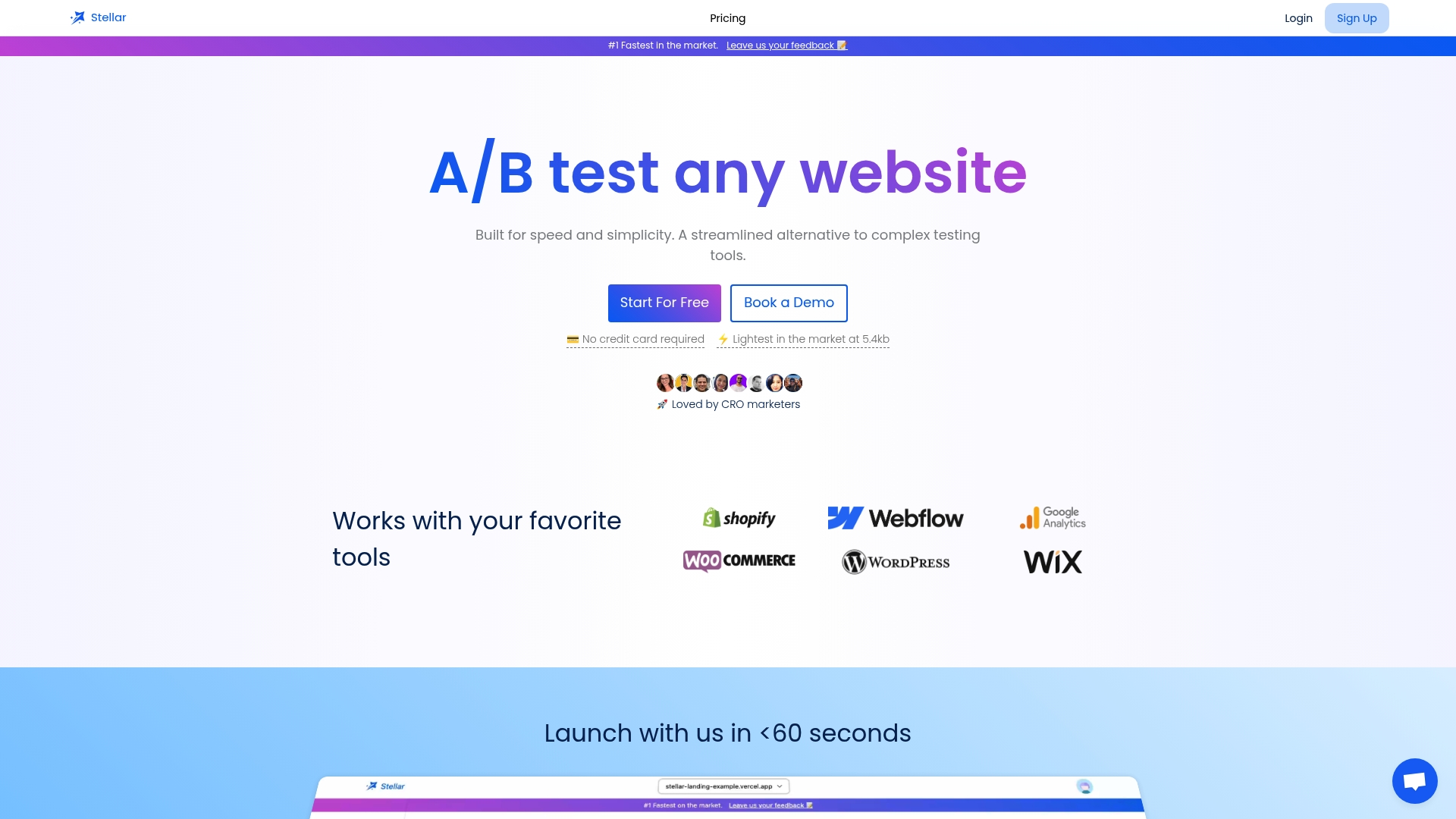
Gostellar is built specifically for marketers and growth teams who want to test and improve their sites without needing a full engineering squad. The platform's A/B testing tool runs on a 5.4KB script that won't compromise the performance scores you just finished optimizing. The no-code visual editor lets you set up experiments directly, while real-time analytics give you the data to make decisions with confidence. Whether you're testing a new landing page variant, measuring the impact of a UX change, or tracking conversion goals across segments, Gostellar keeps the process fast and measurable. There's a free plan for sites under 25,000 monthly tracked users, so there's no reason not to start.
FAQ
What are the main types of web testing?
The main types include functional testing (smoke, sanity, regression, acceptance), non-functional testing (performance, security, usability, accessibility, compatibility), and approach-based testing (black-box, white-box, and experience-based). Each targets a different quality dimension of your site.
What is functional web testing?
Functional testing verifies that your site's features work as intended. It checks inputs, outputs, and user flows against defined requirements, without concern for how fast or secure those features are.
How often should you run regression testing?
Run regression testing after every code change, including minor updates, plugin additions, or third-party script changes. Automating your regression suite makes this sustainable at any release frequency.
What does security testing for websites cover?
Security testing checks for vulnerabilities including SQL injection, cross-site scripting, broken authentication, and insecure data handling. It should be part of every release cycle for sites that collect user input or process transactions.
What are the best web testing practices for small teams?
Focus on automating smoke and regression tests first, prioritize performance and usability testing for highest-traffic pages, and add accessibility testing using a combination of automated tools and manual review. Depth on fewer test types beats shallow coverage across all of them.
Recommended
Published: 5/21/2026