
What is usertesting? Improve UX and conversions easily
TL;DR:
- Usertesting is accessible and valuable for small and medium businesses to improve conversions.
- It reveals specific user friction points, guiding targeted, data-backed website improvements.
- Continuous, well-structured testing with clear objectives and questions leads to measurable growth.
Most marketers at small to medium-sized businesses quietly assume usertesting is reserved for companies with dedicated research budgets and large technical teams. That assumption is costing them real conversion gains every single day. Usertesting is not a luxury tool locked behind enterprise pricing. It is one of the most practical, accessible methods available for understanding why visitors leave without converting and what small changes can turn browsers into buyers. This guide cuts through the confusion, explains what usertesting actually means for growth-focused marketers, and gives you a concrete plan to start using it immediately.
Table of Contents
- Demystifying usertesting: More than just usability
- How usertesting drives higher conversion rates
- Key methods and tools for marketers
- Implementing usertesting: Steps for fast wins
- What most marketers miss about usertesting
- Next steps: Supercharge your testing workflow
- Frequently asked questions
Key Takeaways
| Point | Details |
|---|---|
| Usertesting explained | Usertesting lets you observe real users to uncover problems impacting your conversions. |
| Quick conversion wins | Efficient usertesting helps marketers see measurable results and improve site performance fast. |
| Tool selection made easy | Today’s platforms are marketer-friendly and don’t require coding skills. |
| Practical steps matter | A structured, iterative approach drives continuous learning and conversion growth. |
Demystifying usertesting: More than just usability
Usertesting is the practice of observing real people as they interact with your website, landing page, app, or digital content. You watch, listen, and record. You gather direct evidence about where users get confused, what they ignore, what frustrates them, and what motivates them to take action. That raw feedback is pure gold for any marketer trying to lift conversion rates without guessing.
The common misconception is that usertesting belongs only in the world of UX designers and product teams at large organizations. In reality, it is one of the leanest research methods available. You do not need a lab, a research team, or a massive budget. Even five to eight test participants can reveal patterns that quantitative data alone would never surface. A heatmap might show you that people are not clicking your call-to-action button, but a usertesting session tells you why: the button text was confusing, the page felt untrustworthy, or the offer was buried too far below the fold.
Here is why usertesting matters beyond simple usability checks:
- Friction identification: Real users reveal exactly where your funnel breaks down, not where you think it does.
- Priority setting: Instead of guessing which A/B test to run next, usertesting tells you what to fix first, saving you time and testing budget.
- Copy and messaging validation: Users reveal whether your value proposition lands the way you intended or falls flat entirely.
- Emotional insight: Quantitative tools track clicks, but usertesting captures hesitation, confusion, and delight in real time.
- Quick iteration: A short round of testing can validate or kill an idea before you invest engineering or design resources.
"Good usertesting does not tell you what to build. It tells you what is actually getting in the way of users achieving their goals."
Usertesting platforms have become essential for growth-focused marketers who want to move fast and make confident decisions. When you pair observational research with the right testing tools for marketers, the feedback loop from question to answer shortens dramatically. You stop making site changes based on internal opinions and start making them based on evidence. That shift alone separates the marketers who consistently improve conversion rates from those who run tests endlessly without momentum.
How usertesting drives higher conversion rates
With a clear understanding of what usertesting is, let's look at how it produces measurable increases in conversion rates.
The connection between usertesting and conversions is direct and proven. When you understand exactly how users experience your site, you can make targeted changes that remove friction and guide visitors toward the outcome you want. Those changes are not random tweaks. They are data-informed decisions backed by what real users told you, either through words, behavior, or both.

One of the most powerful uses of usertesting in a marketer's workflow is identifying high-priority A/B testing opportunities. Instead of testing button colors because someone read a blog post, you test the things users actually complained about or struggled with during sessions. That focus dramatically increases your win rate. You are not spraying tests across your site hoping something sticks. You are targeting specific, known friction points with targeted hypotheses.
Here is a practical sequence that connects usertesting directly to conversion improvement:
- Run a short usertesting session on your highest-traffic landing page or checkout flow, with five to eight participants from your target audience.
- Identify the top three recurring friction points that users mention or visibly struggle with during the session.
- Formulate a clear hypothesis for each friction point, stating what change you believe will improve the experience and why.
- Build and launch A/B tests for each hypothesis, prioritizing by potential impact and ease of implementation.
- Measure results using both quantitative conversion data and any follow-up qualitative checks to confirm the change solved the real problem.
The evidence for this approach is compelling. Conversion rates can be boosted by as much as 18% with optimization based on usertesting. That is not a marginal improvement. For a page converting at 3%, moving to 3.5% can mean dozens or hundreds of additional customers per month, depending on your traffic volume.
Real examples of low-effort usertesting sessions revealing high-impact changes are everywhere. A SaaS company discovers users are confused by the pricing page because the plan names are too abstract, not the prices themselves. A direct-to-consumer brand learns that users distrust the checkout page because there are no visible security badges. An agency finds that their contact form is being abandoned because it asks for a phone number before the user feels comfortable sharing it. None of these insights would surface from analytics alone.
Focusing on improving UX for conversions through structured usertesting gives marketers a legitimate competitive edge. It also keeps conversion testing insights grounded in real behavior rather than assumptions about what users want.
Key methods and tools for marketers
Once you see the impact on conversions, the next step is choosing the right methods and tools for your campaigns.
Usertesting is not a single method. It is a category of research approaches that each serve different goals and timelines. Understanding the main types helps you pick the right one for each situation.
Moderated usertesting involves a researcher or marketer facilitating a live session with a participant, asking questions in real time and probing deeper when something interesting happens. It produces rich qualitative data but takes more time to organize and run.
Unmoderated usertesting lets participants complete tasks on their own, often recorded by software that captures their screen and voice. It is faster, cheaper, and scalable to more participants without scheduling conflicts.
Remote usertesting covers both moderated and unmoderated sessions conducted online rather than in person, which dramatically expands your potential participant pool and reduces logistics.
A/B testing is technically a form of usertesting conducted at scale, where two or more page versions are shown to real users simultaneously and compared by conversion outcome. It is quantitative where the others tend to be qualitative.
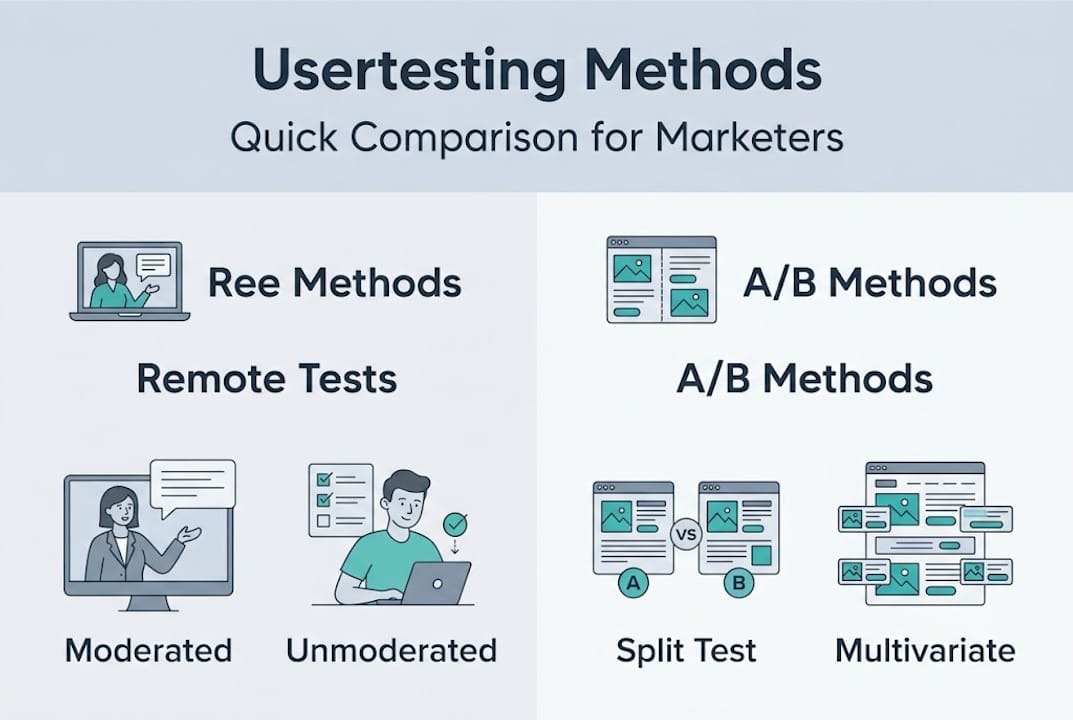
Here is a quick comparison of popular approaches to help you decide what fits your situation:
| Method | Time to insights | Cost level | Best for |
|---|---|---|---|
| Moderated remote sessions | 1 to 2 weeks | Medium | Deep qualitative insight on complex flows |
| Unmoderated task-based testing | 2 to 4 days | Low to medium | Quick feedback on specific pages |
| A/B testing platforms | Days to weeks | Low (with right tool) | Validating hypotheses at scale |
| Customer interviews | 1 to 2 weeks | Low | Strategic messaging and positioning |
When evaluating platforms, look for three things: ease of setup without developer involvement, fast and clear insights delivery, and integration with your existing analytics or CRM stack. Marketers should select usertesting tools that require minimal developer support, because waiting on engineering backlogs kills testing momentum fast.
Pro Tip: If you are short on time, run an unmoderated five-participant session on a single page using a task like "find the pricing and tell me if it makes sense." Five participants often surface 80% of the usability issues on any given page, and you can have results within 48 hours.
Combining qualitative usertesting with A/B testing without dev help creates a research and validation cycle that keeps growing without depending on technical resources. Tools designed for smarter SaaS testing focus on making that cycle as fast and frictionless as possible for marketers.
Implementing usertesting: Steps for fast wins
With the right tools, you are ready to put theory into action. Here is how marketers can run efficient, effective usertesting from day one.
A structured process helps marketers get meaningful usertesting feedback without delays. The most common reason usertesting fails to deliver useful results is not the platform or the participants. It is a lack of structure before the session even starts. Vague objectives produce vague feedback, and vague feedback produces no action.
Follow this quick-start workflow to run your first useful usertesting session:
- Define one clear objective. Ask yourself what specific question you need to answer. "Is our onboarding flow confusing?" is too broad. "Can users find and complete the profile setup step within two minutes?" is testable.
- Write three to five specific tasks. Give participants concrete actions to complete, not open-ended exploration. Tasks should mirror real user goals, not internal business language.
- Recruit the right participants. Recruit people who match your actual target persona as closely as possible. A test with the wrong participants produces misleading results, no matter how well you designed the session.
- Run a pilot test first. Have one person from your team complete the tasks before going live. This catches confusing task wording, broken links, or technical issues before they waste participant time.
- Synthesize fast. After sessions, spend 30 minutes watching the recordings and tagging recurring moments. Look for patterns across participants, not one-off opinions.
- Connect every finding to a business metric. Every insight should tie to a question like: does fixing this reduce drop-off, increase signups, or improve average order value? If you cannot connect it to a metric, deprioritize it.
Common mistakes that slow marketers down include setting unclear objectives before recruiting, treating every participant comment as equally important regardless of frequency, and failing to follow up with an A/B test to validate what usertesting uncovered.
Pro Tip: Create a simple one-page test brief before every session, covering the objective, the tasks, the success criteria, and the business metric it ties to. Sharing this brief with your team before running sessions prevents scope creep and keeps synthesis focused.
Tie your steps to better conversions directly to your testing roadmap. Each usertesting round should feed at least one or two new A/B test hypotheses, creating a continuous improvement cycle that compounds over time.
What most marketers miss about usertesting
Most articles will tell you to run more tests. Set clear goals. Recruit better participants. All of that is true, and none of it is the real issue.
The real reason most usertesting efforts fall short is the quality of the questions asked, not the quantity of tests run. Marketers often design sessions around confirming what they already believe rather than genuinely investigating what they do not know. They ask leading questions that push participants toward expected answers. They watch sessions looking for validation, not contradiction. That is a trap, and it produces insights that feel satisfying but generate zero lift.
The second problem is vanity metrics in usertesting analysis. Teams get excited that users said they "liked" the new design or felt the page was "cleaner." Those responses feel good but rarely predict conversion behavior. What matters is what users did, not just what they said. If they said they loved the checkout flow but still abandoned it twice during the session, behavior wins every time.
Experienced growth marketers treat usertesting as a continuous practice, not a one-time project. They run short sessions consistently, update their hypotheses based on new data, and stay genuinely humble about what they think they know. The UX to conversion connection only compounds when you keep learning rather than declaring victory after a single round of testing.
The marketers who get the most out of usertesting are the ones who stay curious, stay skeptical of their own assumptions, and keep running the cycle.
Next steps: Supercharge your testing workflow
If you are ready to take what you have learned and put it into a real workflow, Stellar is built exactly for this kind of fast, no-code experimentation.
Stellar gives marketers and growth hackers at small to medium-sized businesses a lightweight, no-code A/B testing platform that fits naturally into the usertesting cycle you have just built. With a 5.4KB script that will not slow your site down, a visual editor that requires zero developer support, real-time analytics, and advanced goal tracking, Stellar turns usertesting insights into live experiments within minutes. There is even a free plan for businesses under 25,000 monthly tracked users. Start testing smarter today and see how fast your conversions can move when every test is backed by real user insight.
Frequently asked questions
What is the difference between usertesting and A/B testing?
Usertesting involves observing real users to uncover friction points and gather qualitative insight, while A/B testing compares two page versions to measure which performs better quantitatively. Usertesting platforms let marketers get actionable insights into user behavior that then inform smarter A/B test hypotheses.
Do I need technical skills to run usertesting for my site?
No, many modern usertesting platforms are built for marketers without any developer involvement needed. Marketers can execute A/B tests and usertesting workflows using no-code tools that are designed specifically for non-technical users.
How quickly can usertesting impact my conversion rate?
Many marketers see results within weeks, especially when usertesting is used to target high-traffic pages with known friction. Conversion rates can be boosted by as much as 18% when testing is grounded in real user behavior rather than guesswork.
What's the best way to recruit testers for my business?
Start with your existing customers or email list, since they already match your target audience and will give feedback that maps directly to real buying behavior. Structured recruitment is key for generating usertesting insights that translate into genuine conversion improvements.
Recommended
Published: 4/26/2026