
Build a website test case that wins more conversions
TL;DR:
- Most A/B testing failures stem from poorly structured experiment design rather than technical tools or platforms.
- A comprehensive test case acts as a detailed recipe, ensuring clear hypotheses, control setups, and success metrics, leading to reliable results.
Most A/B testers blame their tools when experiments fail. Wrong platform, wrong plan, wrong price point. But experimentation failures come from test design, not the technology. If your tests produce murky results, winners that don't hold up, or data you can't act on, the real culprit is almost always a poorly structured test case. This guide walks you through every element of a reliable website test case in plain language, with real examples, a practical checklist, and the most common mistakes marketers make without realizing it.
Table of Contents
- What is a website test case and why does it matter?
- Key elements of a reliable website test case
- How to set up and run your website test case
- Avoiding common test case mistakes and false wins
- Why great test cases, not just 'easy tools,' decide winners
- Get started: Simplify website test cases with the right tools
- Frequently asked questions
Key Takeaways
| Point | Details |
|---|---|
| Test case over tool | A clear, thorough test case matters more than the A/B testing tool you choose. |
| Structure prevents mistakes | Strong hypotheses, metrics, and process help avoid wasted effort and false positives. |
| Tracking is critical | Accurate event tracking is required for trustworthy experiment results. |
| Avoid 'peeking' | Stopping tests early increases the risk of false winners, so stick to the plan. |
| Non-tech users can win | With a user-friendly checklist and rigor, small teams can out-perform bigger ones. |
What is a website test case and why does it matter?
A website test case is not just your A/B testing software or the button you change. It's the full written plan for how you'll design, run, and measure a test before you launch it. Think of it like a recipe. You can own the best kitchen equipment in the world, but without a clear recipe, dinner is a gamble.
For marketers and small business owners, skipping a proper test case structure leads to some expensive habits. You end up testing vague ideas with no clear success metric. You stop tests too early because results look exciting. You miss the insight that would have told you why something worked. A well-built test case prevents all of that.
Here are the standard elements a solid test case should include:
- Hypothesis: What you predict will happen and why
- Control and variant: Exactly what the original and changed versions look like
- Audience exposure rules: Who sees the test and how they're assigned
- Primary metric: The single most important outcome you're measuring
- Guardrail metrics: Secondary numbers you'll watch to catch unintended damage
- Sample size and runtime: How many users you need and how long to run
- Monitoring plan: What you'll check during the test to catch errors
- Decision rule: How you'll declare a winner when it's over
A practical test-case template covers all of these elements. That might sound like a lot of paperwork, but each item takes just a few sentences to fill out. The payoff is enormous: you can validate marketing ideas faster, build credibility with stakeholders, and actually trust your results.
"A structured test case turns a gut-feel experiment into a business decision you can defend."
The real advantage is repeatability. When your process is documented, every future test starts from a solid baseline. You stop reinventing the wheel and start building genuine conversion knowledge. Teams that care about measuring marketing success know this instinctively.
Key elements of a reliable website test case
Let's make this concrete. A solid test case covers seven specific areas. Here's how each one looks in practice, using a classic scenario: you want to test whether changing your CTA button from gray to orange increases signups.
The seven elements, numbered for clarity:
- Hypothesis: "Changing the CTA button color from gray to orange will increase signup rate by 15% because orange creates stronger visual contrast on our current page design."
- Control/variant setup: Control = gray button (current live version). Variant = identical page with an orange button and the same copy.
- Audience exposure: All new visitors to the homepage, randomly assigned 50/50 using session-based bucketing.
- Primary metric: Signup conversion rate (signups divided by unique visitors).
- Guardrail metrics: Bounce rate and page load time, to make sure the change doesn't hurt other behavior.
- Sample size and runtime: Calculated using a power analysis targeting 80% statistical power at 95% confidence, requiring roughly 4,000 visitors per variant. At current traffic levels, that's about 14 days.
- Decision rule: Declare a winner only after the full runtime is complete and the primary metric reaches statistical significance at p < 0.05.
A well-structured test case covers all seven of these areas, and you must specify your hypothesis and calculate required sample size before you hit launch.
| Test case element | Example (CTA button color test) |
|---|---|
| Hypothesis | Orange button increases signups by 15% due to visual contrast |
| Control | Gray button (current version) |
| Variant | Orange button, identical copy |
| Audience | 50/50 split, new homepage visitors |
| Primary metric | Signup conversion rate |
| Guardrail metrics | Bounce rate, page load time |
| Sample size | ~4,000 visitors per variant |
| Runtime | 14 days |
| Decision rule | p < 0.05 after full runtime |
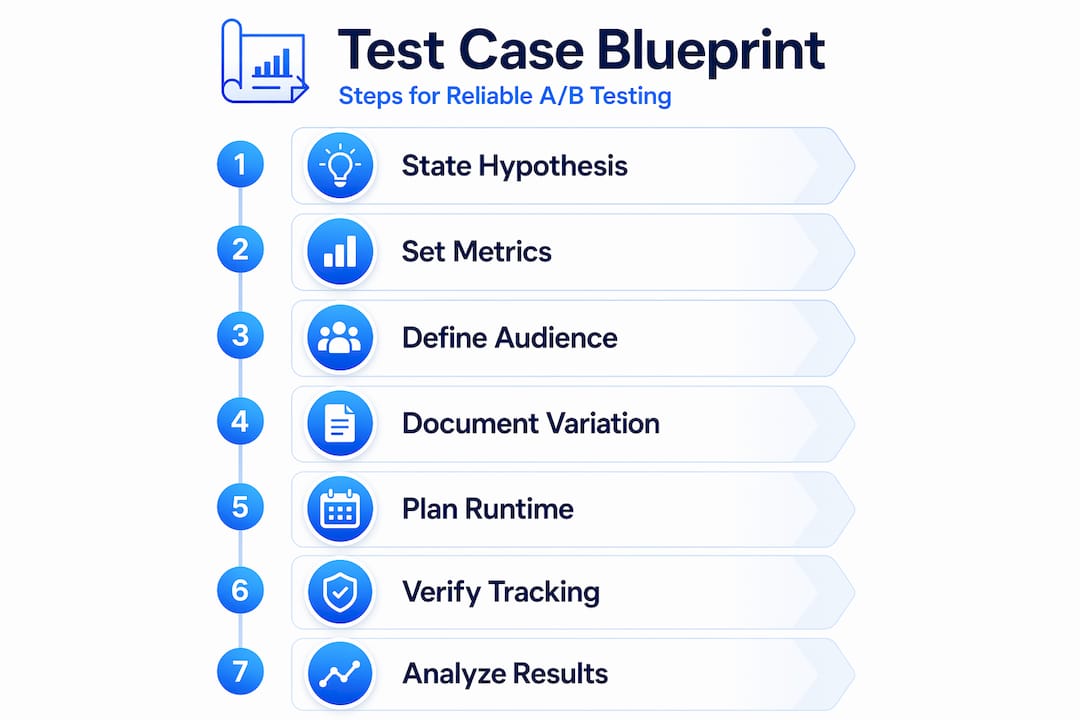
Once you internalize this structure, A/B testing best practices become second nature rather than an abstract ideal. Learning to craft better CTAs also becomes much easier when you have a reliable testing framework to evaluate them.
Pro Tip: Never peek at results and stop a test early, even if early numbers look promising. Data from the first 20% of your planned runtime is almost always misleading and will cause you to make the wrong call.
For anyone new to analyzing test results, this structured approach removes most of the guesswork. You defined success before you started, so reading the results is straightforward.
How to set up and run your website test case
Here's how to move from a filled-out template to an actual live test. Use this step-by-step sequence:
- Write the hypothesis. Be specific. Include what you're changing, what outcome you expect, and the reasoning behind it. Vague hypotheses produce vague takeaways.
- Build your control and variant. Make only one change between them. If you change the button color and the button text, you won't know which change drove the result.
- Set up random assignment. Use your testing tool to randomly assign visitors to control or variant at the session level. This means a single user always sees the same version throughout their visit and across return visits during the test window.
- Validate tracking before launch. Fire the test in a staging environment or with internal traffic blocked. Confirm that your goal events are recording correctly and that both variants are logging pageviews.
- Launch and monitor. Check your test daily for tracking errors, unexpected traffic spikes, or signs that users are seeing both experiences (called contamination).
- Call the result at the planned endpoint. Don't extend the test because results are close. Don't stop it early because one variant looks like a runaway winner. Trust the plan.
Keep experimental and control experiences identical except for the single change you're testing, and prevent users from switching between groups. This is the golden rule of A/B testing integrity.
A homepage banner test is a great real-world example. You might test whether a banner featuring a social proof statement ("Join 12,000 happy customers") outperforms a feature-focused banner ("Unlimited integrations, no coding required"). Write the hypothesis, design both banners, set a 50/50 split for all desktop homepage visitors, and define your primary metric as the click-through rate to the signup page. Then you wait. That's discipline, and it's what separates reliable data from noise.
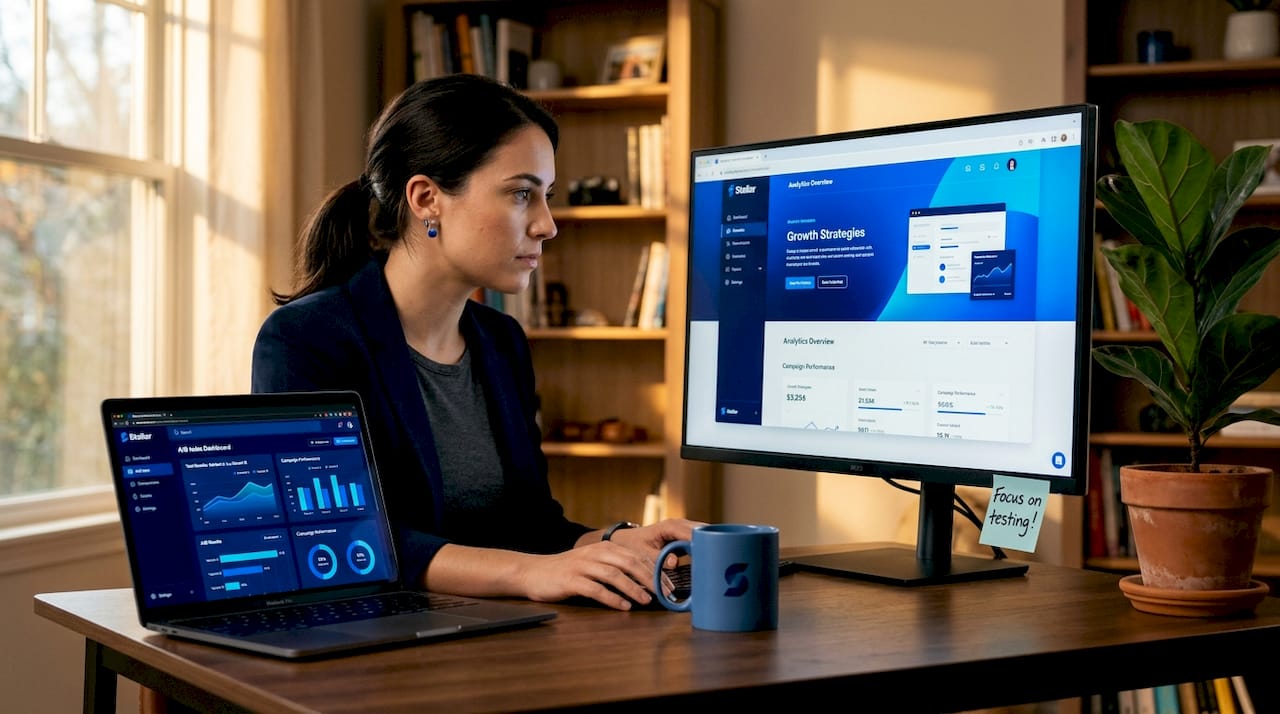
Pro Tip: Always review your tracking setup before you launch. A missing event tag or a misconfigured goal will render your entire test invalid, even if everything else is perfect. Planning digital campaigns with tracking validation as a required pre-launch step saves enormous headaches.
For practical inspiration, explore A/B test examples that show how other marketers structure and execute real experiments.
Avoiding common test case mistakes and false wins
Even experienced marketers make these mistakes. Here's what to watch for:
- Stopping early: You see a 30% lift after three days and call it a win. Two weeks later, the lift disappears. Early stopping is the single biggest source of false positives in A/B testing.
- Underpowered tests: You don't run long enough or attract enough users to detect a real difference. Small sample sizes mean random noise looks like a signal.
- Contamination: Users who were supposed to see only the control end up seeing the variant too, usually because of caching issues, logged-in account sessions, or device switching.
- Multiple comparisons without correction: Running 20 tests at 95% confidence means you'll expect at least one false winner by pure chance. The false positive risk jumps from 5% to 64% when you run that many simultaneous tests without adjusting your threshold.
Stopping early and running underpowered tests create false positives and wasted effort. Group behavior must stay identical throughout the test and you must actively monitor for contamination, including session switching between devices. And if tracking is missing or inconsistent, your test looks valid but produces results you simply cannot trust.
| Common mistake | How to prevent it |
|---|---|
| Stopping tests early | Commit to the planned runtime before you launch |
| Underpowered test | Run a power analysis to calculate minimum sample size |
| Contamination | Use session-based assignment and block internal traffic |
| Multiple comparisons | Apply a Bonferroni correction or lower your significance threshold |
| Broken tracking | QA all goal events before launching the test |
| Unclear hypothesis | Write the hypothesis in full before building variants |
Use the A/B test checklist to run through every item before each launch. For a broader view on how testing tools compare in handling these pitfalls, comparing SEO test tools offers useful context on what features actually matter for reliability.
The bottom line: a test that produces a false winner is worse than no test at all. It sends your team in the wrong direction with false confidence.
Why great test cases, not just 'easy tools,' decide winners
Here's an uncomfortable truth that most A/B testing content skips. The marketing industry has spent years selling the idea that the right tool makes great testing easy. One-click testing. No-code setup. Instant results. And tools have genuinely improved. But the obsession with finding the "easiest" platform distracts marketers from the thing that actually drives results: disciplined test design.
Experiment design errors do far more damage than tool limitations. We've seen small teams running tests in basic spreadsheet-tracked setups consistently outperform larger teams using enterprise platforms, simply because they were rigorous about their hypotheses, their sample sizes, and their decision rules.
Think about it this way. A Ferrari with no map still gets you lost. A Honda Civic with a clear route gets you there. The tool is the car. The test case is the map.
The marketers who win aren't necessarily using the most sophisticated platforms. They're the ones who document their hypothesis before they build anything. They calculate sample size before they launch. They refuse to peek at results mid-test. They treat every experiment as a structured business question, not a feature rollout.
This matters especially for A/B testing without dev support. When you're running experiments solo or with a small team, process discipline is the only thing that compensates for limited resources. A rigorous test case template costs nothing and takes 30 minutes to fill out. It returns that time many times over by preventing wasted effort on tests that never had a chance of producing reliable data.
The real competitive advantage for small and mid-sized marketing teams isn't budget or headcount. It's the habit of running every test through a clear, structured process. That habit compounds. Each well-documented test teaches you something real about your audience. Over time, you build a library of conversion insights that no competitor can easily replicate, because it's specific to your users, your product, and your market.
Start with the template. Get the discipline right. Then the tool becomes a genuine accelerator instead of a crutch.
Get started: Simplify website test cases with the right tools
Building a structured test case is the most important step, and you don't need a development team or a massive budget to do it well.
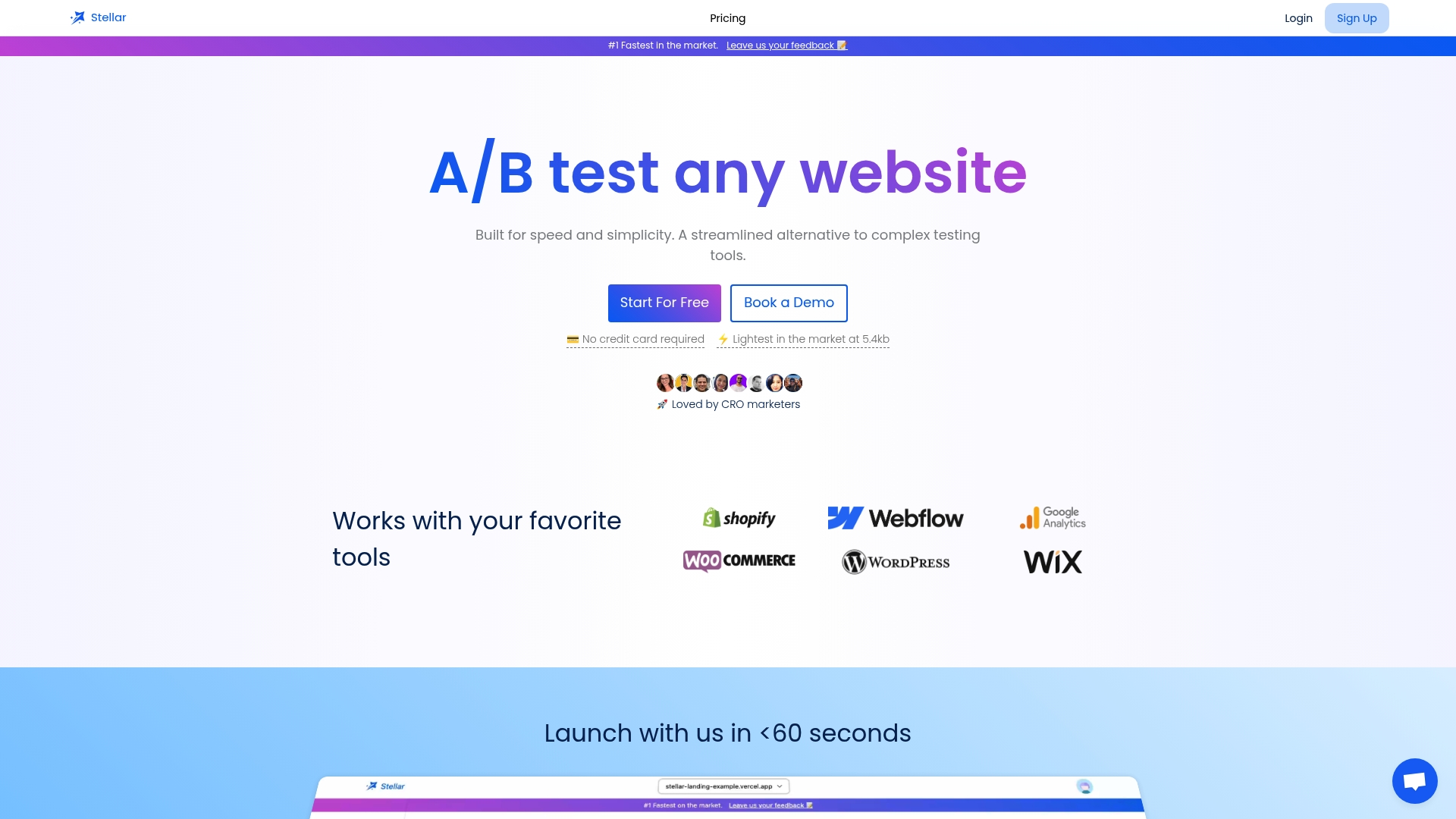
Stellar is built specifically for marketers who want to run clean, reliable A/B tests without writing a single line of code. The no-code visual editor makes it easy to build your control and variant exactly as described in this guide. Real-time analytics let you monitor results without switching between a dozen tabs. Advanced goal tracking ensures your primary metrics and guardrail metrics are always accurate. And with a free plan for smaller sites, you can put this whole framework into practice today, no commitment required. Explore the full guide library for more examples and templates to keep building your testing skills.
Frequently asked questions
What is the main purpose of a website test case?
A website test case ensures every A/B test is designed for reliable results by clarifying the hypothesis, metrics, and process before you start. A complete template includes hypothesis, control vs. variant specifics, exposure rules, primary and guardrail metrics, power sizing, monitoring steps, and a winner decision rule.
What's the most common mistake in website A/B testing?
The most common mistake is stopping tests too early, which inflates false positives and leads to unreliable results. Early stopping and underpowered tests create false wins and wasted effort that send teams in the wrong direction.
How do I keep test results valid if I run many experiments?
If you run multiple tests, adjust your decision threshold or use a statistical correction method to prevent a sharp increase in false positives. Running multiple tests simultaneously increases the probability of at least one false winner appearing in your results.
Why is tracking setup important in a test case?
If your tracking is missing or inconsistent, you can't trust the results even if the test looks statistically correct. Missing or inconsistent tracking makes an A/B test appear valid while the underlying data is fundamentally untrustworthy.
Do I need coding skills to build effective website test cases?
No. A simple checklist and good planning beat complex technical setups every time. Experimentation failures come from test design flaws, not from using basic tools, which means any disciplined marketer can run tests that produce real business insights.
Recommended
Published: 5/13/2026