
Run a Door Test in Days Without a Developer for SMB Marketers
A door test, also called a painted door test, is a simulated feature or call-to-action you put in front of real visitors to measure demand before writing any production code. It gives marketers a way to validate an idea in days rather than months, with little to no engineering help. For SMB teams and growth marketers watching budget and headcount, it is one of the fastest ways to learn whether an idea is worth building.
TL;DR:
- A painted door test is most effective when the development time for a feature is long and the product team needs quick validation of demand.
- It is unreliable for testing regulated claims or purchase intent, as it measures click interest rather than actual transaction willingness.
- Building a door test should be quick and inexpensive, using simple tools like no-code editors, and focusing on clear hypotheses and well-defined metrics.
- Ethical considerations include avoiding deception, ensuring transparency, and seeking consent, especially when the test could exploit trust or vulnerabilities.
- Small teams can run effective door tests with no-code solutions and real-time dashboards, enabling fast deployment and immediate analysis of results.
Table of Contents
- What a painted door test is and key use cases
- When to choose a door test vs other lightweight experiments
- How to build and launch a low-cost painted door test
- Metrics, analysis, and decision rules
- Ethics, consent, and minimizing harm
- Practical adaptations for small marketing teams
- Launch your next door test with Gostellar
- FAQ
- Sources
What a painted door test is and key use cases
The name comes from the idea of a door painted onto a wall: it looks real, but there is nothing behind it. In product and marketing terms, a painted door test presents a button, link, or feature teaser that leads nowhere functional yet so you can measure how many people try to walk through it.
These tests show up in a handful of practical formats:
- A landing page with a CTA button advertising a feature that does not exist yet.
- A popup or modal offering early access to something still on the drawing board.
- An in-app placeholder, like a grayed-out menu item that logs a click.
- A paid ad that drives traffic to a sign-up page testing interest in a new offer.
Growth teams use these setups for more than curiosity. A door test can validate whether real demand exists, help prioritize which feature to build next when the backlog is long, recruit a pool of beta users who already raised their hand, and test which version of your messaging gets the strongest reaction before you commit a budget to it. Because the "feature" behind the door does not need to work, the cost of running the test is mostly the cost of writing copy and setting up tracking.
When to choose a door test vs other lightweight experiments
A door test earns its place when an idea is early, the engineering cost of building the real thing is high, and you genuinely do not know if anyone wants it. If you can answer the demand question with a five-minute conversation or a quick poll, you probably do not need a live experiment.
Signals that favor a door test:
- The feature would take weeks of development time to build for real.
- You have traffic or an audience segment to test against.
- The downside of a wrong guess is wasted engineering hours, not legal exposure.
Door tests are a poor fit when the claim being tested touches regulated territory, such as financial products or health claims, or when you need proof that someone will actually complete a purchase rather than just show interest. A door test measures intent to click, not intent to pay, so flows that require validating real transactions usually need a different setup, like a landing page A/B test with an actual checkout step.
Compared with a working prototype, a door test is faster and cheaper but shallower. Compared with a survey, it measures behavior instead of stated opinion, which tends to be more honest.
Pro Tip: Run a short survey alongside your door test to catch the gap between what people say they want and what they actually click.
How to build and launch a low-cost painted door test
Treat this as a short project with a clear start and finish, not an open-ended experiment.
-
Write a one-sentence hypothesis. Example: An example hypothesis might be that a meaningful proportion of visitors to the pricing page will click a 'Team Plan' CTA that does not exist yet. Pick one primary metric, usually CTA click rate or sign-up rate.
-
Design the door itself. Draft the CTA label, the surrounding copy, and where it sits on the page. Decide what happens after the click: a simple "coming soon, join the waitlist" page works better than a dead link, since it captures an email and signals good faith.
-
Pick your touchpoints. Common options include an existing high-traffic page, a short paid ad campaign, an email blast to an existing cohort, or an in-app banner for logged-in users.
-
Build it with the lightest tool that works. A no-code landing page builder, a tag manager snippet, or a lightweight tracking script can all get a door test live without a sprint cycle. Whatever you use, make sure clicks and any downstream action, like an email sign-up, are both tracked as separate events, as outlined in this guide to click-through tracking.
-
Run a short QA pass. Check the CTA on mobile and desktop, confirm tracking fires correctly, and confirm the follow-up page loads.
Before launch, run through this checklist:
- Confirm your cohort size is large enough to produce a meaningful count of clicks, not just a handful.
- Set a minimum test duration, generally long enough to cover at least one full week of traffic patterns.
- Add an optional one-line feedback field after the click to capture why someone was interested.
- Decide your stop date in advance so you are not tempted to extend the test until the numbers look better.
Ad and landing-page formats for this kind of test, including pop-ups and simulated feature links, are covered in more detail in this guide to ad test pages.
Metrics, analysis, and decision rules
Four numbers matter most in a door test: CTA click rate, sign-up rate on the follow-up page, time spent on the page, and the rate at which people leave qualitative feedback. Click rate tells you how compelling the offer looks at first glance. Sign-up rate tells you whether people are willing to take a second step, which is a stronger signal than a click alone.

None of these numbers prove someone would pay for the feature. A painted door test measures interest, not purchase intent, and clicks can include accidental taps or idle curiosity, which is why pairing the click data with a short feedback prompt helps filter signal from noise.
For small audiences, absolute counts matter more than percentages. A jump from 2 clicks to 4 clicks looks like a 100% increase but is not a reliable basis for a build decision; the Coursera breakdown of painted door tests recommends using large enough cohorts and tracking multiple signals together rather than reacting to a single percentage swing.
Before launch, set simple decision rules:
- If CTA click rate and sign-up rate both clear your pre-set bar, move the idea into a real prototype.
- If click rate is strong but sign-up rate is weak, the offer may need clearer follow-through copy before you draw conclusions.
- If both numbers come in low, treat that as a signal to drop the idea or test a different angle, not just louder copy.
A broader rundown of which metrics matter and why appears in this overview of digital marketing metrics.
Ethics, consent, and minimizing harm
A door test works because it is not fully transparent, and that gap deserves a deliberate check rather than a shrug. A useful way to think about it, adapted from a framework for classifying unethical marketing influence, is to ask three questions in order: what is the intent behind the test, does it exploit a vulnerability or rely on deception, and have people given any form of consent to being tested?
Practical mitigations keep most door tests on solid ground:
- Follow every click with honest messaging, such as "this feature isn't live yet, but we're building it."
- Offer an opt-in path to real early access or a beta program instead of leaving people with nothing.
- Keep the test cohort narrow and the duration short rather than running it indefinitely.
- Consider a small thank-you or discount for people who engaged, especially if the test ran to a known list.
Research on experimental ethics finds that both participants and scholars are uncomfortable with deception, and recommends minimizing it, using consent where feasible, and debriefing or compensating people when some deception is unavoidable.
Practical adaptations for small marketing teams
Small teams rarely have a spare engineer to spin up a feature flag for an experiment that might get killed in a week. Running a door test through a no-code visual editor and a lightweight tracking script cuts that step out entirely, letting a marketer build the CTA, the follow-up page, and the event tracking in one sitting. Real-time dashboards then show click and sign-up activity as it happens, instead of waiting on a weekly report pulled by someone else.
— Juan
Launch your next door test with Gostellar
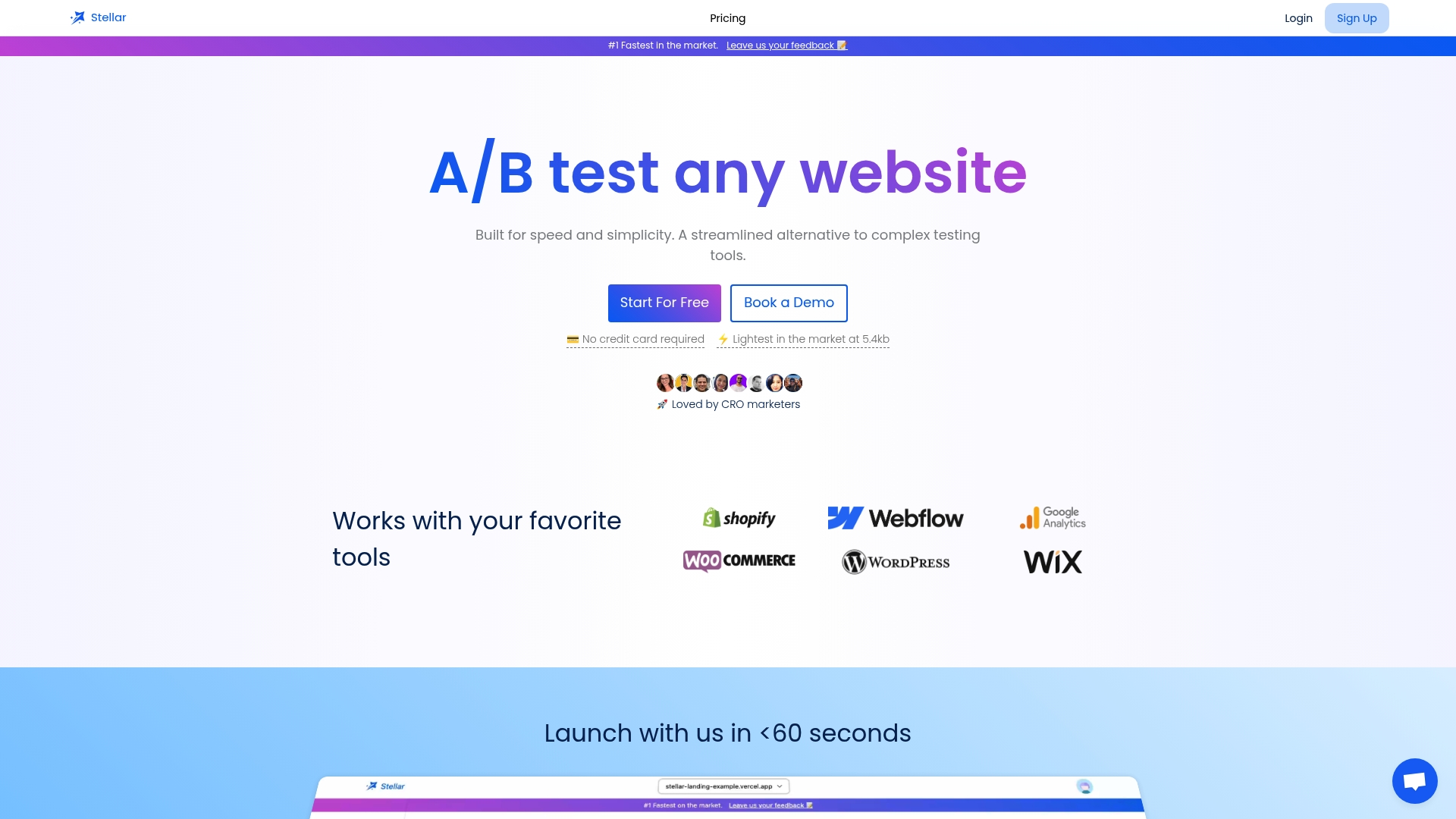
A door test only pays off if you can get it live fast and read the results without digging through a spreadsheet. A no-code visual editor lets you build the CTA and follow-up page yourself, a lightweight script keeps your site speed unaffected, and built-in event tracking and real-time dashboards show clicks and sign-ups as they come in.
If you want a quick popup touchpoint instead of a full landing page, our free FOMO popup generator is a fast way to test a message with zero setup. Start a free test on the Sandbox plan and see your first results within days.
FAQ
What is a painted door test in marketing?
A painted door test is a simulated feature, button, or CTA placed in front of real users to measure demand before any product work begins. It is also called a fake door test and typically leads to a "coming soon" page rather than a working feature.
How is a door test different from an A/B test?
A standard A/B test compares two or more real versions of something that already works, while a door test measures interest in something that does not exist yet. Both rely on splitting traffic and tracking clicks, but a door test is specifically used to validate demand before building, not to optimize an existing flow.
What should I track during a door test?
Track CTA click rate, sign-up rate on any follow-up page, and qualitative feedback if you collect it, since clicks alone do not confirm genuine purchase intent according to Coursera's breakdown of the method. Set your decision thresholds before launch so you are not tempted to reinterpret the numbers afterward.
Is it ethical to run a door test on real customers?
It can be, as long as you avoid deceiving people in a way that exploits trust and you follow up honestly once someone clicks. Frameworks for evaluating marketing influence tactics recommend checking your intent, whether the tactic involves exploitation or deception, and whether any form of consent applies before calling a tactic acceptable.
How long should a door test run?
There is no single fixed duration, but most teams run a door test long enough to capture at least one full week of traffic patterns, since shorter windows risk skewed results from a single unusual day. Stop the test on a date set in advance rather than extending it based on how the numbers look partway through.
Sources
- Painted Door Test: A Method for Validating Product Ideas | Coursera
- Manipulation: An integrative framework of unethical influence in marketing - ScienceDirect
- What Scholars and Citizens Think of Experimental Ethics: Results of a Survey Experiment
Recommended
Published: 10/4/2026