
User Experience Agency: What It Does, Costs and How to Choose
A user experience agency is an outside team you hire to research how people use your product or site, redesign what gets in their way, and test that the new design works. For most US businesses, projects land between $10,000 and $49,999, and the best agencies tie every design decision to a metric you already track. This guide covers what the work includes, what drives price, when hiring makes sense, and how to check an agency's work once it ships.
TL;DR
- A UX agency covers research, information architecture, wireframes, prototypes, usability testing, UI design and handoff to engineering.
- Clutch reports most UX/UI projects it reviews cost $10,000 to $49,999, while research-heavy studies can run far higher.
- Hire for a defined problem (a leaky checkout, a confusing onboarding flow), not for a vague redesign.
- Judge agencies on process depth and metric linkage, not portfolio polish.
- Whatever the agency ships, validate it with an A/B test before you roll it out to everyone.
Table of Contents
- What a user experience agency actually does
- UX design versus UI design
- How a typical engagement runs
- What a UX agency costs
- When hiring an agency makes sense
- How to choose a user experience design agency
- Where UX work meets conversion optimization
- Our view: ship the redesign as an experiment
- Test your agency's designs with Stellar
- FAQ
- Sources
What a user experience agency actually does
The name sounds like "people who make things pretty." That is the smallest part of the job. The Nielsen Norman Group defines user experience as every aspect of a person's interaction with a company, its services and its products, from discovery and purchase through setup, use, updates and replacement. An agency working on UX is therefore looking at the whole journey, not only the screen.
In practice, Clutch's services guide lists the work as UX strategy, user research, information architecture, wireframes and prototypes, usability testing, UI and visual design, implementation support and post-launch evaluation. IBM describes UX as weighing ease of use, accessibility, visual design, interface functions and emotional response, and as drawing on design, psychology, engineering and business. That mix is why a good agency team rarely consists of designers alone.
When people search for a "user experience company" or a "user experience design company," they usually mean the same thing. Some firms are small studios that do research and design only. Others are full-service shops that add content creators, front-end developers and analytics people. The label matters less than what is actually on the proposal.
UX design versus UI design
You will see "UX/UI agency" everywhere, and the two disciplines are different.
- UX design solves a specific problem with how a product works: what steps a user takes, in what order, with what information.
- UI design covers how the product looks and responds: color, typography, components, states, motion.
That split is how Clutch's guide frames it. A beautiful interface on top of a broken flow still loses customers, and a sound flow in an ugly interface still wastes some of its potential. Buy both, but know which one your problem needs first. If shoppers abandon at the shipping step, you have a UX problem. If your brand looks dated next to competitors, you have a UI problem.
How a typical engagement runs
Processes differ by firm, but most follow the same arc. One 2026 agency guide describes it as setting objectives, reviewing analytics and customer evidence, researching or auditing, prioritizing problems, designing flows and prototypes, validating solutions, supporting implementation and measuring results after launch. Here is what each stage should give you.
- Discovery. Stakeholder interviews, a review of your analytics, session recordings, support tickets and past research. You should come out with a written problem statement, not just a mood board.
- Research and synthesis. User interviews, surveys, heuristic audits or usability tests on the current product. The output is a ranked list of friction points with evidence behind each one.
- Design. User flows, wireframes and clickable prototypes. This is where the agency should show alternatives and explain trade-offs, not one polished answer.
- Validation. Prototype tests with real users before engineering starts. The classic finding is that testing with about five users surfaces roughly 85% of usability issues, which is why small, fast rounds beat one giant study.
- UI refinement and handoff. Visual design, a component library or design system, and specs your developers can build from.
- Post-launch evaluation. Did the metric move? This stage is the one most often skipped, and it is the one that proves the work paid off.
Watch for the shortcut. According to one agency guide, a weak firm moves from kickoff straight to polished comps, which hides ambiguity until changes get expensive. If a proposal has no research or validation phase, ask why.
What a UX agency costs
Price varies with scope, timeline, team size and seniority, and agency location. For the US market, these are the best-documented reference points:
| Reference point | Figure | Source |
|---|---|---|
| Typical UX/UI project reviewed on Clutch | $10,000 to $49,999 | Clutch pricing guide |
| Average UX agency project on Clutch (September 2026) | $84,973.08 | Clutch pricing guide |
| Simple usability study, consultancy rate | From $40,000 | NN/g consulting |
| Complex usability study, consultancy rate | $80,000 to $150,000 | NN/g consulting |
The gap between the typical range and the average tells you the distribution is skewed: a few very large engagements pull the mean up. If you are a small or mid-sized business, plan around the lower band and scope tightly. Problem size, research depth, team seniority and speed are the main cost drivers, so you control price mostly by controlling scope.
Ways to keep the budget sane:
- Start with an audit and a single high-traffic flow rather than a full-site redesign.
- Ask for fixed-scope phases with a decision point after research.
- Reuse analytics and recordings you already have so the agency does not pay (and bill you) to rediscover them.
- Compare engagement models by the strategic depth and team capacity they buy, not only the headline number.
When hiring an agency makes sense
Scope depends on the product and its stage. A live ecommerce store with suspected friction may need an audit and targeted improvements, while a new product may need design from the ground up. That gives a useful rule of thumb.
Hire an agency when:
- You need a specialist skill your team lacks, such as formal research or accessibility review.
- You are building something new and need to validate it before paying for development.
- Your internal team is at capacity and the project has a clear end.
- You want an independent read on why a funnel underperforms.
Think twice when:
- You cannot name the problem or the metric you want to move.
- Nobody on your side can own decisions and give feedback quickly. Agencies work best when stakeholders are involved through research, ideation, testing and delivery.
- Your traffic is large enough to test small changes directly. In that case an experimentation program may beat a redesign.
AI has not changed this much. The Nielsen Norman Group argues that AI is a useful tool for tasks such as usability analysis or generating components but does not replace the experts who synthesize findings to solve complex, human-centered problems. Expect agencies to use AI to speed up production, and judge them on the thinking.
How to choose a user experience design agency
A polished portfolio is table stakes. Use these criteria instead.
Do they connect design to business metrics?
Ask for a past project where the brief began with a number (conversion rate, task completion, activation) and ended with a measured result. Agencies worth hiring link design decisions to business metrics rather than aesthetics alone. Be careful with big claims. Even a well-documented NN/g case study found that a revised information architecture increased findability by 85%, yet its effect on revenue and leads could not be isolated. Honest agencies say what they can and cannot attribute.

Is the process visible?
A capable agency should help you shape the brief, say whether discovery research is needed, do research before design, and connect prototyping, testing and implementation to the design direction. Ask to see sample research readouts and handoff files, not just final screens.
Can they hand off to developers?
Design that engineering cannot build cleanly gets watered down. Ask who attends sprint reviews, how specs are written and whether the agency reviews the build against the design.
Do they know your kind of product?
A firm that has shipped dozens of checkout flows will spot problems in yours faster than a generalist. Relevant experience with your product type beats a famous client list.
Questions to ask on the first call
- What would you want to know before quoting this project?
- Which metric would you expect to move, and how will we measure it after launch?
- Who exactly will work on this, and at what seniority?
- What happens if research contradicts our assumptions or your first concept?
- How do you hand off, and what support do we get during implementation?
Write these into an RFP so every bidder answers the same questions, and score them against the same criteria.
Where UX work meets conversion optimization
UX research finds friction, and friction is what costs you conversions. The Interaction Design Foundation lists A/B testing alongside surveys, card sorts and usability testing among the common UX methods, measuring things like time-on-task, error rates and satisfaction. So testing is part of UX practice, not a separate world.
For landing pages in particular, the overlap is large: clear value propositions, shorter forms, obvious next steps. If that is your focus, a guide on optimizing landing pages covers the tactics that usually matter most. For a deeper look at the research side, see our own pieces on UX and conversion rates and web UX for marketers, and our list of common website usability issues is a quick way to see what an audit tends to find.
A practical sequence that works for many teams:
- Use analytics and recordings to find the page or step where users drop.
- Have the agency (or your own team) diagnose why with research.
- Turn the best ideas into variants.
- Run them as an experiment against the current version.
- Roll out what wins, and feed the result back into the next research round.
That last step is the point. Agency recommendations are informed hypotheses. They are usually good ones, but a test tells you whether they work on your audience.
Our view: ship the redesign as an experiment
We build an A/B testing platform, so we see the end of many UX projects: a redesign goes live for everyone on a Monday, conversion shifts, and nobody can say whether the design, the season or a campaign caused it. That is an expensive way to learn.
Our advice is simple. Treat the agency's work as a set of hypotheses with a clear primary metric. Before the project starts, agree which metric each major change should move and what result would count as success. Then launch the new flow to a share of traffic and compare. Small teams can do this without developers: a visual editor lets a marketer change a headline, reorder a form or swap a layout and measure the result, and a lightweight script keeps the test from slowing the page you are trying to improve.

This also makes the agency relationship healthier. When both sides agree on the metric upfront, feedback stops being about taste. If a variant loses, you have learned something specific for the next round, and the agency has a concrete brief rather than a vague "make it better."
The lesson holds whether you spend $15,000 or $150,000: the cheapest insurance on a design investment is measuring it.
— Juan
Test your agency's designs with Stellar
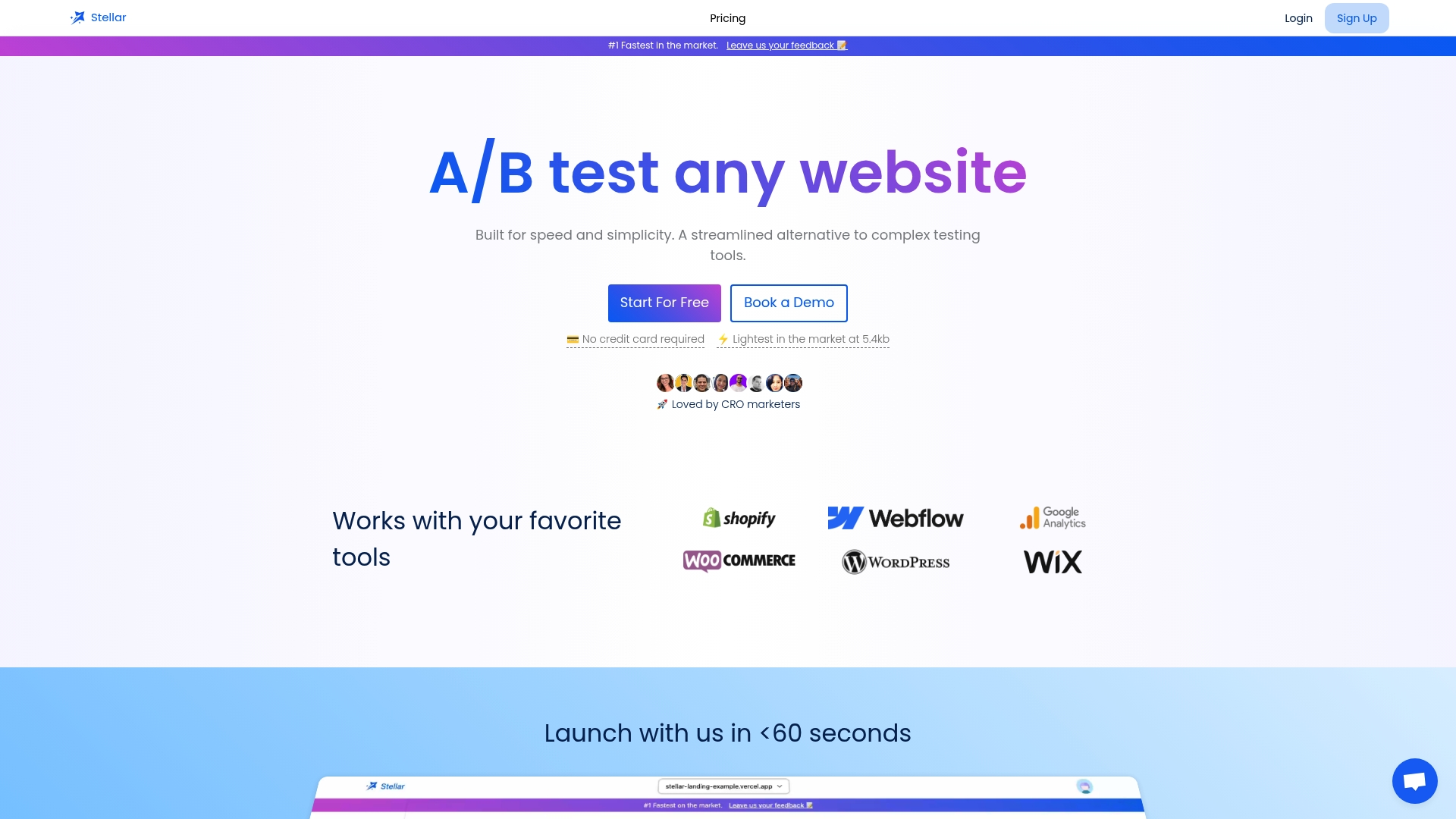
Once your agency hands over new layouts, copy or flows, you need a fast way to find out which ones convert. Stellar is an A/B testing tool with a no-code visual editor, goal tracking and real-time analytics, built for marketers at small and mid-sized businesses. Plans start with Sandbox at $0 per month, then Plus at $29 per month, Pro at $99 per month and Scale at $399 per month, with Enterprise available on request. See the current limits and features on the Stellar pricing page.
If you want a plan for the testing side, our safer 30 to 60 day CRO plan and our guide to fixing copy and form friction on landing pages are good starting points.
FAQ
What does a UX agency do?
A UX agency researches users, then designs, tests and improves digital products or services. The work can include strategy, user research, information architecture, wireframes, prototypes, usability testing, UI design, implementation support and post-launch evaluation, according to Clutch's services guide.
What is a user experience company?
It is a firm that specializes in designing how people interact with a product or service. Full-service firms may combine UX designers, interaction and visual designers, content creators and researchers, so the exact mix varies. Compare proposals by deliverables rather than by the company's label.
How much does it cost to hire a user experience design agency?
Clutch reports that most UX/UI projects it reviews cost between $10,000 and $49,999, and that the average project cost was $84,973.08 as of September 2026, per its pricing guide. Research-heavy usability studies from consultancies can run higher, from $40,000 upward. Scope, seniority and speed decide where you land.
What is the difference between UX and UI design?
UX design focuses on solving a specific problem with how a product works, while UI design focuses on aesthetics and how users interact with the interface. Most agencies offer both, but a flow problem and a visual problem need different fixes, so identify which one you have before you brief anyone.
How do I know the agency's redesign worked?
Agree on a primary metric before work starts, then test the new design against the old one on live traffic. A controlled experiment separates the effect of the design from seasonality and campaigns, which a straight before-and-after comparison cannot do.
Sources
- UX/UI Services Guide, Clutch
- UX UI Design Pricing Guide, Clutch
- What Is User Experience (and What Is It Not)? Nielsen Norman Group
- What is User Experience (UX)? IBM
- Usability Testing and User Experience Research Consulting, Nielsen Norman Group
- Quantifying UX Improvements: A Case Study, Nielsen Norman Group
- Why I'm Not Worried About My UX Job in the Era of AI, Nielsen Norman Group
- What is the UX Design Process? Interaction Design Foundation
- What Is a UX Design Agency and When You Need One?
- UX Agency: What It Does and How to Choose One
- What Does a UI/UX Design Agency Do?
- What Is a UX Design Agency?
- Optimizing Landing Pages: Proven Strategies for 2025