
User Experience Marketing: Turn UX Into Conversions
User experience marketing means judging every campaign, landing page, email and checkout step by how much effort it asks of the person using it, then proving each improvement with a controlled test. Marketing raises the perceived value of what you sell. UX lowers the effort of getting it. This article shows how to combine the two and how to measure the result. On our side, Stellar lets you run those tests without developers, using a 5.4KB script built to keep pages fast.
TL;DR
- User experience marketing applies UX thinking (reducing effort, clarifying the journey) to marketing goals such as acquisition, conversion and retention.
- Marketing builds perceived value, while UX lowers the cost of interaction. You need both in one funnel.
- The workflow is simple: map the journey, find friction, change one thing, test it, and keep what wins.
- Measure with direct metrics (conversion rate, average order value, return rate) and indirect ones (loyalty, referrals).
- A no-code A/B testing tool turns UX opinions into evidence your team can act on.
Table of Contents
- What user experience marketing means
- How it differs from UX design and traditional marketing
- Why it matters for conversion and revenue
- Principles that guide good decisions
- A practical workflow, step by step
- Where to apply it first
- Measuring the impact
- Getting marketing and UX to work together
- Run your first UX experiments with Stellar
- FAQ
- Sources
What user experience marketing means
User experience marketing merges UX design principles with marketing objectives. It looks at how customers behave, what they need at each stage, and where an interaction slows them down. The unit of work is the journey, not the single asset: the ad, the landing page, the email and the checkout are judged as one experience.
The approach also changes the question your team asks. Paul Boag describes traditional digital marketing as asking what we want users to do, while UX marketing asks what users want to do. That sounds small. In practice it changes briefs, headlines, forms and follow-up emails.
The term is used loosely across the web. Some writers treat it as a named methodology, others as a label for good digital marketing. For a working marketer, the useful definition is operational: any marketing decision that is tested against the effort and clarity it creates for the user.
How it differs from UX design and traditional marketing
The cleanest distinction comes from the Nielsen Norman Group. Its research on UX and marketing explains that marketing increases the perceived value of a product through brand perception or special offers, while UX decreases the interaction cost, meaning the mental and physical effort needed to finish a task.
That gives you three roles in one funnel:
| Traditional digital marketing | UX design | User experience marketing | |
|---|---|---|---|
| Main question | How do we get the click or sale? | Can people complete the task easily? | Does the whole journey earn the action? |
| Scope | Channels and campaigns | A product or interface | Ads, pages, emails and checkout together |
| Time horizon | Campaign period | Release cycle | Long-term KPIs such as retention |
| Typical evidence | Click-through, cost per lead | Usability sessions | Conversion tests plus behavior data |
Neither side is enough alone. Persuasive messaging that lands on a confusing page wastes the ad spend. A beautiful, usable page that nobody is brought to wastes the design work. User experience marketing puts both questions on the same dashboard.
Why it matters for conversion and revenue
The commercial case is direct. IBM notes that a well-designed UX drives conversion rates, and that simplified navigation, clear calls to action and fast loading can decide whether a visitor completes a purchase or abandons the cart. The same page says a focus on UX helps businesses stand out in markets full of similar products.
Three effects matter most to a CRO or growth team:
- Conversion. Less friction between intent and action means more of the traffic you already paid for turns into results.
- Efficiency. When the same traffic converts better, acquisition cost per customer falls without changing the media budget.
- Retention. An experience that matches what was promised in the ad reduces regret and churn later in the funnel.
Speed belongs in this list. A page that loads slowly adds effort before the visitor reads a word. That is one reason we built our testing script at 5.4KB: the tool that measures your experience should not degrade it.
Principles that guide good decisions
Across the research and the practitioner writing, a handful of principles repeat. Use them as a checklist when you review a journey.
Give value before you ask for action
Content that answers questions and handles objections builds trust before a form or a checkout appears. Boag lists what a UX-minded marketer avoids: converting everyone on the first visit, overlays, artificial scarcity and over-promising. Trust signals such as real customer content help here, and user-generated content builds brand trust because visitors see real people describing their experience.
Keep the message consistent from ad to page
A visitor who clicks an ad with a specific promise expects to see that promise on the landing page. Aligning the message across ads, landing pages and emails removes the small jolt that makes people leave. Dynamic keyword insertion is one practical way to do this: the headline on a landing page can echo the search term that brought the visitor, so the page confirms they are in the right place.
Reduce effort at every step
Count the fields in your form, the clicks to the price, the seconds before the main content appears. Each one is interaction cost. Cutting a step is often worth more than polishing a design.
Decide with behavior, not assumptions
Behavioral data such as scroll depth, exit points and interaction frequency shows where people struggle. A Corporate Marketing Guide article makes the point that these observable actions let marketers move past guesses and find friction. Data alone does not help until it becomes a specific change you can test.
A practical workflow, step by step
This is the routine a growth team can run every sprint. At each step we note where it usually goes wrong and where a testing tool takes work off your hands.

1. Map the journey you actually have
List every touchpoint between first exposure and purchase: ad, landing page, product page, cart, confirmation email. Marketing and UX teams commonly use journey maps and personas for this. HubSpot describes UX content strategy the same way: define user needs and goals, map the journey, then create content that fits each step.
Where it goes wrong: mapping the journey you wish customers took. Build the map from analytics and session behavior, not from the org chart.
2. Find the friction
Look for the step with the largest drop-off and the strongest signal of confusion: high exits, abandoned forms, pages people scroll past. Pair the numbers with qualitative input such as short surveys or usability sessions. If you want a deeper treatment, our guides on user experience optimization and usability testing cover the research side.
Where it goes wrong: treating the loudest internal opinion as the finding. Opinions about design are hypotheses until visitors behave differently.
3. Write one hypothesis
State it plainly: "If we cut the form from seven fields to four, more visitors will finish it, because the effort is lower." One change, one expected effect, one metric. Bundling five edits into one variant tells you nothing about which one worked.
4. Build the variant without a developer queue
This is where most programs stall: the idea is good, but it waits weeks for engineering. In Stellar, the no-code visual editor lets a marketer change headlines, buttons, layouts and copy directly on the page, for web and mobile. We also integrate with WordPress, Shopify, Webflow, Wix, Squarespace, Framer and Bubble, so the setup works with the site builder you already use.
5. Test and track the right goal
Pick the one primary goal before the test starts: a completed form, a click to checkout, a purchase. Stellar's advanced goal tracking and real-time analytics dashboards show how each variant performs against that goal, and the data API lets you pull results into your own reporting.

Where it goes wrong: stopping the test when the first variant pulls ahead. Early leads often fade. Decide the sample size and duration in advance and hold to them.
6. Ship the winner, then repeat
Keep what wins, record what you learned, and move to the next friction point. Gains stack. A 30 to 60 day plan with a short backlog of hypotheses is realistic, and our guide to conversion rate optimization in 30 to 60 days lays one out. For more tactics, see the steps to improve conversions.
Where to apply it first
Start where traffic is high and the action is close to revenue.
- Landing pages for paid campaigns. Message match between the ad and the page is the cheapest improvement available. Test headline, hero and form length.
- Product and pricing pages. Test how clearly the price, the main benefit and the next step are presented.
- Checkout and signup flows. Every field and every extra screen is interaction cost. Test removing, merging or reordering them.
- Email-to-page handoff. The page a campaign email links to should continue the email's promise, not restart the conversation.
For page-level tactics, our web UX guide for marketers goes through what to test and in what order, and the UX design guide for marketers covers design choices that affect results.
Measuring the impact
A UX change earns its place when it moves a business metric. Mind the Product suggests sorting effects into two groups: direct impact such as conversion rate, average order value and return rate, and indirect impact such as loyalty, brand perception and referrals. The same article reports an experiment on a registration form where a smaller button converted at 5.6% against 4.8% for a larger one, a 16.7% relative uplift. That is a single case and your result will differ, but it shows how a small, testable change translates into a number a finance team understands.
For the experience itself, teams commonly track CSAT (customer satisfaction), NPS (net promoter score, how likely customers are to recommend you) and CES (customer effort score). Contentstack's report lists these and cites Harvard Business Review's finding that winning a new customer can cost as much as 25 times more than keeping one. That is the argument for tracking retention next to conversion.
A simple scorecard for each experiment:
- Primary metric (for example, checkout completion rate) with the baseline and the variant result.
- Guardrail metric (for example, refund or return rate) to confirm the win is not hurting later outcomes.
- Estimated revenue effect: extra conversions multiplied by average order value.
- What you learned and the next hypothesis.
Getting marketing and UX to work together
In many companies the two functions sit apart and argue over priorities. The NN/g piece suggests four ways to collaborate: communicate more so silos do not form, share research insights, build a shared persona for current users who are also potential customers, and align KPIs.
A shared experiment backlog is the easiest way to do all four. Both teams add hypotheses, both see the same results, and the argument shifts from "which design is better" to "what did the test show". If you are a small team with one person covering both roles, the same backlog keeps you honest.
Perspective
Most conversations about user experience marketing stall at definitions. Teams agree that experience matters, then ship the page the loudest person preferred. We think the missing piece is a cheap, fast way to be wrong.
That is why we built Stellar around speed and simplicity. A marketer should be able to open a visual editor, change a headline, set a goal and launch a test without waiting on a developer. A script of only 5.4KB means the test itself is not part of the friction you are trying to remove.
Small and mid-sized teams gain the most. They rarely have a research department, but they have traffic and questions. Each test turns one of those questions into an answer, and the answers compound into a better journey. The free Sandbox plan exists so you can start with real traffic before committing budget.
Experience-led marketing is not a campaign. It is a habit of testing what you believe about your visitors.
Juan
Run your first UX experiments with Stellar
If you have a journey map and a short list of friction points, the next step is testing them. Stellar is an A/B testing platform with a no-code visual editor, dynamic keyword insertion, advanced goal tracking and real-time analytics. Pricing is tiered by monthly tracked users: Sandbox is $0 per month, Plus is $29 per month, Pro is $99 per month and Scale is $399 per month, with Enterprise available on request. The free plan covers businesses with under 25,000 monthly tracked users.
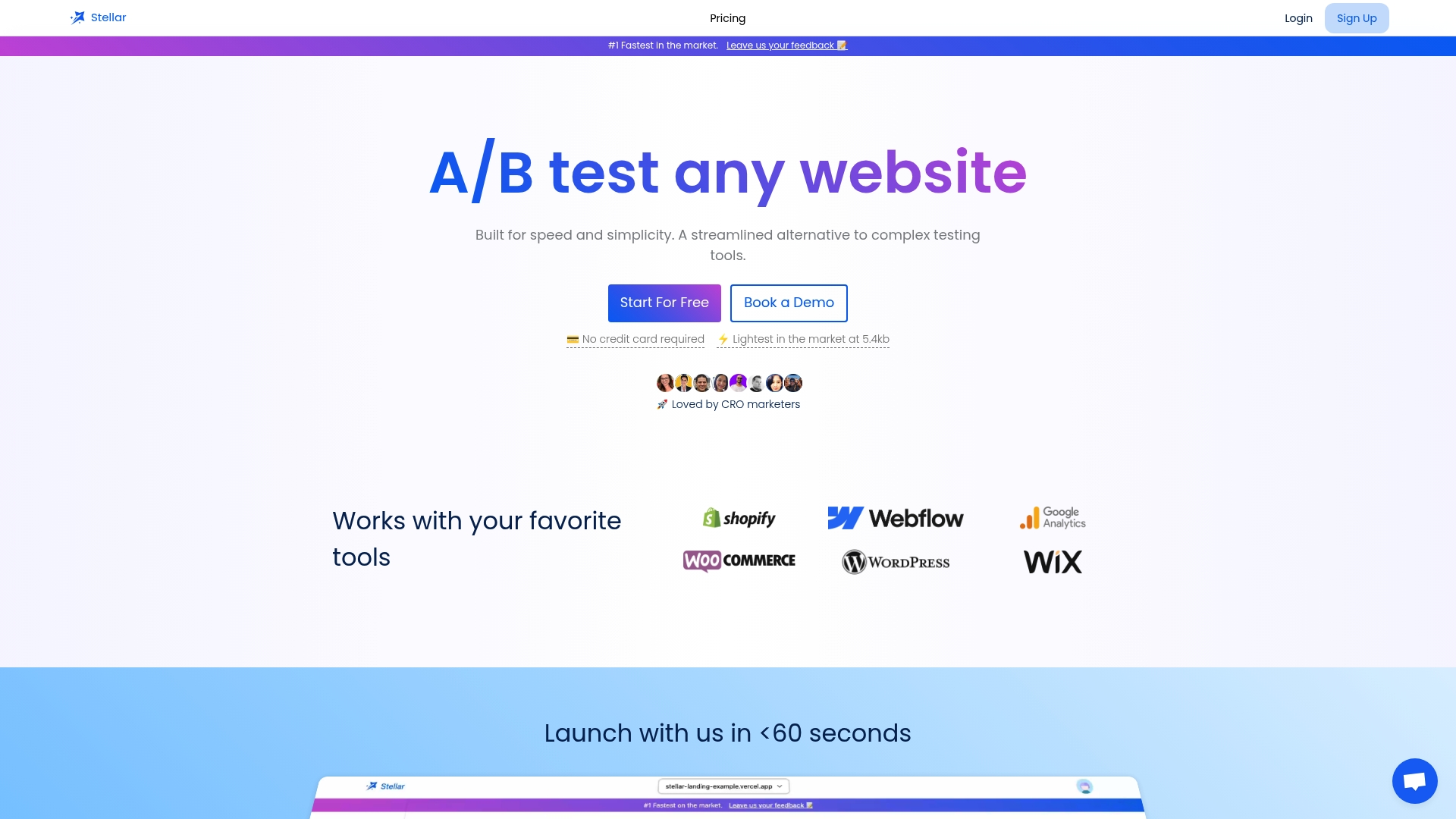
You can see every plan and start on the Stellar site.
FAQ
What is user experience marketing?
It is the practice of applying UX principles, such as reducing effort and clarifying the journey, to marketing goals like conversion and retention. It treats ads, pages, emails and checkout as one experience. Each change is judged by how it affects the user and by a business metric.
Is UX part of marketing?
They are separate disciplines that overlap. NN/g explains that marketing raises perceived value while UX lowers interaction cost. In user experience marketing, the two share goals, research and KPIs rather than working in isolation.
How do I measure whether UX changes help marketing?
Test the change against a primary metric such as conversion rate or average order value, and watch a guardrail such as return rate. Add experience measures like CSAT, NPS or CES for the longer view. Run each test for a pre-set duration so early swings do not mislead you.
Do I need developers to test UX changes?
Not with a no-code visual editor. In Stellar, marketers edit page elements visually and launch tests themselves, and the platform integrates with WordPress, Shopify, Webflow, Wix, Squarespace, Framer and Bubble.
Sources
- UX & Marketing: Balancing Business Goals and Supporting Users, Nielsen Norman Group
- What is User Experience (UX)?, IBM
- UX Marketing: User Experience Marketing Is An Exciting New Discipline, Paul Boag
- UX Content Strategy, HubSpot
- Customer Experience Optimization in Digital Marketing, Corporate Marketing Guide
- How to quantify the value of UX with stakeholders, Mind the Product
- Going beyond ROI with ROX, Contentstack